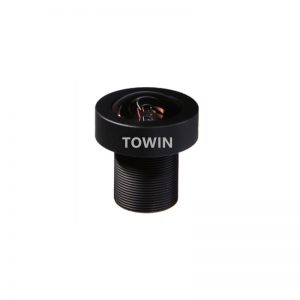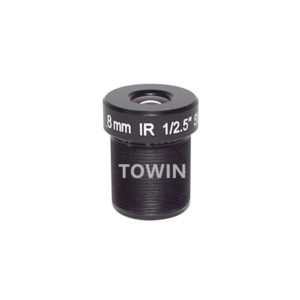



Low Distortion Lens – S25023002014F
08/29/2025
Low Distortion Lens – S25023002080
08/29/2025
Low Distortion Lens – S25023002018
25mm M12 5MP low distortion lens for 2/3″ sensors, featuring <0.3% distortion, F1.8 aperture, and 25° diagonal FOV for industrial vision.
S25023002018 is Low distortion 5-Megapixel 2/3″ M12-mount lens with 25mm focal length, 25° diagonal FOV, F1.8 aperture, for security surveillance.
| IMAGE FORMAT | 2/3″ |
| FOCAL LENGTH | 25mm |
| F.O.V. | 25°(D) |
| 20°(H) | |
| 15°(V) | |
| RESOLUTION | 5MP |
| DISTORTION | <0.3% |
| APERTURE | F1.8 |
| MOUNT | M12x0.5 |
| IRIS | Fixed |
| M.O.D. | 0.5m |
| T.T.L. | 28mm |
| CONSTRUCTION | 6G |
25mm M12 5MP Low Distortion Industrial Lens
This 25mm M12 lens is a 5MP fixed focal length industrial lens designed for 2/3″ image sensors. With less than 0.3% distortion, an F1.8 fixed aperture, and a 25° diagonal field of view, it delivers high-resolution imaging with controlled geometric distortion for compact machine vision and industrial inspection systems.
Product Highlights at a Glance
- 5MP resolution for detailed industrial imaging.
- <0.3% distortion for highly controlled image geometry.
- 2/3″ sensor coverage for larger-format compact camera systems.
- F1.8 fixed aperture for bright and consistent imaging.
- 25mm focal length for focused inspection areas.
- M12 × 0.5 mount for compact embedded camera integration.
25mm M12 Low Distortion Lens Applications
Core Application Scenes
This 25mm M12 low distortion lens is designed for compact industrial cameras that require a combination of high resolution, larger sensor coverage, and very low geometric distortion. Its 25° diagonal field of view provides a moderately narrow viewing area, allowing the camera to concentrate on a defined inspection region without the excessive scene coverage associated with wide-angle optics.
With distortion below 0.3%, the lens is particularly suitable for machine vision tasks where maintaining the shape and relative position of objects across the image is important. It can be used for component inspection, dimensional verification, surface inspection, object identification, and fixed-position imaging of industrial parts.
The 2/3″ image format provides compatibility with larger sensors than many miniature M12 lenses, while the 5MP resolution supports detailed image capture for industrial inspection and recognition. The F1.8 fixed aperture provides a bright optical configuration that can be useful when the camera operates under controlled but non-ideal lighting conditions.
The 0.5m M.O.D. makes this model particularly appropriate for inspection setups where the camera is positioned at a moderate distance from the target. Its compact M12 × 0.5 mount also simplifies integration into space-constrained camera housings and embedded vision equipment.
When designing a complete imaging system, the Sensor Guide can help verify sensor compatibility, while the Lens Selection Guide provides additional guidance on matching focal length, sensor size, and application requirements.
Compatible Device List
- 2/3″ 5MP Industrial Cameras: Suitable for compact cameras using 2/3″ sensors where detailed image capture is required.
- Machine Vision Inspection Systems: The low distortion performance supports inspection tasks where image geometry must remain controlled.
- Embedded Vision Modules: The M12 × 0.5 mount enables integration into compact embedded camera assemblies.
- Industrial Component Inspection Cameras: The 25mm focal length provides focused coverage for defined inspection zones.
- Dimensional and Shape Inspection Systems: The <0.3% distortion specification can help reduce optical image deformation during visual analysis.
- OEM Vision Equipment: The compact 28mm T.T.L. configuration can be considered for customized industrial camera housings.
For engineers determining the required coverage at a specific working distance, the FOV Calculator can be used to estimate the visible target area before selecting the final optical configuration.
Designed for low-distortion component inspection, dimensional imaging, and compact high-resolution machine vision applications.
Frequently Asked Questions
Q: What sensor size is this 25mm M12 lens designed for?
A: This lens is designed for a 2/3″ image format and supports 5MP resolution.
Q: What is the field of view of the 25mm lens?
A: The specified field of view is 25° diagonal, 20° horizontal, and 15° vertical.
Q: How low is the distortion of this M12 lens?
A: The specified distortion is less than 0.3%, providing highly controlled image geometry for industrial imaging and inspection applications.
Q: Is this lens suitable for machine vision applications?
A: Yes. The 5MP resolution, 2/3″ image format, 25mm focal length, and <0.3% distortion make it suitable for selected machine vision and industrial inspection systems.
Q: What aperture does this lens use?
A: The lens uses a fixed F1.8 aperture and does not have an adjustable iris.
Q: What is the minimum object distance of this lens?
A: The specified minimum object distance is 0.5m. The appropriate working distance should be determined according to the target size, required field of view, and camera installation conditions.
Q: What mount does this 25mm industrial lens use?
A: It uses an M12 × 0.5 mount, making it suitable for compact M12-compatible industrial cameras and embedded vision systems.
Q: Can this lens be used for dimensional inspection?
A: Its less-than-0.3% distortion specification makes it suitable for applications where controlled image geometry is important. Final suitability for dimensional measurement should also consider calibration, sensor characteristics, working distance, and the overall imaging system.
Q: How can I calculate the field of view for this lens?
A: You can use the FOV Calculator to estimate image coverage based on the lens, sensor, and working distance. For additional selection guidance, see the Lens Selection Guide.
Online contact