


Low Distortion Lens – M300611108824F
09/22/2025
Low Distortion Lens – M401611005028F
09/23/2025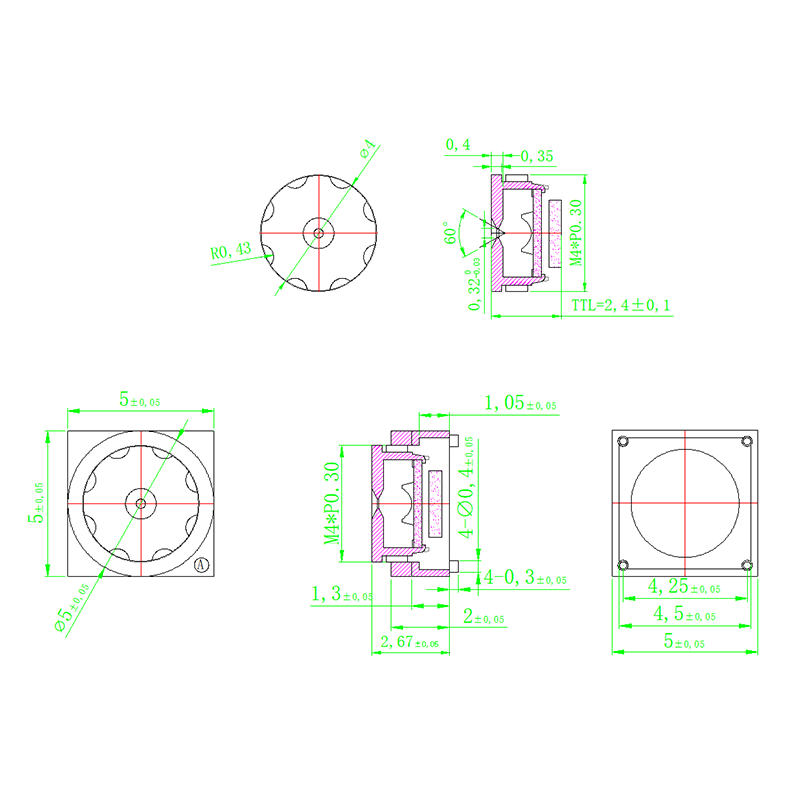
Low Distortion Lens – M401011305028F
1.0mm M4 low distortion miniature lens for 1/13″ GC6153 sensors, featuring <2% distortion, >60% relative illumination, F2.8 aperture, and 2.4mm T.T.L. for compact imaging.
M401011305028F is Low-distortion 1/13″ format CCTV lens with Built-In IR Filter, M4x0.30 mount, 60° field of view, F2.8 aperture, for compact surveillance applications.
| IMAGE FORMAT | 1/13″ |
| MAX IMAGE | Φ2.0mm |
| FOCAL LENGTH | 1.0mm |
| F.O.V.(GC6153) | 60°(D) |
| 50°(H) | |
| 38°(V) | |
| DISTORTION | <2% |
| APERTURE | F2.8 |
| MOUNT | M4x0.30 |
| C.R.A | <4° |
| R.I. | >60% |
| T.T.L. | 2.4mm |
| CONTRUCTION | 1P+IRCF |
1.0mm M4 Low Distortion Miniature Lens
This 1.0mm M4 low distortion miniature lens is designed for 1/13″ compact camera modules, delivering less than 2% distortion with a 60° diagonal field of view. Its 2.4mm total track length, F2.8 aperture, and greater than 60% relative illumination make it suitable for miniature embedded imaging, compact machine vision, and space-constrained visual sensing systems.
Low Distortion Lens Core Highlights
- <2% Low Distortion: Provides controlled image geometry for compact vision applications.
- High >60% Relative Illumination: Helps maintain strong image brightness across the sensor area.
- 1/13″ Sensor Support: Designed around compact GC6153 imaging modules.
- 2.4mm T.T.L.: Enables integration into extremely compact camera assemblies.
- Low <4° C.R.A.: Supports optical matching with small image sensors.
1.0mm Low Distortion Lens Applications
Core Application Scenes
This 1.0mm low distortion miniature lens is designed for compact imaging systems where controlled geometric distortion and efficient sensor illumination are more important than an extremely wide viewing angle. With distortion below 2%, the lens can provide a relatively accurate representation of the captured scene while maintaining a compact optical footprint.
The lens is specifically suited to 1/13″ camera modules using the GC6153 sensor configuration. Its 1.0mm focal length provides a 60° diagonal field of view, while the 50° horizontal and 38° vertical fields of view offer a balanced viewing area for small embedded cameras.
A major advantage for miniature imaging applications is the combination of >60% relative illumination and <4° C.R.A. The high relative illumination helps preserve useful brightness toward the edge of the sensor, while the low chief ray angle can simplify optical matching between the lens and a small CMOS image sensor.
With a total track length of only 2.4mm, the lens is particularly appropriate for thin camera modules and embedded visual sensing devices where the optical path must remain extremely short. It can be integrated into compact inspection equipment, robotic sensing modules, embedded monitoring cameras, and customized OEM imaging systems.
For compact automation equipment, this lens can support visual inspection tasks where image geometry needs to remain controlled. It can also be integrated into machine vision modules that require a small optical package and predictable imaging characteristics.
Designed for low-distortion miniature imaging and compact embedded machine vision applications.
Compatible Device List
- GC6153 Camera Modules: Specifically suited to compact imaging modules based on the GC6153 sensor configuration.
- 1/13″ CMOS Cameras: Designed for very small image sensors with a maximum image circle of Φ2.0mm.
- Embedded Vision Devices: The 2.4mm T.T.L. supports integration into highly space-constrained camera architectures.
- Miniature Machine Vision Modules: Suitable for compact inspection and visual sensing systems requiring controlled distortion.
- Robotic Vision Sensors: Can be integrated into small robotic perception modules where optical size and image consistency are important.
- OEM Camera Assemblies: The M4 × 0.30 mount provides a compact mechanical interface for customized imaging equipment.
Low-Distortion Imaging Performance
The defining optical characteristic of this lens is its less-than-2% distortion. For compact camera modules, controlling distortion can help maintain more consistent image geometry and reduce the amount of geometric correction required during downstream image processing.
Compared with an ultra-wide-angle or fisheye design, this lens prioritizes controlled distortion and optical compactness rather than maximum scene coverage. This makes it more suitable for applications where accurate visual representation is important.
The lens also provides more than 60% relative illumination, which helps maintain useful brightness across the image field. This is particularly valuable for miniature sensors with limited imaging area.
Engineers can use the Distortion Guide to understand how lens distortion affects image geometry and determine whether a low distortion lens is appropriate for a specific vision system.
Optical & Mechanical Integration
The lens uses a 1P + IRCF optical construction and has a total track length of only 2.4mm. This compact configuration allows it to be installed in camera modules where conventional M12 or larger optical systems would be mechanically impractical.
The C.R.A. below 4° is another important parameter when matching the lens with a small CMOS sensor. A low chief ray angle can help simplify optical compatibility with the sensor’s microlens structure.
For engineers comparing focal length and sensor combinations, the Lens Selection Guide provides additional guidance on sensor format, focal length, field of view, distortion, and other lens parameters.
The relationship between the 1.0mm focal length and the specified sensor dimensions can also be evaluated with the FOV Calculator during the camera design process.
Frequently Asked Questions
Q: Is this a low distortion lens?
A: Yes. The lens has a specified distortion of less than 2%, making low distortion one of its primary optical characteristics.
Q: What sensor is this 1.0mm lens designed for?
A: The lens is designed for a 1/13″ image format and is specified for the GC6153 sensor configuration, with a maximum image circle of Φ2.0mm.
Q: What is the field of view of this lens?
A: The lens provides a 60° diagonal FOV, 50° horizontal FOV, and 38° vertical FOV with the specified GC6153 configuration.
Q: Is this lens a wide-angle or fisheye lens?
A: It is better positioned as a compact low distortion lens rather than a fisheye lens. Its 60° diagonal FOV and less-than-2% distortion do not indicate a typical fisheye optical design.
Q: What is the relative illumination of the lens?
A: The relative illumination is specified at greater than 60%, helping maintain useful image brightness toward the edge of the sensor.
Q: What does the C.R.A. specification mean?
A: The chief ray angle is below 4°. This low CRA specification is useful when matching the lens to compact CMOS sensors and their microlens structures.
Q: How compact is this lens?
A: The total track length is only 2.4mm, making it suitable for thin embedded camera modules and other highly space-constrained imaging devices.
Q: Does IRCF mean that this is an IR corrected lens?
A: No. The 1P + IRCF construction indicates an IR-cut filter configuration. It does not by itself indicate optical correction for infrared wavelengths. For customized integration requirements, engineers can contact Towin Optical.
Online contact