

Optical lens basics (II)
02/13/2020
How to Select a Good Machine Vision Lens
02/19/2020
When selecting an industrial lens for machine vision, resolution and focal length are not the only specifications that determine image quality. Engineers must also evaluate MTF (Modulation Transfer Function), aperture, and depth of field (DOF) to ensure that the lens delivers sufficient detail, contrast, brightness, and focus consistency for the intended application.
Understanding industrial lens MTF, aperture, and depth of field helps engineers evaluate optical performance and select suitable lenses for automated inspection, factory automation, robotics, and precision imaging. These parameters are closely related and should be considered together rather than independently.
This guide explains how MTF curves are interpreted, how F-numbers such as F2 and F2.8 affect light transmission, and how aperture and working distance influence depth of field. It also explains how to apply these optical principles when selecting a C-Mount industrial lens or other machine vision optics.
1. Understanding MTF in Industrial Lenses
1.1 What Is MTF (Modulation Transfer Function)?
MTF, or Modulation Transfer Function, is an important optical performance measurement that describes how effectively a lens transfers contrast from an object to the image plane at different spatial frequencies.
In practical terms, MTF indicates how well an industrial lens can reproduce fine details and maintain image contrast. A lens with higher MTF at a particular spatial frequency generally produces better contrast for details of that size under the specified test conditions.
MTF is especially important in machine vision because automated inspection systems depend on clear edges, small features, and consistent image information for detection, measurement, and recognition.
For a more detailed technical explanation, read our guide to MTF Explained for Machine Vision Lenses.
1.2 How to Read an MTF Curve
An MTF chart typically shows how image contrast changes as spatial frequency increases. Understanding its horizontal and vertical axes is essential when comparing optical performance.
Spatial Frequency
Spatial frequency describes how frequently light and dark patterns repeat across a given distance. It is commonly expressed in line pairs per millimeter (lp/mm).
- Low spatial frequencies represent larger image structures and broader details.
- High spatial frequencies represent finer details and smaller image features.
- Higher spatial frequencies generally require the lens to preserve more fine-detail information.
MTF Value
MTF values generally range from 0 to 1, representing the ratio of image contrast to object contrast at a specified spatial frequency.
- Higher MTF: Better contrast transfer at the specified spatial frequency.
- Lower MTF: Reduced contrast for the corresponding detail level.
- Declining MTF: Contrast generally decreases as spatial frequency increases.
Sagittal and Tangential Curves
Many optical MTF charts include two sets of curves: sagittal and tangential. These represent optical performance in different image-plane orientations.
The difference between these curves can help identify directional performance variations caused by optical aberrations, including astigmatism. When the curves differ significantly, image quality may vary depending on the orientation and position of image details.
Engineers should also compare MTF performance at different image heights, including the optical center and off-axis regions, to understand how image quality changes from the center toward the edge of the sensor.
1.3 Why MTF Matters in Machine Vision
MTF performance influences several practical aspects of industrial imaging:
- Defect detection: Better contrast transfer can help reveal small surface defects and fine structural details.
- OCR and barcode recognition: Clear character edges and sufficient contrast support more reliable recognition.
- Precision inspection: Consistent image detail helps image-processing systems identify object boundaries.
- Edge-to-edge image quality: MTF evaluation across the image field helps identify potential edge sharpness limitations.
However, MTF is not the only factor determining system performance. Sensor pixel size, illumination, focus accuracy, lens distortion, mechanical stability, and image-processing conditions also affect the final image.
For a broader understanding of these factors, explore TOWIN’s industrial optical design guide.
2. Understanding Aperture and F-Number in Industrial Lenses
2.1 What Is Lens Aperture?
Aperture is the opening inside a lens that controls how much light passes through the optical system and reaches the image sensor. In industrial lenses, aperture is generally expressed using an F-number, such as F1.4, F2, F2.8, F4, or F8.
The F-number is calculated using the relationship between focal length and entrance pupil diameter:
F-number (N) = Focal Length (f) / Entrance Pupil Diameter (D)
For example, a lens with a 50mm focal length and a 25mm entrance pupil diameter has an F-number of F2.
A smaller F-number represents a larger aperture opening, while a larger F-number represents a smaller aperture opening.
2.2 Common F-Number Values
| F-Number | Relative Aperture | Typical Characteristics |
|---|---|---|
| F1.4 | Very large | High light-gathering capability |
| F2 | Large | Suitable for applications requiring substantial light transmission |
| F2.8 | Moderately large | Common industrial lens aperture |
| F4 | Medium | Balanced light transmission |
| F5.6 | Smaller | Reduced light transmission and potentially greater DOF |
| F8 | Small | Greater DOF in many imaging configurations |
2.3 How Does Aperture Affect Light Transmission?
Aperture directly influences the amount of light reaching the image sensor. A larger aperture allows more light to enter the optical system, while a smaller aperture reduces light transmission.
For the same lens under unchanged imaging conditions, increasing the F-number by one full stop reduces the geometrical light level by approximately half, while decreasing the F-number by one full stop approximately doubles it. Actual sensor exposure also depends on lens transmission, vignetting, and other optical factors.
This relationship is particularly important in industrial imaging systems that operate under limited lighting conditions or require short exposure times.
2.4 Large Aperture and Industrial Imaging
A large aperture, such as F1.4 or F2, can be beneficial in low-light imaging and high-speed inspection applications.
Its potential advantages include:
- More light reaching the image sensor.
- Greater flexibility when using short exposure times.
- Improved exposure conditions in low-light environments.
- Potentially lower camera gain requirements.
However, a larger aperture does not automatically guarantee better image quality. Depending on the optical design, wide-open operation may make certain aberrations more noticeable and may produce a shallower depth of field.
For a practical discussion of this relationship, see How Does Aperture Affect Depth of Field in Industrial Imaging?
3. Understanding Depth of Field (DOF) in Industrial Imaging
3.1 What Is Depth of Field?
Depth of field (DOF) refers to the range of object distances within which image details remain acceptably sharp for a particular imaging system and application.
Although the lens focuses on a specific object plane, objects slightly closer to or farther from that plane may still appear sufficiently sharp for practical inspection.
In machine vision, depth of field is particularly important when inspected objects have different heights, surfaces, or positions.
For example, an automated inspection system may need to capture components positioned at slightly different distances from the camera. Insufficient DOF can cause some areas to become blurred, making defect detection and measurement less reliable.
Learn more about this topic in our dedicated guide: What Is Depth of Field in Industrial Imaging?
3.2 What Factors Affect Depth of Field?
Depth of field is influenced by several optical and imaging parameters.
1. Aperture
A smaller physical aperture, corresponding to a larger F-number, generally increases depth of field. A larger aperture, corresponding to a smaller F-number, generally produces a shallower depth of field.
2. Focal Length
Focal length affects image magnification and depth of field. Its influence depends on the imaging geometry and whether working distance, magnification, and other conditions are held constant.
3. Working Distance
Working distance describes the distance between the lens and the object being inspected. Changes in working distance influence magnification, field of view, and focus tolerance.
4. Magnification
Higher magnification generally reduces depth of field under comparable imaging conditions. This is particularly important for close-range inspection and precision measurement.
5. Sensor and Acceptable Sharpness
Sensor pixel size, viewing conditions, and the minimum feature size that must be detected all influence what counts as acceptable sharpness. A system designed to detect very small defects may require a stricter focus tolerance than a general monitoring application.
3.3 Relationship Between Aperture and Depth of Field
The relationship between aperture and depth of field is one of the most important considerations when selecting an industrial lens.
| Aperture | Light Transmission | General DOF Trend |
|---|---|---|
| F1.4 | High | Shallow |
| F2.8 | Relatively high | Moderate |
| F4 | Moderate | Generally greater |
| F5.6 | Lower | Generally deeper |
| F8 | Lower | Generally deeper |
Important: These are general optical relationships, not universal DOF specifications. Actual performance depends on focal length, magnification, working distance, sensor characteristics, and optical design.
Using an excessively small aperture can introduce diffraction, which reduces fine-detail contrast and may negatively affect effective resolution. Engineers should therefore identify an aperture range that balances DOF, illumination, and image sharpness.
4. How MTF, Aperture and Depth of Field Work Together
MTF, aperture, and depth of field should not be evaluated independently when selecting an industrial lens. Each parameter contributes to overall image quality in a different way.
| Parameter | Main Function | Industrial Application |
|---|---|---|
| MTF | Measures contrast transfer at different spatial frequencies. | Fine-detail detection and image sharpness. |
| Aperture | Controls light transmission and influences optical performance. | Low-light imaging and exposure control. |
| Depth of Field | Defines the acceptable focus range. | Inspection of objects with different heights or positions. |
For example, a machine vision system may require high MTF to detect small defects, sufficient DOF to accommodate variations in object height, and a suitable aperture to provide enough light for short exposure times.
Choosing the largest aperture or the highest resolution lens alone may not achieve the best system performance. The correct optical configuration depends on the complete imaging requirements.
5. How to Select an Industrial Lens for Machine Vision
When choosing an industrial lens, engineers should consider optical performance together with sensor specifications, field of view, working distance, and the actual inspection environment.
5.1 Match Lens Resolution with Camera Sensor
The lens should provide sufficient optical resolution for the camera sensor and the smallest features that must be detected. A high-megapixel sensor does not automatically produce detailed images if the lens cannot transfer sufficient contrast at the required spatial frequencies.
Review the lens MTF information, sensor pixel size, image circle, and required object detail before finalizing the optical configuration.
5.2 Choose the Appropriate Aperture
Determine whether the system prioritizes low-light performance, short exposure times, or a larger depth of field. A large aperture may be useful for high-speed or low-light applications, while a smaller aperture may help accommodate object height variations.
5.3 Calculate Field of View and Working Distance
The focal length must match the required field of view and installation distance. A lens that provides excellent optical performance may still be unsuitable if it cannot capture the required inspection area.
Use the TOWIN FOV Calculator to estimate field of view and review the relationship between sensor size, focal length, and working distance.
5.4 Evaluate Distortion and Edge Performance
For dimensional measurement and precision inspection, geometric distortion is another important consideration. A lens may produce sharp images but still introduce geometric errors that affect measurement accuracy.
Explore Low Distortion Lenses when accurate object geometry is a priority.
5.5 Validate the Complete Imaging System
Before selecting a lens for mass production, evaluate it with the actual camera, lighting, target object, working distance, and operating conditions.
Consider the following:
- Required image resolution and minimum detectable feature size.
- Sensor format and pixel size.
- Required field of view and focal length.
- Available working distance.
- MTF performance across the image field.
- Suitable aperture and depth of field.
- Distortion and illumination uniformity.
- Mechanical and environmental requirements.
For a more complete selection process, read our guide to How to Choose the Right Industrial Camera Lens.
6. TOWIN Industrial Lens Recommendations
Different machine vision applications require different optical configurations. TOWIN provides industrial optical lenses with multiple focal lengths, sensor formats, resolutions, and aperture configurations for machine vision, factory automation, and intelligent imaging applications.
6.1 C-Mount Industrial Lenses
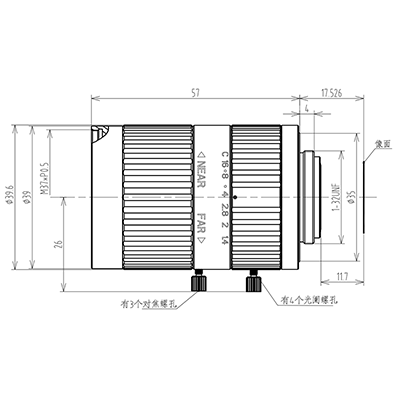
TOWIN C-Mount Industrial Lenses are designed for industrial cameras, factory automation, machine vision inspection, and measurement applications.
When selecting a C-Mount lens, consider resolution, MTF performance, image circle, distortion, focal length, and aperture together. Different models are designed for different sensor formats and imaging requirements.
Explore TOWIN C-Mount Lenses →
6.2 High-Resolution 20MP Machine Vision Lenses
For applications requiring high-resolution imaging and fine-detail inspection, TOWIN offers 1.1-inch 20MP Machine Vision Lenses.
These lenses are available in different focal lengths and optical configurations. Depending on the model, specifications may include large image formats, high resolution, and low distortion.
For example, the C1611028M20 16mm 20MP C-Mount Lens supports a 1.1-inch image format and has a specified distortion of less than 0.5%.
Its suitability for a particular inspection system should be evaluated against the camera sensor, required field of view, working distance, and actual optical performance requirements.
Explore 20MP Machine Vision Lenses →
6.3 Large Aperture F1.4 C-Mount Lenses
Applications involving limited illumination or short exposure times may benefit from a large-aperture lens.
The C2001014M8 20mm 8MP F1.4 C-Mount Lens features a 1.4 maximum aperture, manual iris, and manual focus. It is designed for industrial imaging, machine vision, and factory automation applications.
Its F1.4 aperture provides high light-gathering capability, making it a potential option for systems where illumination and exposure time are important considerations.
View the F1.4 C-Mount Industrial Lens →
6.4 Find the Right Lens for Your Application
Not every machine vision system requires the same resolution, aperture, or depth of field. The right choice depends on the target object, camera sensor, lighting conditions, and inspection requirements.
Explore TOWIN’s Machine Vision Solutions to understand how industrial lenses support automated inspection, positioning, and precision imaging.
For customized optical requirements, contact TOWIN’s industrial lens team to discuss suitable lens specifications and application requirements.
7. Frequently Asked Questions About Industrial Lens MTF, Aperture and DOF
Q1: What Is MTF in an Industrial Lens?
A: MTF (Modulation Transfer Function) measures how effectively an optical system transfers contrast at different spatial frequencies. It helps engineers evaluate lens sharpness, contrast, and fine-detail imaging performance.
Q2: How Do You Read an MTF Curve?
A: An MTF curve typically plots spatial frequency on the horizontal axis and MTF value on the vertical axis. Higher values at a specified spatial frequency indicate better contrast transfer. Engineers should also compare sagittal and tangential curves and evaluate performance at different image heights.
Q3: What Does F2 Mean in a Camera Lens?
A: F2 is an F-number that describes the relationship between a lens’s focal length and entrance pupil diameter. A smaller F-number represents a larger relative aperture and generally allows more light to reach the image sensor than a larger F-number.
Q4: Does a Larger Aperture Improve Image Quality?
A: Not necessarily. A larger aperture increases light transmission and can support shorter exposure times, but it may also reduce depth of field and make certain optical aberrations more noticeable. The optimum aperture depends on the lens design and imaging application.
Q5: How Does Aperture Affect Depth of Field?
A: A smaller physical aperture, represented by a larger F-number, generally increases depth of field. A larger aperture, represented by a smaller F-number, generally produces a shallower depth of field. Engineers must balance focus range with brightness and resolution.
Q6: Can a Smaller Aperture Reduce Lens Resolution?
A: Yes. Although stopping down the aperture can reduce some optical aberrations and increase depth of field, an excessively small aperture introduces diffraction, which can reduce fine-detail contrast and effective resolution.
Q7: What Is More Important for Machine Vision: MTF or Megapixels?
A: Both are important, but they describe different aspects of imaging performance. Megapixels indicate the number of sensor pixels, while MTF describes how effectively the optical system transfers contrast at different spatial frequencies. A high-resolution camera requires a lens capable of delivering sufficient optical detail.
Q8: How Do I Choose the Right Industrial Lens?
A: Start by defining the sensor format, required resolution, field of view, working distance, and inspection target. Then evaluate MTF, aperture, depth of field, distortion, and image circle to identify a suitable optical configuration. Testing the complete camera and lens system under actual operating conditions is also recommended.
Conclusion: Choose an Industrial Lens Based on Complete Optical Performance
Understanding industrial lens MTF, aperture, and depth of field is essential when selecting optics for machine vision and industrial imaging applications.
MTF helps evaluate contrast transfer and fine-detail performance. Aperture controls light transmission and influences optical sharpness, while depth of field determines the acceptable focus range for the inspected object.
For reliable industrial imaging, engineers should evaluate these parameters together with sensor resolution, pixel size, field of view, working distance, distortion, and illumination conditions.
Whether your application requires a high-resolution C-Mount lens, an F1.4 large-aperture lens, or a customized optical solution, selecting the right lens starts with understanding the complete imaging requirements.
Looking for an industrial lens for your machine vision project? Explore TOWIN Industrial Lens Products or contact TOWIN to discuss your optical specifications and application requirements.