


What Is Focal Length in an Industrial Lens?
08/12/2026
How to Calculate Field of View for a Camera Lens
08/18/2026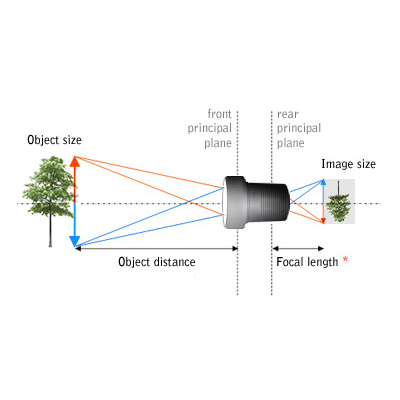
How Does Focal Length Affect Field of View? In an industrial imaging system, focal length has a direct effect on how much of a scene an industrial lens can capture. In general, a shorter focal length produces a wider field of view, while a longer focal length produces a narrower field of view and higher image magnification.
However, focal length does not determine field of view by itself. Sensor size, working distance, target dimensions, and lens design all influence the final image coverage. Understanding these relationships is essential when selecting a lens for machine vision, robotics, inspection, smart traffic, and other industrial imaging applications.
In this guide, we explain how focal length affects field of view, how sensor size and working distance change the result, how to calculate FOV, and how to select the right industrial lens for a specific imaging requirement.
What Is Field of View in Machine Vision?
Field of view, commonly abbreviated as FOV, is the physical area that an imaging system can capture at a specific working distance. In industrial vision systems, FOV is normally described as horizontal, vertical, or diagonal coverage.
For example, if a camera system has a horizontal FOV of 200 mm, the imaging system can capture approximately 200 mm of the target area horizontally at the specified working distance.
FOV is one of the most important parameters in industrial lens selection because the required viewing area determines which focal lengths can be used.
Before selecting a lens, engineers should define the target size, required image coverage, working distance, sensor size, and resolution requirements.
How Does Focal Length Affect Field of View?
The relationship between focal length and field of view is straightforward: a shorter focal length generally produces a wider FOV, while a longer focal length produces a narrower FOV.
This happens because focal length influences the angle at which the lens captures light from the scene. A short focal length allows the imaging system to capture a larger angular portion of the environment, while a long focal length captures a smaller portion of the scene.
| Focal Length | General FOV | Image Magnification | Typical Imaging Requirement |
|---|---|---|---|
| Short | Wide | Lower | Large-area imaging |
| Medium | Moderate | Medium | General inspection |
| Long | Narrow | Higher | Detailed or distant imaging |
For example, when using the same sensor and working distance, a 6 mm lens normally provides a wider viewing area than a 12 mm lens. A 25 mm lens will generally provide a narrower FOV than either of them.
This is why focal length is one of the first optical parameters engineers evaluate when determining the required field of view for an industrial camera.
Shorter Focal Length Produces a Wider Field of View
Short focal length lenses are designed to capture a larger portion of a scene. They are particularly useful when the target is large, the available working distance is limited, or the imaging system needs to cover a broad inspection area.
Typical applications include wide-area machine vision, robotics, embedded vision, smart security, and compact camera systems.
TOWIN’s M12 lenses include a wide range of focal lengths and are commonly used where compact optical designs and different FOV requirements are needed.
However, a wider FOV also means that the target occupies a smaller portion of the image. If the sensor resolution remains unchanged, an excessively wide FOV may reduce the number of pixels available across a small target.
Longer Focal Length Produces a Narrower Field of View
Longer focal length lenses capture a smaller portion of a scene and make distant or small objects appear larger in the image. This makes them useful when the target needs to occupy more pixels or when the camera must be positioned relatively far from the object.
Longer focal lengths can be useful for detailed inspection, long-distance imaging, traffic monitoring, and applications where a narrow viewing area is required.
The important point is that a longer focal length is not automatically better. The correct focal length depends on the required FOV, sensor size, working distance, target size, and optical performance requirements.
Why Does Focal Length Change Field of View?
Focal length describes the optical distance between the lens’s principal plane and the image plane when the lens is focused at infinity. In practical industrial imaging, it is normally specified in millimeters.
As focal length increases, the lens produces a narrower angle of view. As focal length decreases, the angle of view becomes wider.
This relationship can be summarized as:
Shorter focal length → wider angle of view → larger scene coverage
Longer focal length → narrower angle of view → smaller scene coverage
The relationship becomes more useful when focal length is considered together with sensor dimensions and working distance. These three parameters form the foundation of practical FOV calculation.
How Does Sensor Size Affect FOV?
Focal length alone cannot determine the final field of view because the camera sensor also affects how much of the image projected by the lens is captured.
With the same focal length and working distance, a larger sensor generally captures a wider field of view than a smaller sensor.
| Lens | Sensor Size | General FOV Result |
|---|---|---|
| 12 mm | Small sensor | Narrower coverage |
| 12 mm | Medium sensor | Wider coverage |
| 12 mm | Larger sensor | Widest coverage |
Therefore, saying that a particular lens has a fixed FOV without specifying the sensor is incomplete. The same 12 mm lens can produce different FOV values when paired with different sensor formats.
For a more detailed explanation, see TOWIN’s Image Sensor Guide for Machine Vision, which covers sensor size, resolution, pixel size, image circle, and lens matching.
You can also read How Does Sensor Size Affect Lens Selection? to understand how sensor format changes field of view and lens compatibility.
How Does Working Distance Affect FOV?
Working distance, or WD, is the distance between the front of the lens and the target being imaged. It is another critical factor when determining the physical field of view.
When the same lens and sensor are used, increasing the working distance generally allows the camera to capture a larger physical area. Reducing the working distance generally decreases the physical area captured.
| Focal Length | Working Distance | General Result |
|---|---|---|
| 12 mm | Short | Smaller physical coverage |
| 12 mm | Medium | Moderate coverage |
| 12 mm | Long | Larger physical coverage |
This is why industrial lens selection should not begin by simply asking, “Which focal length should I use?” Instead, engineers should first determine the target size, required FOV, sensor size, and working distance.
Focal Length vs Field of View Comparison
The following table provides a general reference for understanding how focal length influences FOV. These ranges are only guidelines because actual field of view depends on sensor size, working distance, lens construction, and optical design.
| Typical Focal Length | FOV Tendency | Magnification Tendency | Typical Application |
|---|---|---|---|
| 4–6 mm | Very wide | Low | Wide-area and embedded imaging |
| 8–12 mm | Wide | Low to medium | Robotics and general vision |
| 16–25 mm | Medium | Medium | Industrial inspection |
| 25–50 mm | Narrow | Medium to high | Detail inspection |
| 50 mm+ | Very narrow | High | Long-distance imaging |
These values should never be treated as universal FOV specifications. For accurate lens selection, the actual sensor dimensions and working distance must be included in the calculation.
How to Calculate Field of View From Focal Length
For many industrial imaging applications, a simplified FOV relationship can be used for an initial estimate:
FOV ≈ Sensor Dimension × Working Distance ÷ Focal Length
For example, assume:
- Sensor width = 6.4 mm
- Working distance = 300 mm
- Focal length = 12 mm
The estimated horizontal field of view would be:
FOV ≈ 6.4 × 300 ÷ 12 = 160 mm
This simplified calculation is useful for initial lens selection, but real optical systems can require more detailed calculations based on sensor dimensions, lens design, distortion, focus position, and other optical characteristics.
For faster lens matching, use the TOWIN FOV and Focal Length Calculator to evaluate focal length, sensor coverage, working distance, and field of view.
How to Choose Focal Length Based on Required FOV
The correct focal length should be selected from the application requirements rather than from focal length alone. A practical industrial lens selection process can follow these steps.
Step 1: Determine the Target Size
Start by measuring the object or inspection area that needs to be captured. For example, a PCB inspection system may need to cover a 200 mm × 150 mm area, while a barcode inspection system may only need to cover a much smaller region.
Step 2: Determine the Required FOV
The required FOV should normally be slightly larger than the target area so that the entire object can be captured reliably. Avoid choosing a FOV that is exactly equal to the object dimensions if additional positioning tolerance is required.
Step 3: Measure the Working Distance
Determine the practical distance between the lens and the target. Mechanical constraints, lighting, robot movement, enclosure design, and operator access can all affect the available working distance.
Step 4: Check Sensor Size
Confirm the camera sensor format before choosing the final focal length. Sensor dimensions affect FOV and also determine the image circle required from the lens.
Step 5: Calculate the Required Focal Length
Once target size, FOV, working distance, and sensor dimensions are known, the required focal length can be estimated. The result should then be checked against lens resolution, distortion, aperture, mount, and mechanical requirements.
For a complete selection workflow, see TOWIN’s Machine Vision Lens Selection Guide.
Focal Length and FOV in Industrial Applications
Machine Vision Inspection
Machine vision inspection systems often require a carefully controlled FOV so that the target fills enough of the sensor without being cropped. Focal length is selected together with sensor size, working distance, resolution, and distortion requirements.
For factory automation, PCB inspection, barcode reading, and high-speed inspection, FA machine vision lenses can provide high-resolution imaging with different focal length options.
Robotics Vision
Robotics systems may require a wider FOV for object detection, positioning, navigation, or manipulation. Compact M12 lenses can be useful where space and weight are important.
Explore TOWIN’s M12 lens solutions for compact machine vision, robotics, embedded vision, and AI imaging applications.
Smart Traffic Imaging
Traffic imaging applications often require a narrower FOV when the camera is positioned far from the target. The focal length must be selected according to the distance to the vehicle, target size, sensor resolution, and required image detail.
In applications such as license plate recognition and intelligent transportation systems, focal length must be evaluated together with optical resolution and distortion performance.
Smart Security Imaging
Security systems may require either a wide FOV for scene coverage or a narrower FOV for identifying distant targets. The correct choice depends on whether the priority is broad coverage, target detail, or a balance between the two.
What Happens If You Choose the Wrong Focal Length?
FOV Is Too Wide
If the focal length is too short, the camera may capture a much larger area than necessary. The target may occupy too few pixels, reducing the effective image detail available for inspection or recognition.
FOV Is Too Narrow
If the focal length is too long, part of the target may fall outside the image. This can make the system unsuitable for inspection tasks where the entire object must remain visible.
Working Distance Becomes Impractical
Selecting a focal length without considering the physical installation environment can result in an impractical camera position. The lens may provide the required FOV only at a working distance that cannot be achieved mechanically.
Sensor and Lens Are Poorly Matched
A lens must provide sufficient image circle coverage for the selected sensor. A mismatch can cause vignetting, loss of image corners, or reduced edge performance.
Learn more about this relationship in How to Match a Lens to Your Sensor.
Focal Length Is Not the Only Lens Parameter
Focal length is important, but it is only one part of industrial lens selection. A reliable machine vision system requires several optical and mechanical parameters to work together.
| Lens Parameter | Why It Matters |
|---|---|
| Focal Length | Influences FOV, viewing angle, and image magnification |
| Sensor Size | Determines image coverage and image circle requirements |
| Working Distance | Determines the physical relationship between lens and target |
| Resolution | Determines whether the lens can resolve the required image detail |
| Distortion | Affects geometric accuracy and measurement reliability |
| Aperture | Influences light transmission and depth of field |
| MTF | Describes contrast and resolving performance |
| Mount | Ensures mechanical compatibility with the camera |
This is why professional lens selection should consider the complete optical system instead of optimizing only one specification.
TOWIN’s Lens Basics Guide provides a broader introduction to focal length, sensor size, FOV, image circle, depth of field, resolution, MTF, and distortion.
How to Choose the Right Industrial Lens
Once the required FOV has been established, the next step is selecting a lens that meets the complete imaging requirements.
| Application Requirement | Lens Direction |
|---|---|
| Wide FOV and compact camera | M12 / S-Mount Lens |
| Factory automation and inspection | FA Machine Vision Lens |
| Geometric measurement | Low Distortion Lens |
| High-precision dimensional inspection | Telecentric Lens |
| Long-distance traffic imaging | ITS / Long-Focal-Length Lens |
For measurement and inspection applications where geometric accuracy is important, explore TOWIN’s Low Distortion Lenses.
For compact embedded and machine vision systems, M12 Lenses provide a broad range of focal lengths and optical configurations.
The final lens should also be evaluated for resolution, distortion, aperture, image circle, mount, environmental conditions, and other application-specific requirements.
Frequently Asked Questions
Q: How Does Focal Length Affect Field of View?
A: A shorter focal length generally produces a wider field of view, while a longer focal length produces a narrower field of view. However, the final FOV also depends on sensor size and working distance.
Q: Does a Longer Focal Length Mean a Narrower Field of View?
A: Yes. With the same sensor and working distance, increasing focal length generally reduces the angle of view and produces a narrower field of view.
Q: Does a Shorter Focal Length Provide a Wider Field of View?
A: Yes. Shorter focal lengths generally capture a larger portion of the scene and are commonly used when a wide inspection area is required.
Q: Does Sensor Size Affect Field of View?
A: Yes. With the same focal length and working distance, a larger sensor generally captures a wider field of view than a smaller sensor.
Q: Can the Same Focal Length Have Different FOVs?
A: Yes. A lens with the same focal length can produce different FOV values when used with different sensor sizes or at different working distances.
Q: What Focal Length Is Best for Machine Vision?
A: There is no universal best focal length for machine vision. The appropriate focal length depends on the required FOV, sensor size, working distance, target dimensions, resolution, and application requirements.
Q: Does Working Distance Affect FOV?
A: Yes. With the same focal length and sensor, increasing working distance generally increases the physical area captured by the imaging system.
Q: Can TOWIN Help Select an Industrial Lens?
A: Yes. TOWIN can help evaluate sensor size, focal length, FOV, working distance, resolution, distortion, mount, and application requirements to identify a suitable industrial lens or customized optical solution.
Conclusion
How Does Focal Length Affect Field of View? The basic relationship is simple: shorter focal lengths generally provide wider fields of view, while longer focal lengths provide narrower fields of view and higher image magnification.
However, focal length should never be selected independently. Sensor size, working distance, target dimensions, resolution, distortion, aperture, image circle, and mounting requirements all influence the final performance of an industrial imaging system.
A practical lens selection process should therefore start with the application and required viewing area, then determine the sensor, working distance, and focal length needed to achieve the desired FOV.
If you already know your target size and working distance, use the TOWIN FOV and Focal Length Calculator to estimate the required lens parameters. You can then review the Industrial Lens Selection Guide or explore TOWIN’s M12 lenses, FA machine vision lenses, and low distortion lenses for application-specific optical solutions.
Understanding How Does Focal Length Affect Field of View is one of the first steps toward building a reliable industrial vision system. Once FOV, sensor size, and working distance are properly matched, the lens can be optimized for resolution, distortion, illumination, and the specific requirements of the application.