


How Does Focal Length Affect Field of View
08/14/2026
How to Match a Camera Lens to Sensor Size
08/21/2026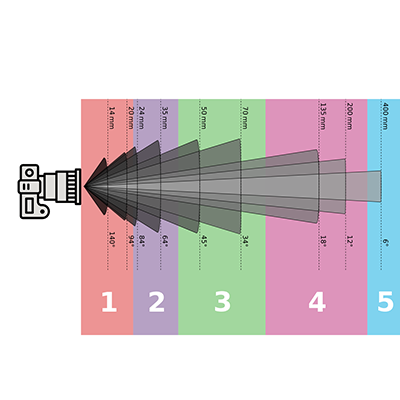
Learning how to Calculate Field of View for a Camera Lens is an important step when designing a machine vision, industrial imaging, robotics, or AI camera system. Field of view (FOV) determines how much of a target can be captured by a camera at a specific working distance and directly affects lens selection, image coverage, and inspection performance.
In most industrial imaging applications, FOV is determined by the relationship between sensor size, focal length, and working distance. Once these parameters are known, you can estimate the required viewing area, determine the appropriate focal length, and select a lens that provides sufficient coverage without sacrificing image quality.
This guide explains the camera lens FOV formula, shows how to calculate horizontal and vertical field of view, provides a practical calculation example, and explains how to use FOV results when selecting an industrial lens.
What Is Field of View (FOV)?
Field of view is the area or angle that a camera and lens combination can capture at a specific distance from the target. In industrial vision systems, FOV determines whether the complete inspection area fits inside one image and whether the system can maintain enough detail for detection and measurement.
FOV is closely related to focal length. A shorter focal length generally produces a wider field of view, while a longer focal length produces a narrower field of view and greater image magnification.
If you are new to industrial optics, start with the Lens Basics for Machine Vision and Industrial Cameras to understand focal length, sensor size, FOV, resolution, distortion, and other fundamental lens parameters.
What Parameters Are Needed to Calculate Field of View for a Camera Lens?
Before calculating field of view, you need to identify several optical and mechanical parameters. The three most important variables are sensor size, focal length, and working distance.
| Parameter | What It Means | Effect on FOV |
|---|---|---|
| Sensor Size | The effective width and height of the camera sensor | Larger sensor generally produces a wider FOV |
| Focal Length | The optical focal length of the lens, normally specified in millimeters | Shorter focal length produces wider FOV |
| Working Distance | The distance between the lens and the target object | Longer working distance produces larger physical coverage |
| Aspect Ratio | The relationship between sensor width and height | Determines horizontal and vertical coverage |
Sensor formats such as 1/3″, 1/2″, 2/3″, 1/1.8″, and 1″ are commonly used in industrial cameras. However, these format names should not be treated as the exact physical sensor dimensions. For accurate calculations, use the effective sensor width and height provided by the camera manufacturer.
For a more detailed explanation of sensor formats, sensor dimensions, pixel size, and lens compatibility, see the Industrial Camera Sensor Guide.
Field of View Formula for a Camera Lens
There are two useful ways to describe FOV: physical field of view and angular field of view. Understanding the difference is important because industrial lens specifications may list FOV in degrees, while system designers often need to know the actual object coverage in millimeters or meters.
Physical FOV Formula
For a standard rectilinear lens and typical machine vision calculations, the approximate physical FOV can be calculated as:
FOV ≈ (Sensor Size × Working Distance) ÷ Focal Length
For horizontal coverage, use the horizontal sensor dimension. For vertical coverage, use the vertical sensor dimension.
Horizontal FOV ≈ (Sensor Width × Working Distance) ÷ Focal Length
Vertical FOV ≈ (Sensor Height × Working Distance) ÷ Focal Length
This relationship is particularly useful when an engineer needs to determine whether a lens can cover a specific inspection area at a known working distance.
Angular FOV Formula
When FOV is expressed as an angle, the standard geometric relationship for an ideal rectilinear lens is:
HFOV = 2 × arctan(Sensor Width ÷ (2 × Focal Length))
Similarly, vertical and diagonal FOV can be calculated using the corresponding sensor dimensions.
VFOV = 2 × arctan(Sensor Height ÷ (2 × Focal Length))
DFOV = 2 × arctan(Sensor Diagonal ÷ (2 × Focal Length))
These angular formulas are useful when comparing lens datasheets that specify FOV in degrees. For wide-angle and fisheye lenses, however, actual FOV can differ from the ideal rectilinear model because of lens distortion. Always check the manufacturer’s datasheet for the actual specification.
For more information about how distortion affects imaging geometry and measurement accuracy, see the Industrial Lens Distortion Guide.
How to Calculate Field of View Step by Step
Step 1: Identify the Sensor Size
First, determine the effective horizontal and vertical dimensions of the camera sensor. For example, a 1/2″ sensor may have an effective imaging area of approximately 6.4 mm × 4.8 mm, depending on the camera and sensor design.
Use the actual sensor dimensions whenever possible rather than relying only on the nominal sensor format.
Step 2: Determine the Lens Focal Length
Next, identify the focal length of the lens. Focal length is one of the most important variables affecting FOV.
If the required FOV is already known, the approximate focal length can be calculated by rearranging the physical FOV formula:
Focal Length ≈ (Sensor Size × Working Distance) ÷ Required FOV
This reverse calculation is useful when selecting a lens for a defined inspection area.
Step 3: Determine the Working Distance
Working distance (WD) is the distance between the lens and the target object. It is an important mechanical constraint in machine vision system design.
For example, if a camera must be mounted 500 mm above a production line, the lens should be evaluated at approximately that working distance. Increasing working distance generally increases physical FOV, while reducing working distance decreases the covered area.
Step 4: Calculate the Required FOV
Once the sensor dimension, focal length, and working distance are known, insert the values into the appropriate formula. Calculate horizontal and vertical coverage separately if the inspection target has a specific aspect ratio.
Camera Lens FOV Calculation Example
Consider an industrial camera using a 1/2″ sensor with an effective sensor size of approximately 6.4 mm × 4.8 mm. The camera is paired with an 8 mm lens and positioned 500 mm from the target.
| Parameter | Value |
|---|---|
| Sensor | 1/2″ |
| Sensor Width | 6.4 mm |
| Sensor Height | 4.8 mm |
| Focal Length | 8 mm |
| Working Distance | 500 mm |
H. F.O.V.
Horizontal FOV ≈ (6.4 × 500) ÷ 8
Horizontal FOV ≈ 400 mm
The camera therefore captures approximately 400 mm of horizontal target width at a 500 mm working distance under the simplified geometric model.
V. F.O.V.
Vertical FOV ≈ (4.8 × 500) ÷ 8
Vertical FOV ≈ 300 mm
This means the theoretical coverage is approximately 400 mm × 300 mm. The actual result can vary because of effective sensor dimensions, lens distortion, optical tolerances, and the specific lens design.
You can verify similar calculations instantly with the TOWIN FOV Calculator, which provides horizontal, vertical, and diagonal FOV results based on sensor size, focal length, and working distance.
How Sensor Size Affects Field of View
Sensor size has a direct effect on FOV. When focal length and working distance remain constant, a larger sensor generally captures a wider area because more of the image circle is used.
| Sensor Size | Relative FOV at Same Focal Length | Typical Consideration |
|---|---|---|
| 1/4″ | Narrower | Compact embedded vision |
| 1/3″ | Narrow to medium | Compact industrial imaging |
| 1/2″ | Medium | General machine vision |
| 2/3″ | Wider | Higher-resolution inspection |
| 1″ | Much wider | Large-format industrial imaging |
Sensor size should never be considered independently from image circle and lens compatibility. A lens must adequately cover the sensor to avoid vignetting and loss of usable image area.
How Focal Length Affects Field of View
Focal length is one of the easiest ways to understand changes in FOV. With the same sensor and working distance, a shorter focal length provides a wider viewing angle, while a longer focal length provides a narrower viewing angle.
| Focal Length Trend | FOV | Typical Imaging Requirement |
|---|---|---|
| Short | Wide | Large-area coverage and compact installations |
| Medium | Moderate | General machine vision inspection |
| Long | Narrow | Detailed or long-distance imaging |
The actual FOV cannot be determined from focal length alone. Sensor size and working distance must also be considered. For this reason, a 12 mm lens can produce very different FOV values when paired with different sensor formats.
How Working Distance Affects Field of View
Working distance determines how far the camera is positioned from the target. With the same sensor and focal length, increasing the working distance generally increases the physical area captured by the camera.
For example, a lens that covers 400 mm horizontally at a 500 mm working distance will generally cover a larger physical area when moved farther away from the target. However, moving the camera farther away also changes the system’s pixel density and may affect the ability to resolve small features.
This is why FOV should always be evaluated together with resolution, object size, and inspection accuracy.
FOV Parameter Comparison
| Parameter Change | Effect on Physical FOV | Typical Result |
|---|---|---|
| Shorter focal length | Increases FOV | More scene coverage |
| Longer focal length | Decreases FOV | Higher magnification and narrower view |
| Larger sensor | Increases FOV | More image area |
| Longer working distance | Increases physical coverage | Larger target area captured |
| Shorter working distance | Decreases physical coverage | Closer, more concentrated inspection area |
How to Choose a Camera Lens Based on FOV
Calculating FOV is only the first step in lens selection. Once the required coverage is known, the lens must also match the camera sensor, resolution, distortion requirements, working distance, mount, aperture, and application environment.
Wide FOV Applications
Wide-FOV systems are useful when the camera needs to capture a large scene or object from a limited installation distance. Typical applications include robotics, embedded vision, warehouse monitoring, and large-area inspection.
Short focal length lenses are often considered for these applications, but wide-angle designs may introduce more optical distortion. Therefore, FOV should be evaluated together with distortion and resolution.
For compact camera systems, explore TOWIN M12 Lenses, which include a broad range of focal lengths and FOV options.
Medium FOV Applications
Medium FOV configurations are common in general machine vision, assembly inspection, barcode reading, packaging inspection, and factory automation. These systems typically require a balance between coverage and image detail.
Depending on the sensor and mechanical configuration, both M12 and C-Mount lenses can be suitable.
Narrow FOV Applications
Narrow FOV systems are useful when the camera is positioned farther from the target or when the application requires greater magnification and detail. Long focal length lenses are commonly considered for long-distance inspection, traffic monitoring, and precision imaging.
For larger sensors and industrial machine vision systems, see the TOWIN C-Mount Lenses collection.
Precision Measurement Applications
If the camera is being used for dimensional measurement or other high-precision applications, selecting a lens based only on FOV is not sufficient. Low distortion, high resolution, MTF performance, and system stability become equally important.
Review the Lens Distortion Guide to understand why distortion can affect measurement accuracy and geometric consistency.
What Else Should You Consider Besides FOV?
A correctly calculated FOV does not automatically guarantee good imaging performance. A complete industrial lens selection should consider several additional optical parameters.
| Parameter | Why It Matters |
|---|---|
| Resolution | Determines whether small details can be resolved clearly |
| Distortion | Affects geometric accuracy and measurement reliability |
| MTF | Helps evaluate contrast and image sharpness |
| Aperture | Affects light collection, exposure, and depth of field |
| Mount | Must be mechanically compatible with the camera |
| Working Distance | Must satisfy the physical installation requirements |
For a complete lens-selection workflow, use the Industrial Lens Selection Guide.
FOV Calculation for Machine Vision Applications
FOV requirements vary significantly between applications. A machine vision inspection system may need enough FOV to cover an entire component, while a robotics camera may require a wider view to locate objects. Smart traffic systems may instead require a narrower FOV to capture distant license plates or specific lanes.
Machine Vision Inspection
The FOV should cover the complete inspection area while maintaining sufficient pixel density for defect detection and measurement.
Robotics Vision
Robotics systems often balance wide coverage with low distortion so that objects can be located and positioned reliably.
Smart Traffic
Traffic monitoring and ANPR applications may require longer focal lengths and narrower FOVs when targets are located at greater distances.
AI Camera Systems
AI imaging applications must balance FOV with resolution and object size. A very wide FOV can place fewer pixels on small targets, potentially reducing recognition performance.
Common FOV Calculation Mistakes
1. Using Sensor Format Instead of Actual Dimensions
A sensor format such as 1/2″ is a nominal classification, not necessarily the exact physical width and height. Use the effective sensor dimensions whenever possible.
2. Ignoring Working Distance
FOV depends strongly on the distance between the camera and target. A calculation without a defined working distance cannot accurately determine physical image coverage.
3. Assuming Focal Length Alone Determines FOV
Focal length is important, but FOV also depends on sensor dimensions. The same focal length can produce different FOV values on different sensors.
4. Confusing Angular FOV With Physical Coverage
A lens may have an FOV specified as 60 degrees, but the actual object coverage depends on the working distance. Always distinguish between angular FOV and physical FOV.
5. Ignoring Lens Distortion
Theoretical calculations assume an ideal optical model. Wide-angle and fisheye lenses can introduce significant distortion, so the manufacturer’s datasheet should be used when accurate imaging geometry is required.
6. Selecting a Lens Based Only on FOV
FOV is a starting point rather than the final selection criterion. Resolution, distortion, sensor coverage, aperture, mount, working distance, and environmental requirements should also be checked.
Use the TOWIN FOV Calculator
Manual calculations are useful for understanding the relationship between optical parameters, but an online calculator can make the lens-selection process faster and reduce calculation errors.
The TOWIN FOV Calculator allows you to evaluate field of view using sensor size, focal length, and working distance. It provides horizontal, vertical, and diagonal FOV results and can help you determine whether a selected lens is suitable for the required imaging coverage.
Calculate Your Camera Lens FOV
Enter your sensor size, focal length, and working distance to estimate the required field of view for your industrial imaging system.
Frequently Asked Questions
What is the formula to calculate Field of View for a camera lens?
For a standard rectilinear lens, physical FOV can be approximately calculated as sensor size multiplied by working distance and divided by focal length. Angular FOV can be calculated using the arctangent relationship between sensor dimension and focal length.
How does focal length affect camera FOV?
With the same sensor and working distance, a shorter focal length produces a wider FOV, while a longer focal length produces a narrower FOV and greater magnification.
Does sensor size affect field of view?
Yes. With the same focal length and working distance, a larger sensor generally captures a wider field of view because it uses a larger portion of the lens image circle.
Does working distance affect FOV?
Yes. Increasing working distance generally increases the physical area captured by the camera, while reducing working distance decreases physical coverage.
What is the difference between horizontal and vertical FOV?
Horizontal FOV describes the width of the visible area, while vertical FOV describes its height. Both depend on the corresponding dimensions of the camera sensor.
Why is my calculated FOV different from the lens datasheet?
Differences can result from the actual sensor dimensions, lens distortion, optical design, manufacturing tolerances, sensor cropping, and differences in how the manufacturer defines FOV. For wide-angle lenses, always verify the manufacturer’s specification.
How do I choose a lens after calculating FOV?
First determine the required sensor coverage and focal length, then verify sensor compatibility, resolution, distortion, working distance, mount, aperture, and application requirements. The Industrial Lens Selection Guide can help organize these selection steps.
Can TOWIN help select or customize an industrial lens?
Yes. If your required FOV, sensor, working distance, resolution, or mechanical requirements do not match a standard lens, you can contact TOWIN to discuss an industrial lens solution or custom optical development.
Conclusion
Learning how to Calculate Field of View for a Camera Lens provides a practical starting point for industrial camera and machine vision lens selection. By combining sensor size, focal length, and working distance, you can estimate the physical area captured by the camera and determine whether a lens provides sufficient coverage for your application.
However, FOV should not be evaluated in isolation. Resolution, distortion, MTF, aperture, sensor compatibility, mount, and working distance all influence the final imaging performance. For demanding inspection and measurement applications, the calculated result should also be validated against the actual lens datasheet and system conditions.
Start with the TOWIN FOV Calculator to estimate your required coverage, then use the Industrial Lens Selection Guide to identify the optical parameters that matter for your application.
Need Help Choosing the Right Industrial Lens?
Calculate Field of View for a Camera Lens first, then let TOWIN help you match the required FOV with sensor size, focal length, resolution, distortion, and mounting requirements.