


Pixel Size vs Resolution: Understanding the Trade-Off for Machine Vision
06/30/2026
How to Match a Lens to Your Sensor
07/02/2026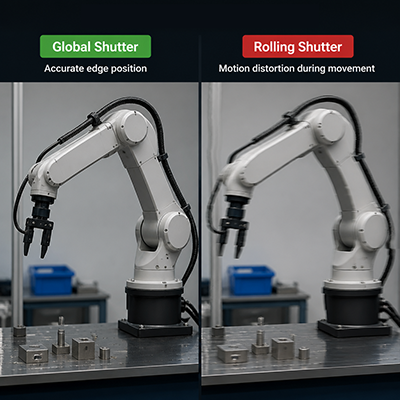
Global Shutter vs Rolling Shutter is one of the most important considerations when selecting an image sensor for industrial vision systems. Although both technologies are widely used in CMOS cameras, they operate differently and can significantly affect image quality, motion accuracy, and overall system performance.
Whether you’re designing a machine vision inspection system, developing a robotics application, or building an AI-powered camera, understanding the differences between these two shutter technologies helps ensure accurate image capture under real-world operating conditions.
A global shutter exposes every pixel on the sensor simultaneously, making it ideal for capturing fast-moving objects without distortion. In contrast, a rolling shutter exposes the sensor line by line, providing a cost-effective solution for many static or slow-moving applications while potentially introducing motion artifacts in dynamic scenes.
In this guide, we’ll compare Global Shutter vs Rolling Shutter from every important perspective, including working principles, image quality, motion performance, cost, industrial applications, and lens selection recommendations. By the end of this article, you’ll know which shutter technology is best suited for your project.
If you’re new to industrial image sensors, we recommend reading our Image Sensor Guide for Machine Vision to understand sensor size, pixel size, image resolution, and lens compatibility before choosing a shutter type.
What Is a Global Shutter?
A global shutter image sensor captures the entire image at exactly the same moment. Every pixel begins and ends exposure simultaneously, allowing the camera to freeze motion without introducing geometric distortion.
This exposure method is particularly valuable in industrial automation where objects move quickly across the field of view. Since every pixel records the scene at the same instant, moving objects retain their correct shape and dimensions, making global shutter sensors the preferred choice for precision measurement and high-speed inspection.
Modern CMOS global shutter sensors have become increasingly popular thanks to improvements in sensitivity, frame rate, and manufacturing cost, making them suitable for many advanced machine vision applications.
Advantages of Global Shutter
- Captures the entire frame simultaneously
- No rolling distortion or image skew
- Excellent for fast-moving objects
- High measurement accuracy
- Ideal for robotic guidance and automation
- Suitable for high-speed production lines
Typical Industrial Applications
- Machine Vision Inspection
- Factory Automation
- Robot Guidance
- Barcode & QR Code Reading
- High-Speed Conveyor Inspection
- Precision Metrology
- Semiconductor Inspection
To maximize imaging performance, global shutter sensors are often paired with high-quality industrial optics such as low-distortion lenses and FA lenses. Learn more about lens optimization in our Optical Design Guide.
What Is a Rolling Shutter?
A rolling shutter image sensor captures an image one row of pixels at a time instead of exposing the entire sensor simultaneously. Exposure begins at the top of the sensor and progresses downward until the entire frame has been recorded.
Because each row is captured at a slightly different moment, moving objects may appear stretched, skewed, or bent if either the object or the camera moves during exposure. These artifacts are commonly referred to as rolling shutter distortion.
Despite this limitation, rolling shutter sensors offer several important advantages. They are generally more affordable, consume less power, and are available in a wide range of resolutions. For static scenes or applications with limited motion, rolling shutter cameras often provide excellent image quality at a lower system cost.
Advantages of Rolling Shutter
- Lower sensor cost
- Lower power consumption
- Higher resolution options available
- Excellent for static imaging
- Suitable for many AI vision systems
- Widely available in industrial CMOS cameras
Typical Industrial Applications
- Medical Imaging
- Smart Security Cameras
- Document Scanning
- Warehouse Monitoring
- Smart City Cameras
- Embedded Vision Systems
- Static Quality Inspection
Choosing the correct lens is equally important when using rolling shutter sensors. Our Industrial Lens Selection Guide explains how focal length, image circle, sensor compatibility, and resolution affect final image quality.
Global Shutter vs Rolling Shutter: Key Differences
Global Shutter vs Rolling Shutter is not simply a comparison of two sensor technologies—it is a decision that directly affects image quality, motion accuracy, inspection reliability, and overall system performance. Understanding these differences helps engineers select the right camera for their specific industrial application.
| Feature | Global Shutter | Rolling Shutter |
|---|---|---|
| Exposure Method | Entire sensor exposed simultaneously | Image captured line by line |
| Motion Distortion | None | Possible on moving objects |
| Image Accuracy | Excellent | Good for static scenes |
| High-Speed Imaging | Excellent | Limited |
| Measurement Precision | Very High | Moderate |
| Frame Synchronization | Excellent | Limited |
| Sensor Cost | Higher | Lower |
| Power Consumption | Slightly Higher | Lower |
| Typical Resolution Options | Medium to High | Wide Range Available |
| Best Applications | Robotics, Machine Vision, AOI, Barcode Reading | Medical Imaging, Smart Security, Static Inspection |
| Recommended Lens | FA Lens / Low Distortion Lens | M12 Lens / Standard Industrial Lens |
Quick Summary
- Choose Global Shutter if your application involves moving objects, robotics, high-speed inspection, or precision measurement.
- Choose Rolling Shutter if your application captures mostly static scenes and prioritizes cost efficiency or ultra-high resolution.
- Regardless of the shutter type, selecting the correct lens, sensor size, focal length, and field of view is essential for achieving optimal imaging performance. You can estimate your system’s viewing area using our Industrial FOV Calculator.
Image Quality Comparison
When comparing Global Shutter vs Rolling Shutter, image quality is influenced not only by sensor resolution but also by how the sensor captures moving subjects. Static scenes often appear nearly identical using either shutter technology. However, once motion is introduced, the differences become immediately visible.
A global shutter captures every pixel at the same instant, preserving the true geometry of moving objects. A rolling shutter records the image line by line, meaning different portions of the image are captured at slightly different times. This can result in skew, wobble, stretching, or curved objects during fast motion.
Visual Comparison
Left: Global Shutter
Right: Rolling Shutter
Caption:
Both shutter technologies produce excellent image quality when photographing stationary objects.
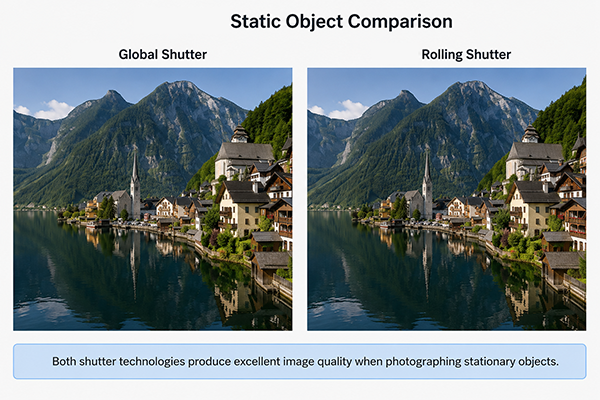
Static Object Comparison
Left: Global Shutter
Perfect rectangular package shape
Right: Rolling Shutter
Package appears stretched or skewed
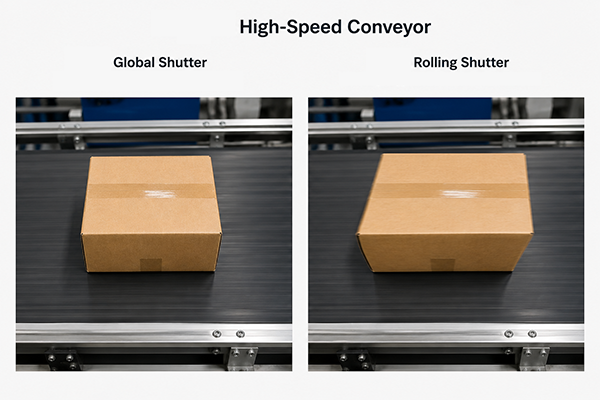
High-Speed Conveyor
Left: Global Shutter
Straight fan blades
Right: Rolling Shutter
Curved or bent fan blades

Rotating Fan
Left: Global Shutter
Accurate edge position
Right: Rolling Shutter
Motion distortion during movement
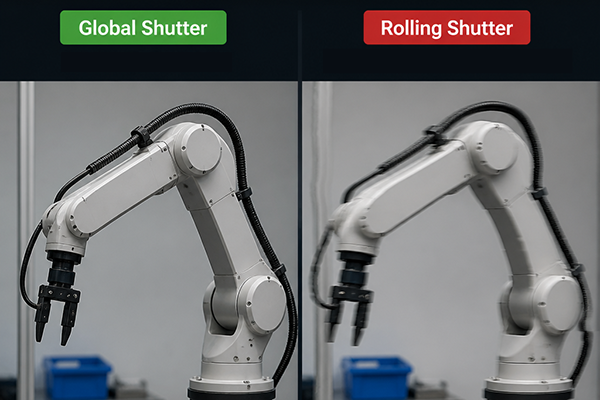
Robot Arm Movement
Image Quality Comparison Table
| Image Quality Factor | Global Shutter | Rolling Shutter |
|---|---|---|
| Static Objects | ★★★★★ | ★★★★★ |
| Moving Objects | ★★★★★ | ★★☆☆☆ |
| Geometric Accuracy | ★★★★★ | ★★★☆☆ |
| Motion Blur | Very Low | Higher |
| Object Measurement | Excellent | Limited |
| AI Detection Accuracy | Excellent | Good |
For applications requiring accurate dimensional measurement or defect inspection, a global shutter sensor combined with a high-quality industrial lens generally delivers the most reliable imaging performance. Learn how lens quality affects image sharpness in our Optical Design Guide.
Which One Is Better for Machine Vision?
The answer depends on your application rather than the sensor technology itself. While global shutter cameras dominate high-speed industrial automation, rolling shutter cameras remain an excellent choice for many static imaging systems.
| Application | Recommended Shutter | Reason |
|---|---|---|
| PCB Inspection | Global Shutter | High positioning accuracy during conveyor movement |
| Robot Guidance | Global Shutter | Captures moving robotic arms without distortion |
| Barcode & QR Code Reading | Global Shutter | Maintains code geometry at high production speeds |
| Automated Optical Inspection (AOI) | Global Shutter | Improves measurement consistency |
| Medical Imaging | Rolling Shutter | Most subjects remain stationary |
| Smart Security | Rolling Shutter | Cost-effective for continuous monitoring |
| Warehouse Monitoring | Rolling Shutter | Limited object motion |
| Document Scanning | Rolling Shutter | Excellent image quality with static objects |
For high-speed industrial automation, global shutter sensors remain the preferred option because they eliminate motion-induced geometric errors that could affect AI algorithms and measurement accuracy.
How to Choose the Right Sensor and Lens
Selecting the correct shutter technology is only one part of building an effective vision system. Sensor size, pixel size, focal length, field of view, and lens resolution all work together to determine final image quality.
Selection Workflow
NO (Static Scene) ↓ Rolling Shutter ↓ General Machine Vision ↓ M12 Lens
Sensor and Lens Recommendation
| Application | Recommended Sensor | Recommended Lens | Typical Focal Length |
|---|---|---|---|
| Robot Guidance | Global Shutter | FA Lens | 12–25mm |
| Factory Inspection | Global Shutter | Low Distortion Lens | 8–16mm |
| Barcode Reading | Global Shutter | M12 Lens | 6–12mm |
| Medical Imaging | Rolling Shutter | Low Distortion Lens | 8–25mm |
| Smart Security | Rolling Shutter | M12 Lens | 2.8–8mm |
| Drone Imaging | Rolling Shutter | Lightweight M12 Lens | 4–12mm |
Before selecting a focal length, calculate your required viewing area using our Industrial Field of View Calculator.
If you’re unsure how sensor size affects lens selection, read our Complete Image Sensor Guide for a detailed explanation.
Need help selecting the right optics? Our Industrial Lens Selection Guide explains how focal length, sensor format, image circle, and working distance influence final imaging performance.
Recommended Industrial Applications
Both global shutter and rolling shutter sensors are widely used across industrial imaging systems. Choosing the appropriate technology depends on motion speed, inspection accuracy, lighting conditions, and budget.
| Industry | Recommended Shutter | Learn More |
|---|---|---|
| Machine Vision Inspection | Global Shutter | Machine Vision Solutions |
| Robotics Vision | Global Shutter | Robotics Vision |
| Medical Imaging | Rolling Shutter | Medical Imaging |
| Smart Security | Rolling Shutter | Smart Security |
| Smart Traffic | Global Shutter | Smart Traffic |
| Drone Imaging | Rolling / Global (depending on flight speed) | Drone Imaging |
| Biometric Recognition | Rolling Shutter | Biometric Recognition |
| ADAS Vision Systems | Global Shutter | ADAS Solutions |
Regardless of whether you choose a global shutter or rolling shutter sensor, overall system performance also depends on optical design, lens resolution, sensor compatibility, and field of view. Optimizing these factors together ensures higher imaging accuracy and more reliable machine vision performance.
Frequently Asked Questions
1. What is the main difference between Global Shutter and Rolling Shutter?
The primary difference is how the image sensor captures light. A global shutter exposes every pixel simultaneously, while a rolling shutter captures the image line by line. This makes global shutter sensors much better for imaging fast-moving objects without distortion.
2. Is a Global Shutter always better than a Rolling Shutter?
Not necessarily. A global shutter is the preferred choice for high-speed industrial automation, robotics, and precision measurement. However, for static scenes, medical imaging, smart security, or cost-sensitive applications, a rolling shutter sensor often provides excellent performance at a lower price.
3. Why do Rolling Shutter cameras produce distorted images?
Rolling shutter sensors expose each row of pixels sequentially. If either the object or camera moves during exposure, different parts of the image are recorded at different moments, causing skew, wobble, stretching, or the well-known “jello effect.”
4. Does shutter type affect lens selection?
Yes. High-speed global shutter cameras often require higher-quality industrial optics with excellent sharpness and low distortion. Rolling shutter cameras can typically use a wider range of industrial lenses depending on image quality requirements.
5. Can an M12 lens be used with a Global Shutter sensor?
Yes. Many machine vision systems combine global shutter CMOS sensors with high-performance M12 lenses. The key is selecting a lens that provides sufficient resolution, image circle coverage, and low distortion for the target sensor.
6. Does Rolling Shutter reduce image quality?
Not in static scenes. Rolling shutter cameras can produce excellent image quality when photographing stationary objects. Image distortion only becomes noticeable when significant motion occurs during exposure.
Conclusion
Global Shutter vs Rolling Shutter is not about determining which technology is universally better—it is about selecting the most appropriate solution for your specific application.
If your vision system must capture moving objects with maximum accuracy, such as robotic guidance, automated optical inspection (AOI), barcode reading, or high-speed production lines, a global shutter sensor is usually the preferred choice. By exposing every pixel simultaneously, it eliminates motion distortion and delivers highly reliable imaging results.
On the other hand, if your application primarily captures stationary scenes, such as medical imaging, smart security, document scanning, or embedded vision systems, a rolling shutter sensor provides an excellent balance of image quality, cost, and power efficiency.
Regardless of the shutter technology you choose, overall system performance depends on much more than the sensor alone. Sensor size, pixel size, optical design, lens resolution, field of view, and focal length all work together to determine final imaging quality. Selecting the right industrial lens is therefore just as important as selecting the right image sensor.
By understanding the strengths and limitations of Global Shutter vs Rolling Shutter, engineers can build more reliable machine vision systems, improve inspection accuracy, and achieve better long-term imaging performance.
Related Resources
Explore Industrial Vision Solutions
Discover how TOWIN industrial lenses support a wide range of machine vision applications.