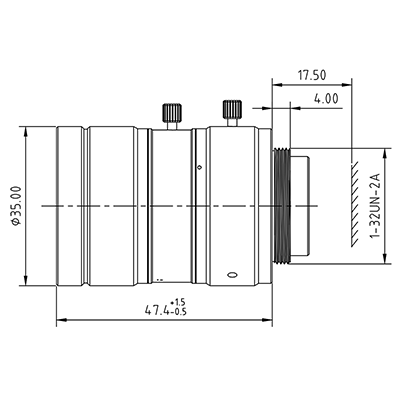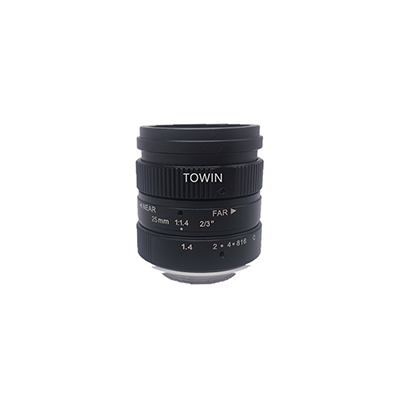



For machine vision, robotics, inspection, smart traffic, and other industrial applications, choosing focal length is not simply a matter of selecting a longer or shorter lens. The correct choice depends on sensor size, required FOV, working distance, target dimensions, resolution, distortion, and the overall imaging objective.
This guide explains focal length from a practical industrial-lens perspective, including how it affects FOV and magnification, how it relates to sensor size and working distance, how to calculate it, and how to choose the right focal length for an industrial vision system.
What Is Focal Length in an Industrial Lens?
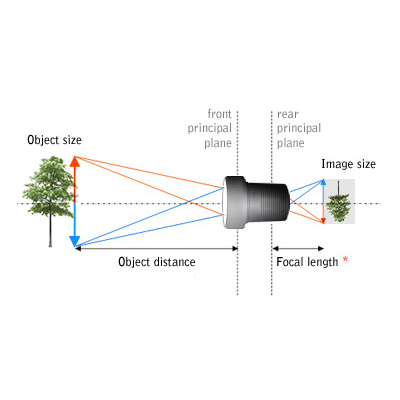
Focal length is the optical distance associated with a lens’s ability to converge light and form an image. In conventional optical specifications, it is expressed in millimeters. In practical industrial imaging, focal length is used to describe the lens’s viewing geometry: shorter focal lengths generally produce wider viewing angles, while longer focal lengths generally produce narrower viewing angles and greater image magnification at the same working conditions.
For example, a 4 mm lens normally provides a much wider view than a 25 mm lens when the sensor and working distance are otherwise comparable. A longer focal length can be useful when the target is relatively small, distant, or when the system needs a tighter field of view.
How Is Focal Length Measured?
Industrial lens specifications normally list focal length in millimeters, such as 2.8 mm, 4 mm, 6 mm, 8 mm, 12 mm, 16 mm, 25 mm, 35 mm, or 50 mm. These values describe the lens’s optical focal length rather than a direct magnification ratio.
It is important not to interpret a “25 mm lens” as a 25× magnification lens. Magnification depends on the complete optical geometry, including focal length, working distance, sensor dimensions, and the imaging configuration.
Why Focal Length Matters in Industrial Imaging
Focal length affects how the target is framed on the sensor. If the focal length is too short, the system may capture excessive background and make the target occupy too few pixels. If it is too long, the system may fail to capture the complete target or required inspection area.
For this reason, focal length should be selected as part of a complete optical design process. TOWIN’s Industrial Lens Basics Knowledge Center provides a broader learning path covering focal length, sensor size, FOV, image circle, depth of field, resolution, MTF, and other essential lens parameters.
How Does Focal Length Affect an Industrial Imaging System?
Focal Length and Field of View
Field of view is the amount of physical area captured by the camera and lens at a specific working distance. For the same sensor size and working distance, a shorter focal length generally produces a wider FOV, while a longer focal length produces a narrower FOV.
This relationship is especially important when designing inspection systems. A wide-area inspection may require a shorter focal length so the complete object fits inside the image. A long-distance inspection or small-target application may require a longer focal length to obtain a tighter view.
For a deeper explanation, see Field of View (FOV) for Industrial Imaging or use the TOWIN FOV Calculator to estimate FOV from sensor size, focal length, and working distance.
Focal Length and Magnification
Longer focal lengths generally make a target appear larger on the sensor when the other imaging conditions are comparable. This can help when a system needs to resolve small features at a relatively long working distance.
However, focal length should not be treated as magnification by itself. A 25 mm lens does not automatically provide a fixed magnification value. The final image scale depends on the relationship between the lens, sensor, working distance, and target.
Focal Length and Working Distance
Working distance (WD) is the physical distance between the lens and the target or object being imaged. Focal length and working distance must be considered together because changing the camera-to-object distance changes the physical area covered by the imaging system.
A lens that produces the desired FOV at one working distance may not produce the same FOV after the camera is moved. For industrial system design, define the acceptable working-distance range before finalizing the focal length.
Focal Length and Sensor Size
Sensor size is another critical variable. With the same focal length, a larger sensor generally captures a wider viewing area than a smaller sensor. The lens must also provide an image circle large enough to cover the entire sensor.
Read How Does Sensor Size Affect Lens Selection? for a detailed explanation of sensor compatibility, image circle, FOV, and lens selection. You can also review How to Match a Lens to Your Sensor before choosing a final optical configuration.
Short Focal Length vs Long Focal Length
The following comparison provides a practical starting point. Actual performance depends on sensor size, working distance, lens design, distortion, and other optical parameters.
| Feature | Short Focal Length | Long Focal Length |
|---|---|---|
| Typical viewing angle | Wider | Narrower |
| Image coverage | Larger area | Smaller area |
| Target image size | Generally smaller | Generally larger |
| Typical use | Wide-area inspection, navigation, compact vision | Detailed or long-distance imaging |
| Example focal lengths | 2.8–8 mm | 25–50 mm and above |
These ranges are examples rather than universal classifications. For example, TOWIN’s M12 lens portfolio covers a broad focal-length range, while C-Mount industrial lenses can support many different focal lengths and sensor formats. Explore M12 Lens Solutions if compact integration is important, or compare M12 and C-Mount Lenses when evaluating lens mounting and sensor compatibility.
How Is Focal Length Calculated?
In a simplified rectilinear imaging model, focal length can be estimated from sensor size, required field of view, and working distance. A commonly used approximation is:
Focal Length ≈ (Working Distance × Sensor Dimension) ÷ Field of View
The sensor dimension and FOV must refer to the same direction. For example, horizontal sensor size should be used with horizontal FOV.
Example of Focal Length Calculation
Suppose an inspection system has a working distance of 200 mm, a horizontal sensor dimension of 6.4 mm, and a required horizontal FOV of 100 mm. A simplified estimate would be:
Focal Length ≈ (200 × 6.4) ÷ 100 = 12.8 mm
This result is an initial estimate rather than a final lens specification. Real lens selection must also consider optical distortion, sensor coverage, lens design, resolution, MTF, aperture, mechanical constraints, and the actual product’s optical characteristics.
For a more detailed calculation workflow, read Focal Length Calculation for Machine Vision & Industrial Lens Selection. For practical FOV estimation, use the FOV Calculator.
Focal Length vs Other Industrial Lens Parameters
Focal length is important, but it should never be evaluated in isolation. Industrial imaging performance results from the interaction of several optical and mechanical parameters.
| Parameter | Main Function | Relationship to Focal Length |
|---|---|---|
| Field of View (FOV) | Defines the physical area captured | Strong; focal length directly affects viewing angle |
| Sensor Size | Defines the active imaging area | Strong; sensor size changes the resulting FOV |
| Working Distance | Defines camera-to-target distance | Strong; changes physical image coverage |
| Magnification | Defines target image scale | Related, but not identical to focal length |
| Resolution | Defines detail reproduction capability | Must be matched to the sensor and target detail |
| Distortion | Controls geometric deformation | Depends on optical design and lens type |
| MTF | Describes contrast and spatial-detail performance | Helps verify whether the lens can support the required imaging detail |
For more information, see TOWIN’s Industrial Lens Selection Guide and How Does Resolution Influence Lens Choice?. These resources help connect focal length with the wider lens-selection process.
How to Choose the Right Focal Length for an Industrial Lens
There is no single “best” focal length for every industrial camera. The correct focal length is the result of matching the optical geometry to the application.
Step 1: Determine Sensor Size
Start with the camera sensor format and physical sensor dimensions. Confirm that the selected lens provides an image circle large enough to cover the sensor. Sensor size also affects the final FOV for a given focal length.
Step 2: Determine the Target or Object Size
Define the width and height of the object that must be captured. Include enough margin around the target if the inspection algorithm or positioning system requires additional context.
Step 3: Determine Working Distance
Measure the practical distance between the lens and the target. Installation space, robot movement, safety clearance, lighting, and mechanical constraints may limit the available working-distance range.
Step 4: Determine the Required FOV
The required FOV should normally be slightly larger than the target area so the entire object can be captured reliably. Use the TOWIN FOV Calculator to test different combinations of sensor size, focal length, and working distance.
Step 5: Select the Focal Length
Once sensor size, target size, working distance, and FOV are known, calculate an initial focal-length range. Then verify resolution, MTF, distortion, aperture, mount type, image circle, and environmental requirements against the actual lens datasheet.
A practical workflow is therefore:
Sensor Size → Target Size → Working Distance → Required FOV → Estimated Focal Length → Resolution/MTF/Distortion Check → Final Lens Selection
This approach aligns with the selection methodology described in TOWIN’s Machine Vision Lens Selection Guide.
Focal Length Selection for Different Industrial Applications
Machine Vision Inspection
Factory inspection systems may require different focal lengths depending on target dimensions, camera position, sensor size, and required measurement detail. Shorter focal lengths can be useful for larger inspection areas, while longer focal lengths may help isolate smaller targets at longer working distances.
For complete application requirements, explore TOWIN’s Industrial Lens Solutions and review the machine-vision-focused Machine Vision Lens Selection Guide.
Robotics Vision
Robotic systems often balance FOV, compact integration, working distance, distortion, and image detail. Navigation and environment perception may favor wider FOV configurations, while robotic inspection or positioning may require a tighter view and higher optical detail.
See Robotics Vision Lens Solutions for examples of how focal length, FOV, distortion, and sensor matching work together in AGV, AMR, SLAM, and AI-robot applications.
ADAS and Automotive Imaging
Automotive cameras often require carefully controlled FOV and distortion because the optical system must capture the appropriate road scene while maintaining stable image geometry. Focal length selection should be evaluated together with sensor format, mounting position, temperature requirements, and application-specific FOV.
Explore ADAS Lens Solutions for automotive optical requirements.
Smart Traffic and ANPR
Traffic imaging systems may use longer focal lengths when the camera must capture vehicles or license plates from relatively long distances. The final choice depends on target distance, lane coverage, sensor size, required pixel density, low-light performance, and distortion control.
See Smart Traffic Lens Solutions for ANPR, traffic monitoring, tolling, and intelligent transportation applications.
Common Focal Length Selection Mistakes
Mistake 1: Selecting Focal Length Without Checking Sensor Size
The same focal length can produce different viewing coverage on different sensors. Always verify the physical sensor dimensions and lens image-circle compatibility.
Mistake 2: Ignoring Working Distance
Focal length and FOV cannot be selected correctly without knowing where the camera will be installed relative to the target.
Mistake 3: Treating Focal Length as Magnification
A focal length value is not a magnification ratio. Image scale depends on the complete optical geometry.
Mistake 4: Choosing Only by FOV
Meeting the required FOV does not automatically guarantee a good inspection image. Resolution, MTF, distortion, aperture, illumination, and sensor performance must also be checked.
Mistake 5: Ignoring Optical Distortion
For measurement, calibration, robotics positioning, and geometric analysis, distortion can affect the relationship between the real object and its image. Review the Industrial Lens Distortion Guide when geometric accuracy is important.
Practical Focal Length Examples
Example 1: Wide-Area Inspection
Imagine a factory camera positioned approximately 200 mm from a target that is 100 mm wide. The system needs to capture the complete target with some surrounding margin. A shorter focal length may be appropriate because the system needs a relatively wide FOV.
Example 2: Small-Object Inspection
Now consider a small component that must be inspected from a longer working distance. If the target needs to occupy more pixels, a longer focal length may provide a narrower FOV and larger target image scale. The final choice should still be validated against sensor size, resolution, MTF, and distortion requirements.
These examples demonstrate why focal length should be derived from the system geometry rather than selected from a focal-length number alone.
Frequently Asked Questions
What is focal length in an industrial lens?
Focal length is an optical parameter expressed in millimeters that describes the lens’s imaging geometry. It strongly influences field of view and image scale and must be evaluated with sensor size and working distance.
What does focal length affect in machine vision?
Focal length primarily affects field of view and image scale, while its practical effect depends on sensor size, working distance, and the lens design. It is one of the key parameters used in industrial lens selection.
Does a longer focal length give a narrower field of view?
Yes. For the same sensor size and working distance, a longer focal length generally produces a narrower field of view, while a shorter focal length generally produces a wider field of view.
Does a longer focal length increase magnification?
Generally, a longer focal length produces a larger target image when the other imaging conditions are comparable. However, focal length is not itself a fixed magnification value.
How do I calculate focal length?
A practical estimate uses working distance, sensor dimension, and required FOV. The relationship can be approximated as focal length ≈ working distance × sensor dimension ÷ FOV. For detailed calculations, see TOWIN’s Focal Length Calculation Guide.
How do I choose the right focal length for machine vision?
Start with sensor size, target size, working distance, and required FOV. Then select an initial focal-length range and verify resolution, MTF, distortion, aperture, image circle, mount, and environmental requirements.
Is focal length the same as magnification?
No. Focal length is an optical parameter measured in millimeters, while magnification describes the relationship between object size and image size. Magnification depends on the complete optical geometry rather than focal length alone.
Conclusion
Focal length is a fundamental parameter for industrial imaging because it helps determine how the camera frames the target, how wide the field of view will be, and how large the target appears on the sensor. The correct focal length depends on the relationship between sensor size, working distance, target dimensions, FOV, resolution, and the optical performance required by the application.
For engineers and system integrators, the best approach is to define the imaging geometry first, calculate an appropriate focal-length range, and then validate the lens against resolution, MTF, distortion, image circle, aperture, mount, and environmental requirements.
Ultimately, understanding What Is Focal Length in an Industrial Lens is a fundamental step toward selecting the right optical configuration for machine vision, robotics, automotive imaging, smart traffic, and other industrial vision systems. If you need help matching focal length, sensor size, FOV, and working distance, start with the TOWIN FOV Calculator or explore the Industrial Lens Selection Guide.
Need Help Selecting the Right Industrial Lens?
Share your sensor size, target dimensions, working distance, required FOV, resolution, and application. TOWIN can help evaluate the appropriate focal length and industrial lens configuration.
Explore TOWIN Industrial Lens Solutions | Contact TOWIN Optical Engineers