


What Is Optical Distortion in Industrial Lenses?
06/07/2026
940nm TOF Lens Guide: Why 940nm Is Preferred for Modern Depth Sensing
06/09/2026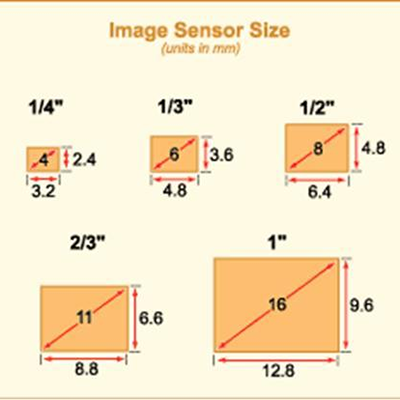
Sensor Size is one of the most important factors influencing field of view (FOV) in machine vision and industrial imaging systems. Whether you are designing an automated inspection system, robotics vision platform, ADAS solution, or smart traffic application, understanding the relationship between sensor size and field of view is essential for selecting the correct camera and lens combination.
In simple terms, when focal length and working distance remain unchanged, a larger sensor captures a wider scene, while a smaller sensor captures a narrower area. This directly impacts image coverage, object detection accuracy, and overall system performance.
If you are new to image sensors, we recommend first reading our Sensor Guide to understand common sensor formats and dimensions.
What Is Sensor Size?
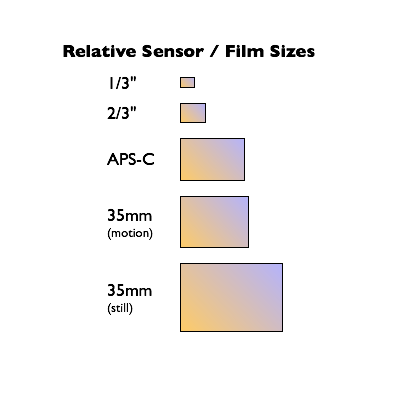
Sensor size refers to the physical dimensions of an image sensor inside a camera. The sensor is responsible for capturing light and converting it into digital image data.
Common machine vision sensor formats include:
| Sensor Format | Approximate Width |
|---|---|
| 1/4″ | 3.6 mm |
| 1/3″ | 4.8 mm |
| 1/2″ | 6.4 mm |
| 2/3″ | 8.8 mm |
| 1″ | 12.8 mm |
| 1.1″ | 14 mm |
| APS-C | 23.6 mm |
As sensor dimensions increase, the camera can capture a larger image area, which directly affects field of view calculations.
What Is Field of View (FOV)?
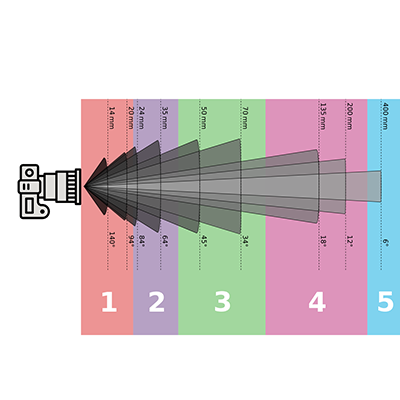
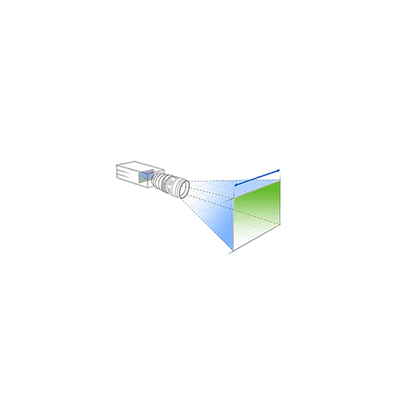
Field of View (FOV) is the observable area captured by a camera and lens system. It determines how much of a scene is visible in an image.
Three primary factors influence FOV:
- Sensor Size
- Lens Focal Length
- Working Distance
A larger sensor generally results in a wider field of view when using the same lens and working distance.
You can calculate coverage requirements using our FOV Calculator.
How Sensor Size Affects Field of View
This is where many engineers and system integrators become confused.
Imagine the following setup:
- Working Distance: 1000 mm
- Lens Focal Length: 16 mm
- Only Sensor Size Changes
In this scenario:
| Sensor Format | Relative Field of View |
|---|---|
| 1/3″ | Narrow |
| 1/2″ | Wider |
| 2/3″ | Even Wider |
| 1″ | Widest |
A larger sensor captures more of the image projected by the lens. As a result, the camera can view a wider scene without changing focal length or installation distance.
Understanding this relationship is critical when selecting cameras for industrial automation, robotics, and machine vision inspection systems.
Sensor Size Comparison Example
Consider a machine vision application with the following parameters:
- Working Distance: 1000 mm
- Lens Focal Length: 25 mm
| Sensor Format | Sensor Width | Approximate Horizontal FOV |
|---|---|---|
| 1/3″ | 4.8 mm | 192 mm |
| 1/2″ | 6.4 mm | 256 mm |
| 2/3″ | 8.8 mm | 352 mm |
| 1″ | 12.8 mm | 512 mm |
As shown above, increasing sensor dimensions significantly expands the observable area without requiring a different working distance.
Sensor Size vs Focal Length
Although sensor size affects field of view, focal length plays an equally important role.
To achieve the same field of view:
| Sensor Size | Typical Lens Requirement |
|---|---|
| Smaller Sensor | Shorter Focal Length |
| Larger Sensor | Longer Focal Length |
Engineers must balance sensor dimensions and focal length to achieve the desired image coverage while maintaining image quality and resolution.
For additional lens fundamentals, see our Lens Basics Guide.
How Sensor Size Influences Lens Selection
Choosing a lens is not only about focal length. Sensor compatibility is equally important.
When selecting a lens, consider:
1. Sensor Coverage
The lens image circle must fully cover the sensor. Otherwise, vignetting and dark corners may occur.
2. Desired Field of View
Determine how much area must be captured within the camera’s field of view.
3. Resolution Requirements
Larger coverage often requires higher sensor resolution to maintain measurement accuracy.
4. Working Distance Constraints
Installation limitations may affect lens and sensor choices.
Recommended product categories:
- FA Lens
- Low Distortion Lens
- Telecentric Lens
At this point in the selection process, Sensor Size becomes a key consideration because it determines both lens compatibility and achievable field of view.
Application Examples
Machine Vision Inspection
Larger sensors can inspect wider areas while maintaining image detail.
Learn more about Machine Vision Solutions.
Robotics Vision
Robot navigation, object detection, and pick-and-place systems often require carefully balanced sensor and lens combinations.
Explore Robotics Vision Solutions.
Smart Traffic Systems
Traffic monitoring applications benefit from wider scene coverage and improved vehicle recognition.
See our Smart Traffic Solutions.
ADAS and Autonomous Systems
Advanced driver assistance systems require optimized image coverage for object detection and environmental awareness.
Discover ADAS Imaging Solutions.
Common Mistakes When Choosing Sensor Size
Assuming Larger Is Always Better
Larger sensors increase cost and may require larger optics.
Ignoring Lens Image Circle Specifications
Not all lenses support all sensor formats.
Overlooking Working Distance
Installation constraints can significantly affect achievable FOV.
Ignoring Resolution Requirements
A wider field of view may reduce pixel density on the target object.
Frequently Asked Questions
Does a larger sensor always provide a wider field of view?
Yes. When focal length and working distance remain constant, a larger sensor captures a wider scene.
Can any lens be used with any sensor?
No. The lens image circle must fully cover the sensor dimensions.
Which sensor formats are common in machine vision?
1/2″, 2/3″, and 1″ sensors are among the most widely used formats.
Does sensor size affect image quality?
In many cases, larger sensors can collect more light and improve image performance, although pixel design and resolution also play important roles.
How can I calculate field of view?
You can use our FOV Calculator or follow standard FOV equations.
Conclusion
Choosing the correct camera system begins with understanding how sensor dimensions influence image coverage. When focal length and working distance remain unchanged, larger sensors produce wider fields of view, while smaller sensors provide narrower coverage.
By understanding the relationship between sensors, lenses, and field of view, engineers can build more effective machine vision systems for industrial inspection, robotics, smart traffic, and ADAS applications.
To continue learning, explore our Sensor Guide, FOV Calculator, and Lens Basics Guide to make informed imaging decisions based on your required Sensor Size.