


How Does Focal Length Affect FOV?
07/16/2026
Common Lens Selection Mistakes and How to Avoid Them
07/17/2026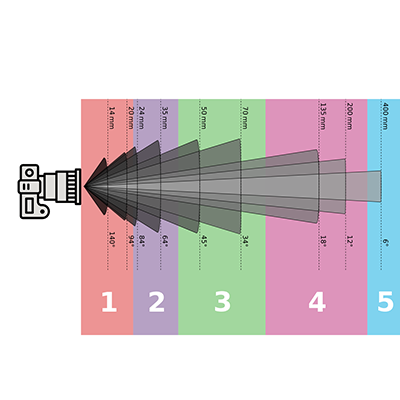
Why is FOV important in industrial cameras? Field of view (FOV) is one of the most important factors that determines how much of an object or scene an industrial camera can capture. In machine vision systems, selecting the correct FOV directly affects image coverage, inspection accuracy, and overall system performance.
Unlike consumer cameras, industrial cameras are designed for precise imaging tasks such as automated inspection, robotics guidance, measurement, and quality control. A properly selected FOV ensures that the target object fits completely within the image while maintaining sufficient resolution and optical accuracy.
Engineers need to evaluate several optical parameters together, including sensor size, focal length, working distance, and lens performance. The FOV Calculator can help quickly estimate the required field of view and simplify industrial lens selection.
Understanding FOV is the first step toward choosing the right lens solution for machine vision applications. This guide explains why FOV matters, how it affects imaging performance, and how engineers can select suitable industrial lenses based on application requirements.
What Is FOV in an Industrial Camera?
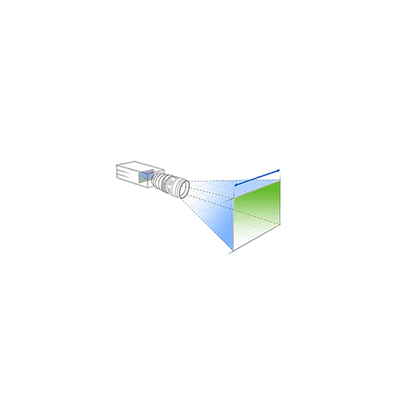
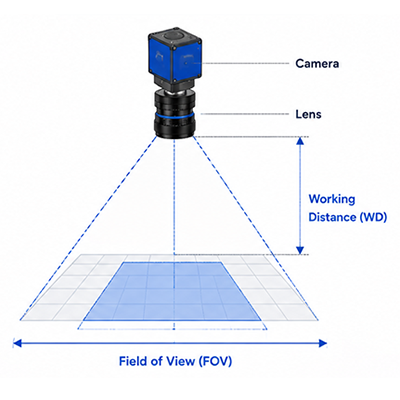
Field of View (FOV) refers to the visible area captured by a camera and lens system. It represents the size of the scene that can be viewed through the optical system at a specific working distance.
In industrial imaging, FOV is usually measured in millimeters and describes the physical area that appears in the camera image.
For example:
- A camera with a wide FOV can capture larger objects or a larger inspection area.
- A camera with a narrow FOV can capture smaller details with higher magnification.
Types of Field of View
Horizontal FOV (HFOV)
Horizontal field of view represents the width of the area captured from left to right. It is commonly used when calculating whether an object can fit completely within the image frame.
Vertical FOV (VFOV)
Vertical field of view represents the height of the visible area from top to bottom.
Diagonal FOV
Diagonal FOV measures the diagonal coverage of the image area and is often used in camera specifications.
The final FOV value depends mainly on three optical factors:
- Sensor Size: Determines how much of the projected image is captured.
- Focal Length: Controls magnification and viewing angle.
- Working Distance: Determines the physical coverage area of the target.
To understand these parameters in more detail, visit our Industrial Lens Fundamentals guide.
Why Is FOV Important in Industrial Cameras?
Why is FOV important in industrial cameras? Because FOV directly influences whether an imaging system can successfully capture, analyze, and measure the target object. Incorrect FOV selection can lead to incomplete inspection, insufficient detail, or unnecessary system costs.
In industrial applications, FOV is not simply a viewing angle specification. It determines the relationship between the camera, lens, and object being inspected.
1. FOV Determines Object Coverage
The primary purpose of selecting the correct FOV is ensuring that the entire target object appears within the camera image.
For example, in PCB inspection, the camera must capture the complete circuit board area while maintaining enough detail to identify defects.
If the FOV is too small:
- Parts of the object may be outside the image area.
- Multiple images may be required for inspection.
- Inspection efficiency may decrease.
If the FOV is too large:
- The object occupies fewer pixels.
- Small defects may become difficult to detect.
- Image resolution may not meet inspection requirements.
2. FOV Affects Image Resolution
FOV and image resolution are closely related. When a camera captures a larger area, the available pixels are distributed across a larger space, reducing the pixel density on the object.
| FOV Type | Advantages | Limitations |
|---|---|---|
| Wide FOV | Large area coverage, suitable for monitoring and positioning | Lower object detail |
| Medium FOV | Balanced coverage and resolution | Limited for extremely small objects |
| Narrow FOV | High magnification and detailed inspection | Smaller inspection area |
For machine vision systems, selecting the correct balance between FOV and resolution is critical. A lens that provides excessive coverage may reduce inspection accuracy, while an overly narrow FOV may fail to capture the complete target.
3. FOV Determines Lens Selection
FOV is one of the first parameters engineers should evaluate when selecting an industrial lens. The required field of view directly affects the choice of focal length, sensor compatibility, and lens type.
For example:
- Wide-area inspection requires shorter focal length lenses.
- Precision measurement usually requires narrower FOV and higher magnification.
- Large sensor cameras may require lenses designed for larger image circles.
A complete lens selection process should consider FOV together with resolution, distortion, working distance, and sensor size. Learn more in our Industrial Lens Selection Guide .
4. FOV Helps Reduce System Cost
Choosing the correct FOV at the beginning of system design can reduce unnecessary hardware costs.
Incorrect FOV selection may require:
- Higher resolution cameras to compensate for poor lens selection.
- Additional cameras to cover the inspection area.
- Mechanical redesign of the imaging system.
A properly calculated FOV allows engineers to achieve the required inspection performance with the most efficient camera and lens combination.
5. FOV Determines Application Feasibility
Different industrial applications require different field of view characteristics. A lens that works well for one application may not be suitable for another because the inspection area, object size, and accuracy requirements can vary significantly.
Understanding FOV requirements before selecting a camera lens helps engineers design more reliable vision systems.
How FOV Affects Different Industrial Camera Applications
Industrial cameras are used in a wide range of applications, including machine vision inspection, robotics, smart security, and automated measurement. Each application has different FOV requirements depending on the imaging objective.
Machine Vision Inspection
Machine vision systems require a carefully controlled FOV because inspection accuracy depends on the relationship between object size, camera resolution, and lens magnification.
Typical requirements:
- Medium FOV for balanced object coverage
- High resolution for defect detection
- Low distortion for measurement accuracy
Common applications include:
- PCB inspection
- Electronic component inspection
- Product quality control
- Barcode and OCR inspection
For these applications, engineers often select:
- M12 Lens for compact machine vision systems.
- Low Distortion Lens for precision measurement applications.
Learn more about industrial imaging applications through our Machine Vision Solution .
Robotics Vision
Robotics applications often require a wider FOV because robots need to understand their surrounding environment and locate objects quickly.
Typical FOV requirements:
- Wide viewing area
- Fast object detection
- Reliable positioning
Examples include:
- Robot navigation
- Pick-and-place systems
- Autonomous industrial robots
Wide-angle M12 lenses are commonly used because they provide compact size and flexible focal length options.
Explore more applications in our Robotics Vision Solution .
Smart Security Cameras
Security imaging systems usually require a large FOV to monitor wide areas such as buildings, roads, and public spaces.
Typical requirements include:
- Wide coverage
- Long working distance
- Reliable imaging under different environments
A wider FOV reduces the number of cameras required for area coverage, improving system efficiency.
More information can be found in our Smart Security Solution .
Medical Imaging Systems
Medical imaging applications require accurate and stable imaging because small details may affect diagnosis or analysis.
Typical requirements:
- Controlled FOV
- High optical resolution
- Low distortion performance
In these systems, selecting the correct FOV helps maintain image accuracy while ensuring the target area is fully captured.
Relationship Between FOV and Lens Parameters
FOV is not determined by the camera alone. The final field of view depends on several optical parameters working together.
1. Sensor Size and FOV
Sensor size has a direct influence on the visible area captured by a lens. A larger sensor can capture more of the image circle, resulting in a wider field of view compared with a smaller sensor using the same lens.
For example, an 8mm lens mounted on a 1/2.3″ sensor will provide a wider FOV than the same 8mm lens mounted on a 1/4″ sensor.
| Sensor Size | Typical Application | Recommended Lens Range |
|---|---|---|
| 1/4″ | Compact cameras, barcode recognition | 2.8mm – 6mm |
| 1/3″ | Embedded vision, security imaging | 3.6mm – 8mm |
| 1/2″ | Machine vision inspection | 4mm – 12mm |
| 1/1.8″ | High-resolution inspection | 6mm – 16mm |
| 1″ | Precision measurement | 12mm – 35mm |
Understanding sensor compatibility is essential when selecting a lens. You can learn more from our Sensor Size Guide .
2. Focal Length and FOV
Focal length is another major factor affecting field of view. The relationship is simple:
- Short focal length → wider FOV
- Long focal length → narrower FOV
| Focal Length | FOV Characteristics | Typical Applications |
|---|---|---|
| 2.8mm – 4mm | Wide-angle imaging | Robotics, security, embedded cameras |
| 6mm – 12mm | Balanced coverage and detail | Machine vision inspection |
| 16mm – 25mm | Narrow FOV with higher magnification | Measurement and precision inspection |
For a detailed explanation of focal length and field of view relationships, read:
How Does Focal Length Affect FOV
3. Working Distance and FOV
Working distance is the physical distance between the lens and the target object. It also influences the actual area captured by the camera.
A longer working distance generally allows the camera to capture a larger area, while a shorter working distance creates a smaller inspection area.
When designing a machine vision system, engineers should balance:
- Required object coverage
- Available installation space
- Required image resolution
FOV Selection Guide for Industrial Cameras
Choosing the correct FOV requires a systematic approach. Instead of selecting a lens based only on focal length, engineers should consider the complete imaging requirement.
Step 1: Define the Target Object
Measure the size of the object that needs to be captured, including width, height, and inspection area.
Step 2: Determine Required FOV
The required FOV should be slightly larger than the target object to ensure complete coverage while maintaining enough image detail.
Step 3: Select Suitable Sensor Size
Sensor selection affects both FOV and image resolution. Larger sensors may provide wider coverage but require compatible lenses.
Step 4: Choose Lens Focal Length
Select a focal length that provides the required viewing angle:
- Wide inspection area → Short focal length
- General inspection → Medium focal length
- Detailed measurement → Long focal length
Recommended Industrial Lens Solutions Based on FOV Requirements
After determining the required field of view, engineers need to select a lens that matches the application requirements. FOV should always be evaluated together with sensor compatibility, resolution, distortion, and working distance.
TOWIN provides different industrial optical solutions designed for various FOV requirements, from compact embedded imaging systems to high-precision machine vision applications.
M12 Lens for Flexible Industrial Imaging
As one of the most widely used lens formats in industrial cameras, M12 lenses feature a compact size, flexible focal length options, and broad compatibility with numerous embedded vision systems.
M12 lenses are available with different focal lengths to achieve different FOV requirements:
- Short focal lengths (2.8mm-4mm) for wide-angle imaging
- Medium focal lengths (6mm-12mm) for balanced inspection
- Longer focal lengths for higher magnification applications
Typical applications include:
- Machine vision inspection
- Robotics vision
- Barcode recognition
- Embedded AI cameras
- Smart automation equipment
C Mount Lens for High-Resolution Applications
C Mount Lens solutions are suitable for industrial systems requiring larger sensors, higher resolution, or longer working distances.
Compared with compact lens formats, C Mount lenses provide greater flexibility for advanced imaging systems.
Typical applications include:
- Precision measurement
- High-resolution inspection
- Large sensor industrial cameras
- Scientific imaging systems
Low Distortion Lens for Accurate Measurement
When field of view accuracy is critical, optical distortion can affect measurement results. Even if the object fits within the FOV, geometric distortion may reduce inspection accuracy.
Low Distortion Lens solutions are designed for applications where image geometry and measurement accuracy are important.
Common applications include:
- PCB inspection
- Industrial measurement
- Precision positioning
- Automated quality inspection
Use the FOV Calculator to Select the Right Industrial Lens
Calculating FOV manually can be challenging because multiple optical parameters influence the final result. Engineers need to consider sensor size, focal length, and working distance together.
The TOWIN FOV Calculator provides a practical way to estimate field of view requirements before selecting an industrial lens.
Parameters Required for FOV Calculation
| Parameter | Why It Matters |
|---|---|
| Sensor Size | Determines the image area captured by the lens |
| Sensor Width | Used for horizontal FOV calculation |
| Focal Length | Controls viewing angle and magnification |
| Working Distance | Determines physical object coverage |
By entering these parameters into the calculator, engineers can quickly estimate:
- Horizontal FOV
- Vertical FOV
- Required imaging coverage
- Suitable focal length range
Calculate Your FOV Before Selecting a Lens
Use the TOWIN FOV Calculator to determine your imaging requirements and find a suitable industrial lens solution.
Frequently Asked Questions
1. What is FOV in an industrial camera?
FOV (Field of View) is the visible area captured by an industrial camera and lens combination. It defines how much of the target scene can be viewed and inspected.
2. Why is FOV important in machine vision?
FOV determines whether the camera can capture the complete target object while maintaining enough resolution for inspection. The correct FOV helps improve accuracy, efficiency, and system reliability.
3. How does FOV affect image quality?
A wider FOV covers a larger area but distributes pixels across more space, which may reduce detail. A narrower FOV increases magnification but captures a smaller area.
4. How do I calculate the FOV of an industrial camera?
FOV calculation requires sensor size, focal length, and working distance information. Engineers can use the FOV Calculator to quickly estimate the required viewing area.
5. Does sensor size affect camera FOV?
Yes. A larger sensor generally provides a wider field of view because it captures more of the lens image circle. Sensor compatibility should always be checked when selecting a lens.
Learn more from our Sensor Size Guide .
6. How does focal length affect FOV?
Short focal length lenses create wider FOV, while longer focal length lenses create narrower FOV with higher magnification. The correct choice depends on the application requirements.
7. What FOV is suitable for PCB inspection?
PCB inspection usually requires a controlled FOV that captures the complete board while maintaining sufficient resolution for defect detection. Low distortion lenses are often preferred for measurement accuracy.
8. How do I choose the right industrial lens based on FOV?
Lens selection should consider:
- Required field of view
- Sensor size
- Working distance
- Resolution requirement
- Distortion performance
- Lens mount type
A complete selection process can be found in our Industrial Lens Selection Guide .
Conclusion
Understanding Why is FOV important in industrial cameras is essential for designing accurate and reliable machine vision systems. The correct field of view ensures complete object coverage, maintains image resolution, and helps engineers select the most suitable lens for their application.
FOV should not be evaluated separately. Sensor size, focal length, working distance, resolution, and distortion performance all influence the final imaging result. By considering these factors together, engineers can avoid lens selection mistakes and improve system performance.
The TOWIN FOV Calculator provides an efficient way to evaluate imaging requirements and identify suitable lens solutions for industrial applications.
Whether you need an M12 Lens , C Mount Lens , or Low Distortion Lens , choosing the correct FOV is the foundation of successful industrial imaging design.
For any industrial imaging project, remembering Why is FOV important in industrial cameras helps engineers make better optical decisions and build more reliable vision systems.