


What is an Industrial Lens? A Complete Guide to Industrial Camera Lenses
07/16/2026
Why Is FOV Important in Industrial Cameras?
07/17/2026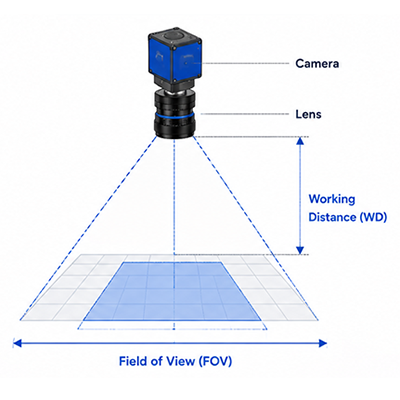
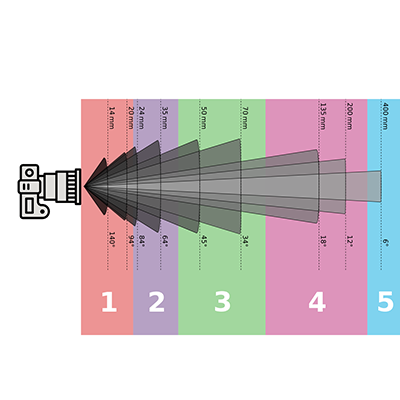
How does focal length affect FOV? In industrial imaging systems, focal length is one of the most important optical parameters that determines how much of a scene a camera can capture. A shorter focal length creates a wider field of view (FOV), allowing the camera to cover a larger area, while a longer focal length produces a narrower FOV with higher magnification.
For machine vision, robotics, smart security, and automated inspection applications, selecting the correct focal length directly affects image coverage, measurement accuracy, and overall system performance. Engineers need to consider not only focal length but also sensor size, working distance, resolution requirements, and lens characteristics.
Before selecting an industrial lens, you can use the FOV Calculator to quickly estimate horizontal and vertical field of view based on sensor size, focal length, and working distance.
What Is Focal Length?
Focal length is the distance between the optical center of a lens and the camera sensor when the image is focused. It is usually measured in millimeters (mm) and is one of the key specifications used to describe an industrial lens.
In optical systems, focal length determines the level of magnification and viewing angle. A lens with a shorter focal length captures more of the surrounding area, while a lens with a longer focal length provides a closer and more detailed view of distant objects.
Short Focal Length Lens
Short focal length lenses, such as 2.8mm, 4mm, or 6mm lenses, provide a wider field of view. They are commonly used in applications where the camera needs to observe a large area or where the working distance is limited.
Typical applications include:
- Robotics vision systems
- Embedded vision cameras
- Smart security cameras
- Wide-area monitoring
Long Focal Length Lens
Long focal length lenses, such as 12mm, 16mm, or 25mm lenses, provide a narrower field of view but higher image magnification. These lenses are suitable for applications requiring detailed inspection of smaller objects or objects located farther away.
Typical applications include:
- Precision machine vision inspection
- Measurement systems
- Industrial inspection cameras
- Long-distance imaging
What Is Field of View (FOV)?
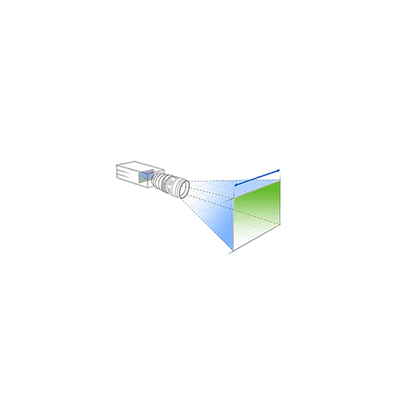
Field of View (FOV) refers to the visible area captured by a camera and lens combination. It describes the width, height, or diagonal range of the scene that can be viewed at a specific working distance.
In industrial imaging, FOV is usually expressed as:
- Horizontal FOV (HFOV): The width of the visible area from left to right.
- Vertical FOV (VFOV): The height of the visible area from top to bottom.
- Diagonal FOV: The diagonal measurement of the captured image area.
The relationship between focal length and FOV is essential when selecting a machine vision lens. A mismatch between lens focal length and required FOV can result in incomplete object coverage, insufficient resolution, or inaccurate measurements.
For a deeper understanding of optical fundamentals, you can also explore our Lens Basics Guide to learn more about sensor matching, resolution, and lens parameters.
How Does Focal Length Affect FOV?
How does focal length affect FOV? The relationship is straightforward: focal length and field of view have an inverse relationship. When focal length increases, the field of view becomes narrower. When focal length decreases, the field of view becomes wider.
| Focal Length | Field of View | Image Characteristics | Typical Applications |
|---|---|---|---|
| 2.8mm – 4mm | Very Wide FOV | Large scene coverage | Security, robotics, embedded cameras |
| 6mm – 8mm | Medium FOV | Balanced coverage and detail | Machine vision inspection |
| 12mm – 16mm | Narrow FOV | Higher magnification | Precision inspection |
| 25mm+ | Very Narrow FOV | Long-distance detailed imaging | Measurement and specialized applications |
Example: Comparing Different Focal Lengths
Assume the same industrial camera and sensor are used:
- 4mm lens → captures a wider area but with lower object magnification.
- 8mm lens → provides a balanced field of view and image detail.
- 16mm lens → captures a smaller area with greater magnification.
This means that choosing the correct focal length depends on the size of the target object, required viewing area, and inspection accuracy.
Focal Length, Sensor Size, and FOV Relationship
Although focal length is a major factor affecting FOV, it does not work independently. The final field of view also depends on the camera sensor size.
The same focal length can produce different FOV values when paired with different sensors. A larger sensor captures a wider image area, while a smaller sensor creates a narrower viewing angle.
The three key factors determining FOV are:
- Focal Length: Controls magnification and viewing angle.
- Sensor Size: Determines how much of the lens image circle is captured.
- Working Distance: Determines the physical coverage area of the target.
Engineers can calculate the combined effect of these parameters using the Industrial FOV Calculator before selecting a lens.
Focal Length vs FOV Comparison for Industrial Lenses
Understanding the relationship between focal length and field of view helps engineers quickly narrow down suitable lens options. In industrial imaging applications, the ideal focal length depends on the required inspection area, object distance, and image resolution.
| Focal Length | Typical FOV | Working Distance | Recommended Application | Suggested Lens Type |
|---|---|---|---|---|
| 2.8mm | Ultra Wide | Short Distance | Wide-area monitoring, embedded vision | Wide Angle M12 Lens |
| 4mm – 6mm | Wide FOV | Short to Medium | Robotics, machine vision, barcode inspection | M12 Lens |
| 8mm – 12mm | Medium FOV | Medium Distance | Industrial inspection and automation | Industrial M12 Lens |
| 16mm – 25mm | Narrow FOV | Long Distance | Precision measurement and detailed inspection | C Mount Lens |
In general, shorter focal lengths are suitable when the camera needs to capture a larger area, while longer focal lengths are preferred when higher magnification and detailed inspection are required.
How Sensor Size Changes FOV with Different Focal Lengths
Many engineers assume that a specific focal length always provides the same field of view. However, FOV is also strongly influenced by sensor size.
For example, an 8mm lens mounted on a 1/4″ sensor will provide a narrower viewing angle compared with the same 8mm lens mounted on a 1/2.3″ or 1″ sensor.
| Sensor Size | Typical Applications | Recommended Focal Length Range | Recommended Lens Solution |
|---|---|---|---|
| 1/4″ | Barcode scanning, compact embedded cameras | 2.8mm – 6mm | M12 Lens |
| 1/3″ | Smart security, embedded vision systems | 3.6mm – 8mm | M12 Lens |
| 1/2″ | Machine vision inspection | 4mm – 12mm | M12 Machine Vision Lens |
| 1/1.8″ | High-resolution inspection | 6mm – 16mm | C Mount Lens |
| 1″ | Precision measurement and metrology | 12mm – 35mm | Low Distortion Lens |
Because sensor size and focal length work together, selecting a lens only by focal length may result in incorrect FOV calculations. Engineers should always verify sensor compatibility before finalizing a lens.
Learn more about sensor compatibility and image performance in our Industrial Camera Sensor Guide .
Real Industrial Example: Selecting a Lens for PCB Inspection
A practical example shows how focal length selection affects FOV in a real machine vision application.
Application Requirements
| Application | PCB Inspection |
| Camera Sensor | 1/2.3″ Sensor |
| Sensor Resolution | 12MP |
| Working Distance | 300mm |
| Required Object Coverage | 120mm Width |
Lens Selection Process
The first step is determining the required FOV. The lens must capture at least 120mm of the PCB surface while maintaining enough resolution for defect detection.
After calculating the required field of view, an 8mm focal length lens provides a suitable balance between image coverage and magnification.
Recommended Solution
8mm M12 Lens
- Sensor Compatibility: 1/2.3″
- Focal Length: 8mm
- Application: PCB Inspection
- Advantages: Compact design, high resolution, stable imaging
How to Choose the Right Focal Length Based on FOV Requirements
Selecting the correct focal length should always start with application requirements rather than choosing a lens randomly.
Step 1: Determine Object Size
Measure the width and height of the target object that needs to be captured.
Step 2: Calculate Required FOV
The required field of view should be slightly larger than the target object to ensure complete coverage.
Step 3: Check Sensor Size
Sensor size determines how much of the lens image circle is captured. Larger sensors generally provide a wider FOV.
Step 4: Select Suitable Focal Length
General guideline:
- Wide coverage requirements → shorter focal length lenses
- Balanced inspection → medium focal length lenses
- Detailed measurement → longer focal length lenses
Step 5: Verify Optical Performance
Besides FOV, engineers should also evaluate:
- Resolution
- Distortion
- Relative illumination
- Depth of field
- Mount compatibility
For advanced lens selection considerations, visit our Industrial Lens Selection Guide .
Recommended Industrial Lens Solutions Based on FOV Requirements
Choosing the correct focal length is only one part of industrial lens selection. The lens type, sensor compatibility, optical performance, and application requirements must also be considered.
Based on different FOV requirements, TOWIN provides several industrial lens solutions for machine vision and embedded imaging applications.
M12 Lens for Flexible FOV Applications
M12 lenses are widely used in compact industrial cameras because of their small size, flexible focal length options, and compatibility with various sensors.
Available focal lengths typically include wide-angle options such as 2.8mm and 4mm, as well as medium focal lengths such as 6mm, 8mm, and 12mm.
M12 lenses are suitable for:
- Machine vision inspection
- Robotics vision systems
- Barcode recognition
- Embedded AI cameras
- Smart automation equipment
C Mount Lens for High-Resolution Imaging
For applications requiring larger sensors, higher resolution, or longer working distances, C Mount lenses provide more flexibility.
They are commonly used in:
- High-precision inspection
- Industrial measurement
- Large sensor cameras
- Scientific imaging systems
Low Distortion Lens for Measurement Accuracy
When FOV accuracy is critical, such as dimensional inspection or metrology applications, a standard lens may introduce unacceptable image distortion.
Low distortion lenses are designed to maintain geometric accuracy across the entire image area.
They are ideal for:
- PCB inspection
- Precision measurement
- Industrial automation
- Machine vision systems requiring accurate positioning
Use the FOV Calculator to Select the Right Lens Faster
Calculating field of view manually can be time-consuming because multiple optical parameters affect the final result. Engineers need to consider focal length, sensor size, and working distance together.
The TOWIN FOV Calculator helps simplify this process by allowing users to enter key parameters and quickly estimate the required field of view.
Parameters Required for FOV Calculation
- Sensor Size: Determines the image area captured by the lens.
- Sensor Width: Used for horizontal FOV calculation.
- Focal Length: Determines magnification and viewing angle.
- Working Distance: Defines the physical coverage area.
After calculating FOV, engineers can compare the result with available lens specifications and select a suitable industrial lens solution.
Need Help Selecting the Right Lens?
Share your sensor size, working distance, and application requirements with our optical engineers for professional lens recommendations.
Frequently Asked Questions
1. How does focal length affect FOV?
Focal length has an inverse relationship with field of view. A shorter focal length creates a wider FOV, allowing the camera to capture more area, while a longer focal length produces a narrower FOV with higher magnification.
2. Does a higher focal length mean a smaller FOV?
Yes. Increasing focal length reduces the viewing angle of the lens. For example, a 16mm lens captures a smaller area than a 4mm lens when used with the same sensor.
3. What focal length is best for machine vision?
The best focal length depends on the application requirements, including object size, working distance, sensor size, and required image detail. Medium focal lengths such as 6mm to 12mm are commonly used for many machine vision applications.
4. How do I calculate FOV from focal length?
FOV can be calculated using the relationship between sensor dimensions and focal length:
Horizontal FOV = 2 × arctan(sensor width / (2 × focal length))
For faster calculation, engineers can use the FOV Calculator to estimate viewing coverage.
5. Does sensor size affect the FOV of a lens?
Yes. A larger sensor captures more of the image circle and generally provides a wider FOV. The same focal length lens can produce different FOV values depending on the sensor format.
Learn more through our Sensor Guide .
6. What lens should I choose for a wide FOV application?
Wide FOV applications usually require shorter focal length lenses, such as wide-angle M12 lenses. However, sensor size and distortion requirements should also be considered.
7. How do I select the correct industrial lens?
Lens selection should consider:
- Required field of view
- Sensor compatibility
- Working distance
- Resolution requirements
- Distortion performance
- Lens mounting type
For a complete selection process, visit our Industrial Lens Selection Guide .
Conclusion
Understanding how does focal length affect FOV is essential for selecting the right industrial lens for machine vision and imaging systems. A shorter focal length provides a wider field of view for capturing larger scenes, while a longer focal length provides higher magnification for detailed inspection.
However, focal length should never be considered alone. Sensor size, working distance, resolution, and optical performance all influence the final imaging result.
By combining focal length knowledge with the FOV Calculator and professional lens selection guidance, engineers can quickly identify the most suitable lens solution for their applications.
Whether you need an M12 lens, C Mount lens, or low distortion imaging solution, TOWIN provides customized industrial optical solutions to support your vision system design.