


M12 wide angle CCTV lens IR corrected
03/24/2026
Top 7 Recommended CCTV Lenses in 2026
03/25/2026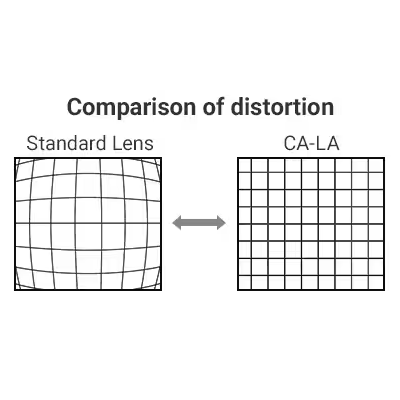
Table of Contents
- Standard Lens: Lower cost, wider field of view, noticeable barrel/pincushion distortion; reduces OCR accuracy and edge AI detection reliability, requires heavy software correction.
- Low Distortion Lens: Minimal geometric distortion (<1% typical), straight-line preservation, consistent edge-to-edge sharpness; boosts OCR accuracy by 5%–20% and stabilizes AI recognition, lowers computing load.
- For OCR & AI Vision: Low distortion lenses are strongly recommended for high-precision text reading, object detection, measurement, and industrial inspection.
- Selection Rule: Choose low distortion when accuracy >95% is needed; standard lenses work only for low‑precision, non‑critical applications.
Introduction
Choosing between Standard vs Low Distortion Lens directly determines the accuracy of OCR text extraction and AI visual recognition systems. Lens distortion causes geometric warping that confuses algorithms, degrades edge detail, and increases correction overhead. This article explains how distortion impacts recognition performance, compares key parameters, and helps you select the right lens for your machine vision, security, robotics, or scanning project.
What Are Standard & Low Distortion Lenses?
Standard Lens
A conventional optical lens designed for general imaging, balancing cost and field of view.
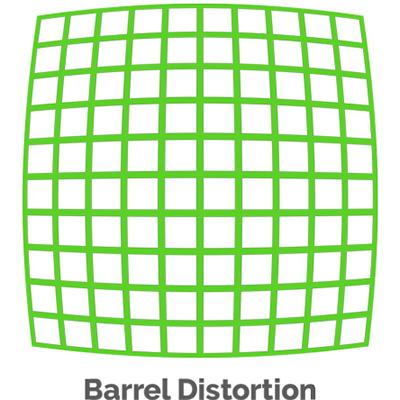
- Features noticeable barrel distortion (edges curve outward) or pincushion distortion (edges curve inward).
- Common in consumer cameras, basic webcams, and general-purpose CCTV.
- Lower cost and easier mass production.
Low Distortion Lens
An optimized precision lens with advanced optical design and coating to minimize geometric distortion.
- Distortion rate typically <1% (often <0.5%).
- Preserves straight lines and true proportions across the entire frame.
- Used in high‑precision OCR, metrology, industrial AI, and machine vision.
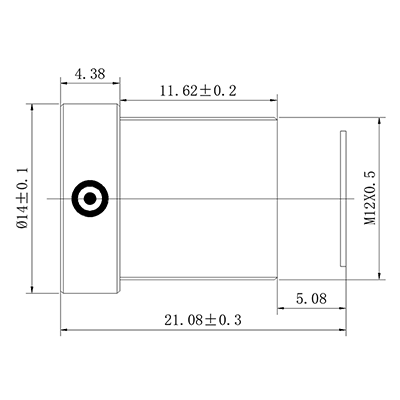
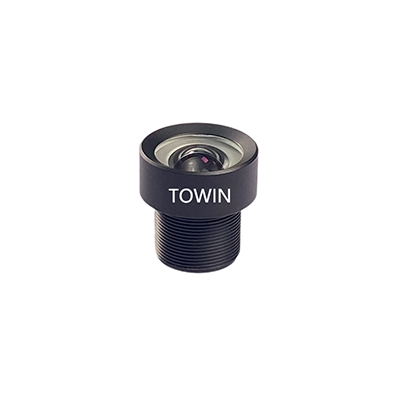
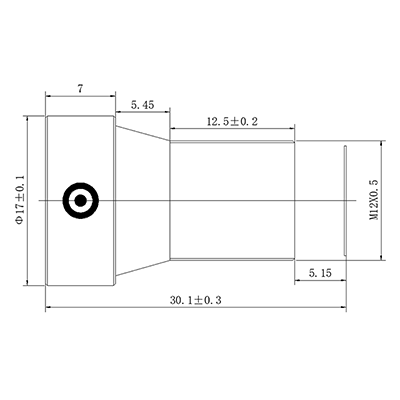
16mm Low-distortion 5-Megapixel CCTV lens
How Distortion Impacts OCR & AI Recognition
Negative Effects of Standard Lenses
- Character deformation: Straight text lines bend; characters stretch/squash, lowering OCR confidence.
- Edge performance collapse: Corners blur and warp, causing missed detections.
- Higher algorithm load: Software correction uses CPU/GPU and introduces errors.
- Inconsistent inference: AI models trained on undistorted data fail on warped inputs.
Benefits of Low Distortion Lenses
- True geometric reproduction: Text lines stay straight; shapes remain accurate.
- Uniform sharpness: Center and edges perform equally, critical for full‑frame scanning.
- Higher recognition stability: OCR word accuracy and AI detection precision improve significantly.
- Reduced computing cost: Less correction, faster inference, lower latency.
Standard vs Low Distortion Lens: Full Comparison
Table 1: Core Performance Comparison
| Parameter | Standard Lens | Low Distortion Lens | Impact on OCR & AI |
| Distortion Rate | 2%–10%+ | <0.5%–1% | Low distortion drastically reduces character/shape warping |
| OCR Accuracy | Medium–Low | High (↑5%–20%) | Directly improves character and word recognition rate |
| Edge Image Quality | Poor, blurred/warped | Excellent, consistent | Fixes missed detections at image corners |
| Geometric Fidelity | Low | High | Critical for measurement, positioning, and alignment |
| Software Correction | Heavy required | Light or none | Saves computing power and reduces error |
| Typical Cost | Lower | Moderate–Higher | Better total cost of ownership for high‑accuracy systems |
Table 2: Optical & Application Parameters
| Item | Standard Lens | Low Distortion Lens |
| Optical Design | Conventional lens groups | Optimized multi‑group, low‑dispersion glass |
| Coating | Standard coating | Multi‑broadband coating, IR correction available |
| Mount Types | M12, C/CS, generic | M12, C/CS, industrial machine vision mounts |
| Suitable Sensors | 1/4″–1/3″ | 1/4″–1/1.2″, large‑format industrial sensors |
| Main Applications | Consumer imaging, basic monitoring | OCR scanners, industrial AI, metrology, inspection |
Key Parameters to Evaluate Lenses for OCR & AI
- Distortion rate (%): The most critical index; target <1% for high accuracy.
- Relative illumination: Uniform brightness across the frame avoids dark edges.
- Resolution (MP): Match your sensor (5MP, 8MP, 12MP, 4K).
- MTF performance: High values at center and edges mean crisp detail.
- Wavelength range: Visible light or IR correction for day/night use.
- Mount: M12 (board lens), C/CS (industrial camera) compatibility.
Application Scenarios: Which Lens to Choose?
Choose Low Distortion Lens When
- High‑precision OCR: Document scanners, ticket readers, industrial code reading.
- AI vision detection: Defect inspection, part measurement, robot positioning.
- Security & surveillance: LPR, facial recognition, long‑distance identification.
- Machine vision: Measurement, alignment, high‑precision sorting.
Choose Standard Lens When
- Low‑accuracy monitoring: General indoor/outdoor CCTV.
- Consumer devices: Webcams, toy cameras, basic video.
- Budget‑constrained projects where accuracy is not critical.
Quick Selection Flowchart
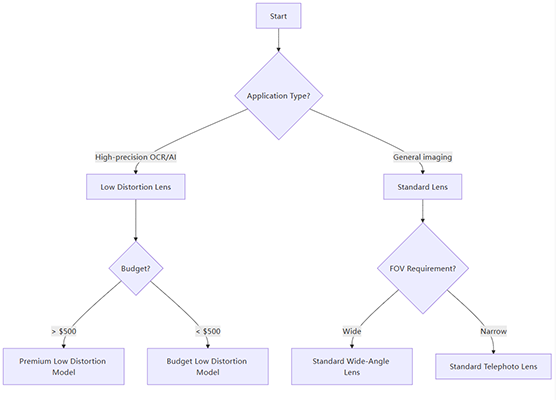
Quick Selection Flowchart
FAQs
Q1: Can software fully fix distortion from standard lenses?
Software can reduce distortion but cannot fully restore lost detail or eliminate warping errors, especially at edges. It also increases latency.
Q2: Are low distortion lenses compatible with M12/CS/C mounts?
Yes. Towin provides low distortion lenses in M12, C, CS mount for board cameras, industrial cameras, and security systems.
Q3: How much does low distortion improve OCR accuracy?
In real‑world tests, low distortion lenses typically improve word recognition rate by 5%–20% compared to standard wide‑angle lenses.
Q4: Do low distortion lenses work for day/night cameras?
Yes. Many models feature IR correction coating to maintain sharpness and low distortion under both visible and infrared light.
Conclusion
The choice between Standard vs Low Distortion Lens is critical for OCR and AI recognition accuracy. Standard lenses save cost but sacrifice precision and increase computing load. Low distortion lenses deliver stable, high‑accuracy results and lower long‑term system costs. For professional OCR, machine vision, and AI applications, low distortion lenses are the reliable choice.
Get Custom Optics from Towin
Towin is a professional optical lens manufacturer supplying low distortion lenses, M12 mount lenses, C/CS mount lenses, fisheye lenses, and industrial lenses for OCR, AI vision, security, and machine vision.
Get Custom Quote: info@towin-elec.com