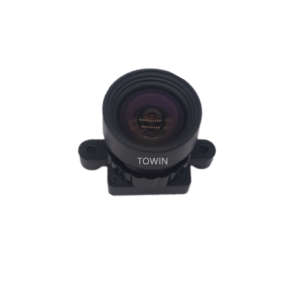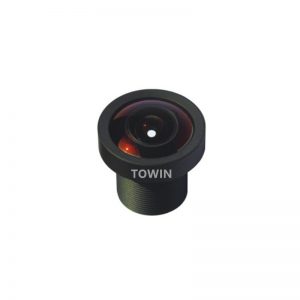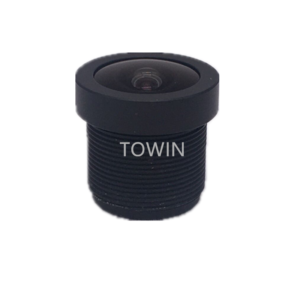



Fisheye Lens – CCL13012MPF
07/07/2025
Wide Angle Lens – CCL13018
07/09/2025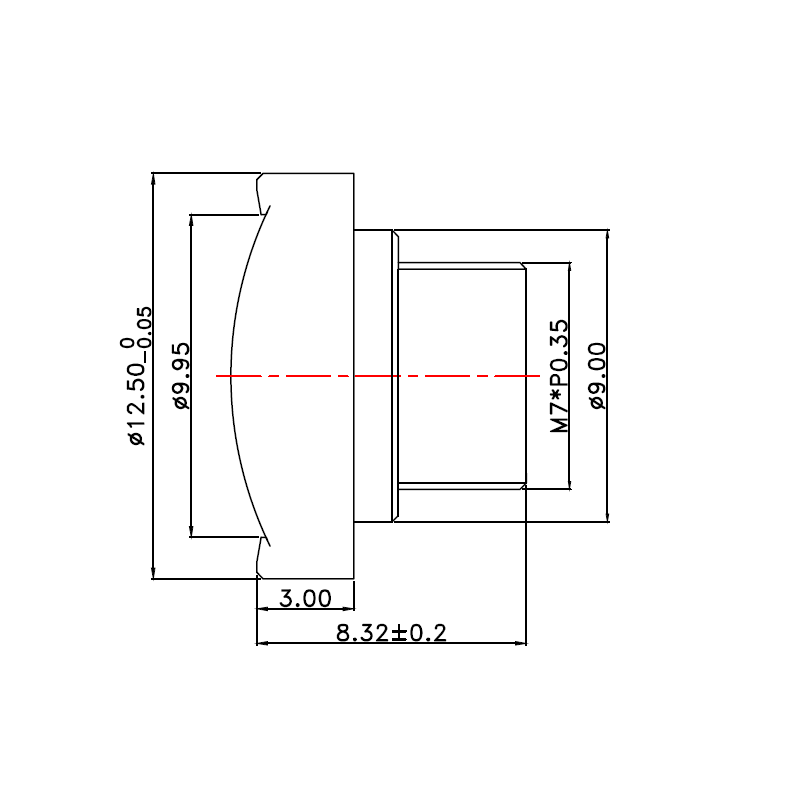
Wide Angle Lens – CCL13016MPF
This 1.6mm M7 fisheye lens provides 155° FOV, F2.0 aperture, 1/3″ sensor support, and a compact 10.9mm TTL for miniature panoramic and embedded vision systems.
CCL13016MPF is 1.6mm Wide angle CCTV MegaPixel lens with IR filter, 1/3″ format, 155° diagonal FOV, F2.0 aperture, M7X0.35 mount.
| IMAGE FORMAT | 1/3″ |
| FOCAL LENGTH | 1.6mm |
| F.O.V. | 155°(D) |
| 125°(H) | |
| 100°(V) | |
| RESOLUTION | MegaPixel |
| DISTORTION | <45% |
| APERTURE | F2.0 |
| MOUNT | M7X0.35 |
| IRIS | Fixed |
| FOCUS | Manual |
| ZOOM | Fixed |
| T.T.L. | 10.9mm |
| LENS COMPOMEMT | 2G2P+IR filter |
1.6mm M7 Wide Angle Miniature Lens
This 1.6mm M7 Wide Angle lens is designed for compact imaging systems that require extremely wide scene coverage from a miniature optical assembly. With a 155° diagonal FOV, 125° horizontal FOV, 100° vertical FOV, and M7×0.35 mount, it provides a space-efficient solution for panoramic, embedded, and spatial awareness imaging applications.
With its 1/3″ image format, 10.9mm TTL, and compact M7 interface, this M7 miniature lens is well suited to small camera modules where installation space is limited and maximum viewing coverage is required.
M7 Wide Angle Lens Core Highlights
- 155° Ultra-Wide FOV: Captures a very broad scene from a compact 1.6mm focal length.
- Miniature M7 Mount: M7×0.35 interface supports integration into space-constrained camera modules.
- F2.0 Aperture: Provides effective light transmission for compact imaging applications.
- Compact Optical Path: 10.9mm TTL helps reduce the overall optical assembly length.
- 2G2P + IR Filter: Provides a compact optical structure with infrared filtering for visible-light imaging.
M7 Wide Angle Lens Applications
Core Application Scenes
This 1.6mm M7 wide angle lens is designed for applications where camera size and viewing coverage are both critical. Its 155° diagonal FOV allows a single compact camera to observe a very large surrounding area, making it suitable for miniature panoramic cameras, embedded spatial-awareness modules, compact robotic vision devices, indoor monitoring equipment, and small-form-factor visual sensing systems.
The M7×0.35 mount and 10.9mm total optical length are particularly valuable for devices with restricted internal space. Unlike larger lens assemblies, this miniature configuration can be integrated into compact housings, embedded electronics, and small camera boards where optical volume must be carefully controlled.
The lens is also suitable for close-range wide-angle imaging, with its optical configuration supporting applications where objects or surrounding structures need to be captured from relatively short distances. However, the specified <45% distortion means it should be selected for applications prioritizing scene coverage rather than precision geometric measurement.
For applications involving Wide Angle image processing or distortion correction, engineers can refer to TOWIN’s Distortion Guide when evaluating whether the optical characteristics match their image-processing workflow.
Designed for miniature panoramic imaging, embedded spatial awareness, and ultra-wide close-range vision applications.
Compatible Device List
- Miniature Camera Modules: Suitable for compact camera boards where PCB space and optical height are restricted.
- Robotics Vision Devices: Provides broad environmental awareness for small robots and embedded robotic platforms.
- Panoramic Imaging Modules: The 155° diagonal FOV enables extensive scene capture from a single compact optical assembly.
- Embedded Monitoring Cameras: Suitable for small monitoring devices requiring broad coverage within a confined installation area.
- Smart IoT Vision Devices: The miniature M7 interface supports integration into compact connected imaging equipment.
- Compact Spatial Awareness Cameras: Useful for devices requiring broad visual information around the camera.
- OEM Miniature Camera Assemblies: The M7×0.35 mounting configuration provides a practical basis for customized small-form-factor camera designs.
Ultra-Wide FOV and Compact Optical Design
The lens is designed for a 1/3″ image format and provides 155° diagonal, 125° horizontal, and 100° vertical FOV. Its 1.6mm focal length enables exceptionally broad scene coverage while maintaining a miniature optical package.
The 10.9mm TTL is particularly useful when designing compact camera housings or embedded vision devices with limited optical space. Engineers can review the Sensor Guide when confirming the relationship between image format and usable field of view.
For applications requiring a specific viewing area, the FOV Calculator can also help estimate expected scene coverage before finalizing the camera configuration.
Frequently Asked Questions
Q: What type of lens is this?
A: This is a 1.6mm M7 wide angle lens designed for compact camera modules requiring extremely broad scene coverage and a miniature optical interface.
Q: What is the field of view of this M7 lens?
A: The lens provides 155° diagonal, 125° horizontal, and 100° vertical FOV when used with the specified 1/3″ image format.
Q: What sensor size is compatible with this lens?
A: The lens is specified for a 1/3″ image format. The final camera design should verify the sensor’s active image area and required field of view before integration.
Q: Is this a low distortion lens?
A: No. The specified optical distortion is below 45%, which is characteristic of a very wide-angle/fisheye design. This model is intended to maximize scene coverage rather than provide geometrically corrected imaging.
Q: Is this lens suitable for panoramic imaging?
A: Yes. Its 155° diagonal FOV makes it suitable for panoramic and ultra-wide scene capture where broad environmental coverage is more important than low distortion.
Q: What is the difference between an M7 lens and an M12 lens?
A: M7 and M12 refer to different mechanical mounting interfaces. An M7×0.35 lens uses a smaller mounting diameter and is generally better suited to miniature camera assemblies where available space is highly constrained.
Q: Is this lens IR corrected?
A: No. This model uses an IR filter, not an IR-corrected optical design. An IR filter controls infrared transmission, while an IR-corrected lens is optically designed to maintain focus across visible and near-infrared wavelengths.
Q: Can TOWIN customize this miniature M7 lens?
A: TOWIN can evaluate customized optical and mechanical requirements for OEM and ODM projects. Customers can contact TOWIN with their sensor, FOV, mechanical dimensions, and camera integration requirements.
Product Selection Reference
When selecting a 1.6mm M7 Wide Angle lens, designers should consider field of view, sensor format, optical distortion, installation space, and image-processing requirements together. This model prioritizes exceptionally broad scene coverage with a 155° diagonal FOV while maintaining a miniature 10.9mm TTL.
The M7×0.35 mount makes this lens particularly suitable for applications where a standard M12 lens may occupy too much mechanical space. Its 1.6mm focal length also provides much broader coverage than conventional miniature lenses with longer focal lengths.
For more information about miniature lens selection and optical parameters, visit the Lens Basics section.
For applications requiring customized focal length, FOV, sensor compatibility, or mechanical dimensions, contact TOWIN for an application-specific optical evaluation.
Online contact
| SENSOR | |
|---|---|
| E.F.L. | |
| H. F.O.V. | |
| RESOLUTION | |
| FNo. | |
| Max Dist. | |
| FEATURE | |
| MOUNT | |
| IRIS | |
| T.T.L.(mm) | |
| MARK |