


TOF Lens for Robotics: Choosing the Right Optical Solution for Autonomous Navigation
06/12/2026
What is a medical imaging lens?
06/13/2026
Medical Imaging systems demand exceptional image accuracy because even minor geometric errors can affect measurements, diagnostics, and AI-based analysis. Whether used in endoscopy, ophthalmology, dental imaging, microscopy, or laboratory diagnostics, imaging systems must capture anatomical structures as accurately as possible.
One of the most critical factors affecting image accuracy is optical distortion. A lens with excessive distortion can alter the shape, size, and position of objects within the image, potentially introducing measurement errors and reducing confidence in clinical evaluations.
As healthcare technology continues to advance, medical device manufacturers increasingly require high-performance optical solutions capable of delivering precise and reliable imaging results. This is why low-distortion lens design has become a key consideration in modern Medical Imaging Solutions.
What Is Optical Distortion?
Optical distortion is a lens aberration that causes straight lines in a scene to appear curved in the captured image. Unlike blur or focus-related issues, distortion affects geometric accuracy.
There are three primary types of distortion commonly encountered in imaging systems:
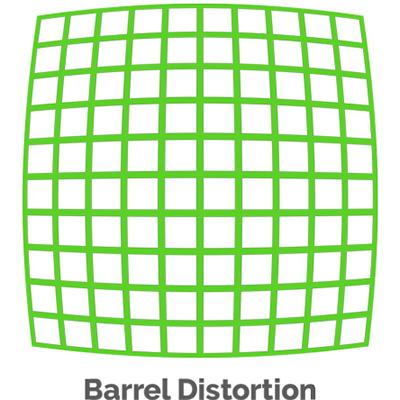
Barrel Distortion
Barrel distortion causes image magnification to decrease toward the edge of the frame. Straight lines appear to bulge outward from the center.
Pincushion Distortion
Pincushion distortion causes magnification to increase toward the image edges, making straight lines appear to bend inward.
Mustache Distortion
Mustache distortion combines both barrel and pincushion effects, creating a more complex geometric deformation that is often difficult to correct completely.
To learn more about distortion mechanisms, see our detailed guide on Optical Distortion.
Why Does Distortion Matter in Medical Imaging?
In consumer photography, moderate distortion may be acceptable. However, in medical environments, image accuracy directly influences diagnosis, treatment planning, and system performance.
1. Accurate Anatomical Representation
Medical professionals rely on imaging systems to visualize tissues, organs, blood vessels, and other anatomical structures. Distortion can alter perceived shapes and dimensions, potentially affecting interpretation.
Low-distortion lenses help preserve anatomical accuracy, enabling healthcare professionals to make more informed decisions.
2. Reliable Measurement and Quantification
Many imaging systems perform dimensional analysis, including:
- Tumor measurement
- Wound assessment
- Tissue inspection
- Dental alignment analysis
- Surgical planning
When distortion is present, measurement results may deviate from actual dimensions.
| Distortion Level | Measurement Reliability |
|---|---|
| <0.5% | Excellent |
| 0.5% – 1% | Good |
| Above 1% | May Require Correction |
3. Improved AI Diagnostic Accuracy
Artificial intelligence is increasingly used in medical image analysis. AI algorithms learn patterns based on image geometry and spatial relationships.
Distortion can negatively impact:
- Lesion detection
- Tumor segmentation
- Cell classification
- Anomaly recognition
- Image registration
By minimizing geometric errors, low-distortion optics help improve AI model consistency and reliability.
4. Better Image Stitching and Reconstruction
Applications such as endoscopy and digital pathology often require multiple images to be stitched together.
Low-distortion lenses simplify:
- Image alignment
- 3D reconstruction
- Panoramic imaging
- Digital pathology workflows
Medical Imaging Applications That Require Low Distortion Lenses
Endoscopy Systems
Endoscopes operate within confined spaces where accurate visualization is critical. Low distortion helps physicians assess tissue conditions more accurately.
Microscopy Imaging
Microscopy applications often involve cell counting, biological analysis, and dimensional measurements. Geometric precision is essential.
Ophthalmic Imaging
Retinal imaging and eye diagnostics require precise mapping of anatomical structures. Distortion may influence diagnostic interpretation.
Dental Imaging
Orthodontic planning, implant positioning, and oral diagnostics all benefit from geometrically accurate images.
Diagnostic Equipment
Medical cameras integrated into diagnostic instruments require low-distortion optics to ensure consistent and repeatable imaging performance.
Learn more about industry-specific requirements in our Medical Imaging Solutions page.
Low Distortion Lens vs Standard Lens
| Feature | Low Distortion Lens | Standard Lens |
|---|---|---|
| Geometric Accuracy | Excellent | Moderate |
| Measurement Reliability | High | Lower |
| AI Analysis Performance | Better | Less Consistent |
| Calibration Effort | Reduced | Higher |
| Medical Applications | Recommended | Limited |
How Much Distortion Is Acceptable in Medical Imaging?
The acceptable distortion level depends on the application and measurement requirements.
| Application | Recommended Distortion |
|---|---|
| Microscopy | <0.5% |
| Precision Measurement | <0.3% |
| Endoscopy | <1% |
| AI Diagnostics | <1% |
Factors affecting lens selection include sensor size, field of view, working distance, and imaging resolution.
How to Choose a Low Distortion Lens for Medical Imaging
Evaluate Distortion Specifications
Review lens datasheets carefully and look for distortion values below 1%. For precision applications, values below 0.5% are often preferred.
Match the Lens to the Sensor
Sensor compatibility directly influences image quality and coverage. Ensure the lens image circle adequately covers the intended sensor.
Related reading: Sensor Size Guide.
Select an Appropriate Focal Length
Focal length affects both field of view and distortion characteristics. Selecting the proper focal length is critical for maintaining image accuracy.
Related reading: Lens Focal Length Guide.
Consider Resolution Requirements
Medical cameras increasingly use high-resolution sensors. Lens resolution should match sensor capabilities to maximize image performance.
Assess Long-Term Stability
Medical devices often operate continuously for extended periods. Mechanical stability and optical consistency are essential for reliable operation.
Can Software Correct Lens Distortion?
Software correction can reduce visible distortion through calibration and image processing.
Advantages include:
- Lower hardware cost
- Flexible correction profiles
- Compatibility with existing systems
However, software correction also introduces limitations:
- Image cropping
- Reduced edge resolution
- Additional processing requirements
- Potential calibration drift
For high-precision medical applications, optical correction through low-distortion lens design is generally preferred over relying solely on software compensation.
Frequently Asked Questions
Q: What is considered a low-distortion medical lens?
A: Most medical applications consider distortion below 1% acceptable, while high-precision systems often require distortion below 0.5%.
Q: Can distortion affect diagnostic accuracy?
A: Yes. Distortion may alter object dimensions and spatial relationships, potentially impacting measurements and image interpretation.
Q: Why is low distortion important for AI medical imaging?
A: AI systems rely on accurate geometric information. Distortion can introduce inconsistencies that affect model performance.
Q: Can software completely eliminate distortion?
A: Software can significantly reduce distortion, but optical correction remains the preferred approach for applications requiring maximum accuracy.
Q: Are low-distortion lenses more expensive?
A: They may involve more advanced optical design and manufacturing processes, but the benefits often outweigh the additional cost in medical environments.
Towin Low-Distortion Lens Solutions for Medical Imaging
Towin develops high-performance optical solutions designed for demanding imaging applications.
Key advantages include:
- Low-distortion optical design
- High-resolution image quality
- Wide sensor compatibility
- Custom lens development
- OEM and ODM support
- Long-term product stability
Explore our complete Medical Imaging Solutions portfolio or Contact Towin to discuss your project requirements.
Conclusion
As healthcare technologies become increasingly dependent on digital imaging, geometric accuracy is more important than ever. Optical distortion can affect measurements, AI-assisted diagnostics, image reconstruction, and overall system reliability.
By selecting a high-quality low-distortion lens, medical device manufacturers can improve imaging precision, reduce calibration complexity, and enhance clinical confidence. Whether developing endoscopy systems, microscopy platforms, ophthalmic devices, or AI-powered diagnostic equipment, investing in advanced optical design delivers measurable benefits throughout the imaging workflow.
For organizations seeking reliable optical solutions, Towin provides customized lens technologies engineered to meet the demanding requirements of modern Medical Imaging.