


How Optical Distortion Affects AI Vision Accuracy
06/03/2026
What Lenses Are Used in Endoscope Systems?
06/05/2026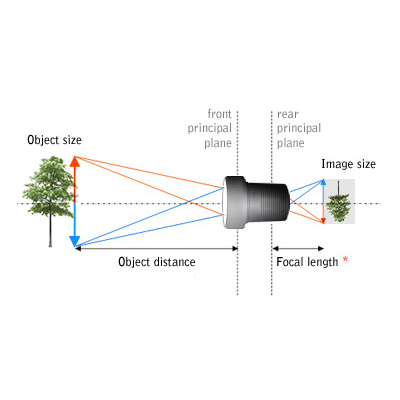
Understanding Focal Length in Machine Vision Systems
Focal Length in Machine Vision is one of the most important parameters when designing an industrial imaging system. It directly affects the field of view, image magnification, working distance, and overall inspection accuracy.
Whether you are building an automated inspection system, robotic guidance application, intelligent traffic monitoring solution, or medical imaging device, selecting the correct focal length helps ensure that the camera captures the required target area with sufficient detail and precision.
A misunderstanding of focal length can result in images that are either too wide to capture important details or too narrow to cover the entire object being inspected. Therefore, understanding how focal length works is essential for engineers, system integrators, and machine vision professionals.
In this guide, we will explain what focal length is, how it affects image formation, how it relates to field of view and sensor size, and how to choose the right industrial lens for your application.
What Is Focal Length?
Focal length is the distance between the optical center of a lens and the image sensor when the lens is focused at infinity. It is typically measured in millimeters (mm).
In practical machine vision applications, focal length determines how much of a scene the camera can see and how large objects appear within the captured image.
A shorter focal length provides a wider viewing angle and captures a larger area. A longer focal length provides a narrower viewing angle and increases image magnification.
The following examples illustrate the general relationship:
| Focal Length | Viewing Angle | Typical Result |
|---|---|---|
| 4 mm | Very Wide | Large coverage area |
| 8 mm | Wide | General inspection |
| 16 mm | Medium | Balanced imaging |
| 25 mm | Narrow | Greater detail |
| 50 mm | Very Narrow | Long-distance inspection |
How Focal Length Affects Field of View
Field of View (FOV) refers to the observable area captured by the camera and lens system.
One of the most important principles in machine vision is:
- Shorter focal length = Larger field of view
- Longer focal length = Smaller field of view
For example, a 4 mm lens may capture an entire production line, while a 50 mm lens may only capture a small section of a product but reveal significantly more detail.
When designing an imaging system, focal length and field of view must always be considered together. Engineers typically determine the required field of view first and then calculate the appropriate focal length based on sensor size and working distance.
For a more detailed explanation of field of view calculations, users can explore the Towin FOV Calculator and related Lens Basics resources.
Focal Length and Image Magnification
Magnification describes how large an object appears on the image sensor.
As focal length increases, objects occupy more pixels on the sensor, making fine details easier to inspect.
This relationship is particularly important in applications such as:
- Semiconductor inspection
- PCB inspection
- Precision measurement
- Surface defect detection
- Barcode and code reading
For example, a 50 mm lens may reveal tiny defects that would be difficult to detect with an 8 mm lens.
However, increased magnification usually comes at the cost of a smaller field of view, making proper lens selection critical.
Focal Length and Working Distance
Working distance is the physical distance between the lens and the target object.
For the same target size:
- Short focal length lenses generally require the camera to be positioned closer to the object.
- Long focal length lenses allow the camera to be positioned farther away.
This characteristic makes longer focal lengths suitable for applications where space constraints prevent the camera from being installed near the target.
Examples include:
Industrial robots often require a balance between working distance and field of view to ensure accurate positioning and guidance.
Intelligent Traffic Systems
Traffic cameras frequently use longer focal lengths to identify vehicles and license plates from significant distances.
Factory Automation
Production lines may require different focal lengths depending on installation space and inspection requirements.
Common Focal Lengths Used in Machine Vision
The following focal lengths are commonly used in industrial imaging systems:
| Focal Length | Typical Applications |
|---|---|
| 4 mm | Security and wide-area monitoring |
| 6 mm | Mobile robots and AGVs |
| 8 mm | Factory automation |
| 12 mm | General machine vision inspection |
| 16 mm | Measurement systems |
| 25 mm | Long-distance inspection |
| 35 mm | Traffic monitoring |
| 50 mm | High-precision imaging |
The optimal choice depends on sensor size, field of view requirements, working distance, and desired image resolution.
How to Choose the Right Focal Length
Selecting the correct focal length involves several steps.
Step 1: Determine Sensor Size
Sensor dimensions significantly influence the final field of view. Larger sensors capture wider scenes when paired with the same focal length.
Step 2: Define the Required Field of View
Determine the exact area that must be captured for inspection or measurement.
Step 3: Measure Working Distance
Measure the available distance between the camera installation point and the target object.
Step 4: Estimate the Required Focal Length
A simplified estimation formula is:
f=\frac{WD\times Sensor\ Size}{FOV}
This formula provides a useful starting point for machine vision system design.
Step 5: Select the Appropriate Industrial Lens
Machine Vision Lens Selection Guide
After determining the focal length, choose a lens that matches the sensor format, resolution requirements, and environmental conditions.
Recommended Industrial Lens Types
Different applications may require different lens designs.
Suitable for:
- Machine vision inspection
- Factory automation
- Robotics vision
Suitable for:
- Metrology
- Measurement systems
- AOI inspection
Telecentric Lens
Suitable for:
- Precision measurement
- Semiconductor inspection
- Dimensional verification
Common Focal Length Selection Mistakes
Many imaging issues result from incorrect focal length selection.
Common mistakes include:
Ignoring Sensor Size
The same focal length produces different fields of view when paired with different sensor sizes.
Focusing Only on Working Distance
Working distance alone is not enough to determine the correct lens.
Overlooking Future System Expansion
Future product changes may require a larger field of view or additional inspection coverage.
Using Wide-Angle Lenses for Precision Measurement
Wide-angle lenses often introduce distortion that can reduce measurement accuracy.
Related Lens Parameters You Should Understand
Focal length is only one component of a complete lens selection process.
To build a better understanding of industrial imaging systems, it is also important to learn about:
- Field of View (FOV)
- Sensor Size
- Lens Distortion
- Aperture
- Resolution
- Working Distance
These topics are covered throughout the Towin Lens Basics Knowledge Center.
Frequently Asked Questions
What is focal length in machine vision?
Focal length is the distance between the lens optical center and the image sensor when focused at infinity. It determines field of view and image magnification.
How does focal length affect field of view?
A shorter focal length produces a wider field of view, while a longer focal length produces a narrower field of view.
Does a longer focal length increase magnification?
Yes. Longer focal lengths make objects appear larger on the image sensor and provide more detail.
How do I calculate focal length?
Focal length is typically calculated using sensor size, field of view, and working distance. Lens calculators are commonly used for accurate results.
What focal length is best for machine vision?
There is no universal answer. The best focal length depends on the application requirements, target size, working distance, and sensor dimensions.
Conclusion
Selecting the correct lens begins with understanding Focal Length in Machine Vision.
Focal length determines how much of a scene can be captured, how large objects appear in the image, and how far the camera can be positioned from the target. By understanding the relationship between focal length, field of view, sensor size, and working distance, engineers can design more efficient and accurate imaging systems.
Before selecting an industrial lens, evaluate your application requirements carefully and use a field of view calculator whenever possible. A well-chosen focal length improves image quality, inspection accuracy, and overall system performance.
Ultimately, mastering Focal Length in Machine Vision is a fundamental step toward building reliable and high-performance machine vision solutions.
Explore Towin Industrial Lens Solutions