


Fisheye lenses and usage tips
06/23/2025
CCTV lens for video surveillance
06/24/2025
Choosing the best lens to avoid distortion is essential for applications where image geometry, dimensional accuracy, and reliable object recognition matter. In industrial imaging, even small amounts of optical distortion can affect measurement results, object positioning, and automated inspection performance.
A low distortion lens is often the preferred choice for machine vision inspection, precision measurement, PCB inspection, and industrial automation. However, the best lens depends on several factors, including sensor size, focal length, field of view (FOV), working distance, and the required measurement accuracy.
This guide explains how to choose a low distortion industrial lens, compares different optical solutions, and highlights the key specifications engineers should evaluate before selecting a lens for a machine vision system.
For industrial applications, the goal is not necessarily to find a completely distortion-free lens, but to select an optical solution with sufficiently low geometric distortion for the intended imaging task.
Quick Answer: What Is the Best Lens to Avoid Distortion?
For most industrial imaging applications, a dedicated low distortion fixed focal lens is a practical choice. For high-precision dimensional measurement, a telecentric lens may be more suitable because it helps control magnification changes caused by object height variations. The correct choice depends on the required accuracy, field of view, working distance, and camera specifications.
1. What Is a Low Distortion Lens?
A low distortion lens is an optical lens designed to minimize geometric deformation in an image. It helps preserve the shape, relative position, and proportions of objects so that straight lines and measured dimensions remain closer to their actual geometry.
In industrial imaging, lens distortion is particularly important because machine vision systems often rely on accurate image coordinates to perform dimensional measurement, object positioning, defect detection, and automated inspection.
Unlike image blur, which reduces sharpness and detail, geometric distortion changes the spatial relationship between image points. An image may appear sharp while still containing significant distortion.
Common Types of Lens Distortion
Barrel Distortion
Straight lines near the image edges curve outward. This type of distortion is frequently associated with wide-angle optical designs.
Pincushion Distortion
Straight lines curve inward toward the center of the image, creating a pincushion-like appearance.
Mustache Distortion
A more complex distortion pattern combining barrel-like and pincushion-like deformation across different image regions.
Understanding these distortion patterns helps engineers determine whether an optical design, camera calibration, or a combination of both is needed.
For a more detailed explanation, read our industrial lens distortion guide.
2. Why Lens Distortion Matters in Machine Vision
In machine vision systems, image geometry directly affects how software interprets the position, shape, and dimensions of objects. When distortion is not properly controlled, an inspection system may produce inaccurate measurements even when the image appears visually clear.
Precision Dimensional Measurement
Industrial measurement systems use image coordinates to calculate object dimensions, distances, and geometric tolerances. Distortion can introduce position-dependent measurement errors, especially when objects are located near the edges of the image.
A low distortion lens helps maintain more consistent geometric relationships across the image field.
PCB and Electronic Component Inspection
PCB inspection requires reliable imaging of small components, solder joints, circuit traces, and mounting positions. Geometric distortion can affect component location measurements and alignment between inspection regions.
Low distortion optics can improve the consistency of image coordinates used in automated inspection.
Barcode and OCR Recognition
Geometric deformation may affect the apparent shape and spacing of printed characters, labels, and barcode elements. A properly selected industrial lens helps maintain image geometry and supports reliable recognition.
Robotics and Automated Positioning
Robotic vision systems use image information to locate objects and determine their positions. Lower geometric distortion can improve the consistency of image-based positioning, although camera calibration and system geometry remain important.
Explore our machine vision lens solutions for industrial inspection, robotics, and automated imaging applications.
3. What Type of Lens Is Best for Minimizing Distortion?
Different optical designs provide different advantages. The best low distortion lens depends on the imaging task, required accuracy, working distance, and mechanical installation conditions.
| Lens Type | Main Advantage | Typical Application |
|---|---|---|
| Low Distortion Fixed Focal Lens | Controls geometric distortion while providing a fixed field of view. | Machine vision inspection and industrial imaging. |
| Telecentric Lens | Helps maintain consistent magnification when object height varies within the design range. | Precision measurement and metrology. |
| Low Distortion Wide-Angle Lens | Provides a wider field of view while controlling geometric distortion. | Large-area inspection and compact imaging systems. |
Low Distortion Fixed Focal Lenses
A low distortion fixed focal lens is a practical option for many machine vision applications. Its fixed focal length provides a consistent optical configuration, making it suitable for inspection systems with defined working distances and fields of view.
When selecting this type of lens, engineers should evaluate distortion percentage, resolution, sensor compatibility, focal length, and edge-to-edge image performance.
It is particularly useful for industrial inspection, automated measurement, and applications where image geometry needs to remain consistent.
Telecentric Lenses for Precision Measurement
Telecentric lenses use specialized optical designs to reduce perspective-related magnification changes. In object-space telecentric systems, the chief rays are approximately parallel to the optical axis within the designed object space.
This makes telecentric optics particularly useful when measuring components with varying heights or when dimensional consistency is critical.
However, telecentric lenses generally have specific working distance, field of view, and mechanical requirements. They are not automatically the best choice for every industrial imaging application.
Low Distortion Wide-Angle Lenses
Wide-angle lenses capture a larger area without requiring a long camera-to-object distance. However, wide-angle optical designs can introduce stronger geometric distortion if not properly corrected.
For applications requiring a large field of view, engineers should compare the distortion specification across the entire image field rather than selecting a lens based on viewing angle alone.
4. Key Parameters for Selecting a Low Distortion Industrial Lens
Selecting a suitable low distortion industrial lens requires evaluating several optical and mechanical parameters together. A lens with low distortion may still be unsuitable if its image circle, resolution, or focal length does not match the camera system.
1. Distortion Percentage
Distortion percentage is one of the most important specifications when selecting a low distortion lens.
It describes the geometric deviation between the actual image position and the ideal image position under a specified measurement convention. The exact definition and measurement method should be confirmed when comparing different manufacturers.
For example, a lens with a maximum distortion of 0.4% may be suitable for certain inspection applications, while more demanding metrology tasks may require a lower value or a telecentric optical design.
Always check whether the quoted distortion represents maximum distortion across the full image field and whether the specification is measured optically or after digital correction.
2. Sensor Size and Image Circle
The lens image circle must adequately cover the camera sensor. If the image circle is too small, the image may show vignetting, dark corners, or incomplete coverage.
Common industrial sensor formats include 1/3″, 1/2″, 1/1.8″, 2/3″, and 1″. The correct lens should be selected according to the actual sensor format and optical image circle.
Learn more about compatibility in our industrial camera sensor guide.
3. Focal Length and Field of View
Focal length determines the relationship between the sensor size, working distance, and field of view. A shorter focal length generally provides a wider viewing angle, while a longer focal length provides a narrower viewing angle under comparable conditions.
Engineers should calculate the required field of view before selecting a lens. Choosing a focal length based only on the desired viewing angle may lead to insufficient object coverage or unsuitable image resolution.
Use our field of view calculator to estimate the imaging area based on sensor size, focal length, and working distance.
4. Resolution and MTF Performance
Resolution determines how much fine detail a lens can reproduce. A high-resolution sensor cannot deliver its full potential if the lens does not provide sufficient optical resolving power.
For industrial inspection, engineers should consider sensor pixel size, lens resolving power, and MTF performance across the image field.
Good edge-to-edge performance is particularly important when measurement or defect detection takes place near the image boundaries.
5. Working Distance
Working distance is the distance between the front of the lens and the target object, according to the specified measurement convention.
It affects the required focal length, magnification, field of view, and mechanical installation. Engineers should confirm the available mounting space before selecting a lens.
6. Lens Mount and Mechanical Compatibility
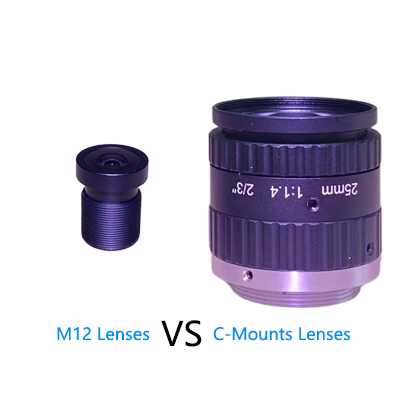
Lens mount compatibility is essential for reliable system integration. M12, C-Mount, and CS-Mount lenses are used in different types of industrial cameras and embedded imaging systems.
Check the mount thread, flange distance, sensor coverage, back focal requirements, and mechanical dimensions before installation.
5. How to Choose a Low Distortion Industrial Lens
Choosing the right low distortion lens requires a systematic evaluation of the application rather than focusing on a single optical specification.
Step 1. Define the Inspection Application
Determine whether the system is used for dimensional measurement, defect detection, PCB inspection, object positioning, or barcode recognition. Different tasks require different levels of geometric accuracy.
Step 2. Confirm Camera Sensor Specifications
Identify the sensor format, resolution, and pixel size. Ensure the selected lens provides sufficient image circle coverage and optical resolving power.
Step 3. Determine Field of View and Working Distance
Measure the target object and the available camera installation distance. Calculate the required field of view before deciding on focal length.
Step 4. Set the Required Distortion Limit
Define the maximum acceptable geometric distortion according to the application’s measurement tolerance and calibration requirements.
Step 5. Compare Optical Performance
Evaluate distortion, MTF, resolution, relative illumination, and edge image quality. Do not choose a lens based on distortion percentage alone.
Step 6. Validate the Lens in the Actual System
Test the selected lens with the target camera, lighting, working distance, and inspection object. Use calibration where necessary to verify actual measurement accuracy.
For a more comprehensive selection process, see our machine vision lens selection guide.
6. Industrial Applications of Low Distortion Lenses
Low distortion lenses are used in various industrial imaging applications where geometric accuracy, image consistency, and reliable inspection results are important.
PCB and Electronic Component Inspection
Electronic manufacturing requires accurate inspection of PCB layouts, solder joints, connectors, and small components. Low distortion optics help maintain consistent geometric relationships for component positioning and measurement.
Automated Optical Inspection
Automated optical inspection systems analyze product images to identify defects, verify assembly quality, and check component positions. Suitable low distortion lenses support reliable image-based measurements and inspection consistency.
Robotics Vision and Object Positioning
Robotic systems use cameras to locate objects, recognize features, and guide picking or positioning operations. Low distortion optics can help improve geometric consistency across the captured image.
Precision Measurement and Metrology
Dimensional measurement applications require accurate relationships between image coordinates and physical dimensions. Depending on the required tolerance and object geometry, low distortion or telecentric optics may be appropriate.
Industrial Quality Control
Manufacturing inspection systems use optical imaging to check product dimensions, alignment, surface conditions, and assembly quality. Proper lens selection helps improve image consistency and reduce measurement uncertainty.
Discover how these optical requirements are addressed in our machine vision solutions for industrial inspection.
7. TOWIN Low Distortion Lens Solutions
TOWIN provides industrial optical lens options for machine vision, automated inspection, and embedded imaging applications. Our low distortion lens range includes different focal lengths, sensor formats, and optical configurations to support various imaging requirements.
When evaluating a low distortion lens, engineers should compare the actual specifications of each model, including:
- Maximum optical distortion
- Effective focal length (EFL)
- Compatible sensor size
- Supported image resolution
- Horizontal and diagonal field of view
- F-number and illumination requirements
- Mechanical dimensions and lens mount
Different models are designed for different imaging conditions. A lens with a wider field of view may have different distortion characteristics from a lens with a narrower field of view. Therefore, selecting the correct model requires comparing the complete optical specification rather than relying on the product category name alone.
Explore TOWIN Low Distortion Lenses
Compare available industrial lens models, focal lengths, sensor compatibility, and maximum distortion specifications to identify a suitable solution for your machine vision application.
For projects with specific imaging requirements, TOWIN can also help evaluate lens parameters and optical compatibility. Contact our team with your camera sensor, field of view, working distance, and distortion requirements.
8. Frequently Asked Questions About Low Distortion Lenses
Q1: What is the best lens to avoid distortion?
A: A dedicated low distortion lens is generally a practical choice for industrial imaging applications. For precision dimensional measurement, a telecentric lens may be more suitable when object height variations affect measurement accuracy. The best option depends on the application and required optical performance.
Q2: Are there lenses with zero distortion?
A: In practical optical systems, completely zero distortion is difficult to achieve across the entire image field. Most industrial lenses are designed to minimize distortion to a specified level. The acceptable distortion depends on the measurement tolerance and imaging requirements.
Q3: What is considered a low distortion lens?
A: A low distortion lens is designed to minimize geometric image deformation. There is no single universal threshold for every application. Engineers should compare the specified maximum distortion with the required measurement accuracy and system calibration capability.
Q4: Are telecentric lenses better than low distortion lenses?
A: Not necessarily. Telecentric lenses are particularly useful for precision measurement when changes in object height could affect magnification. Conventional low distortion lenses are often more practical for general industrial inspection. The correct choice depends on the optical and mechanical requirements.
Q5: Does focal length affect lens distortion?
A: Focal length influences field of view and optical design, which can affect distortion characteristics. However, focal length alone does not determine distortion. The complete optical design and measured distortion specification should be evaluated.
Q6: Can software correct lens distortion?
A: Yes. Camera calibration and distortion correction algorithms can compensate for predictable geometric distortion. However, software correction cannot recover all lost optical information and may reduce usable image coverage near the edges. Selecting an appropriate optical lens remains important, especially for precision measurement.
Q7: How do I select a low distortion lens for machine vision?
A: Start by confirming the camera sensor size, resolution, required field of view, and working distance. Then compare lens distortion, MTF performance, focal length, image circle, and mechanical compatibility. Finally, validate the selected lens in the actual imaging system.
Q8: How can barrel distortion be reduced?
A: Barrel distortion can be reduced by selecting an optical design with suitable distortion correction and by applying camera calibration when necessary. The best approach depends on the required field of view and measurement accuracy. Read our guide on how to reduce barrel distortion for more details.
Conclusion: Choose the Right Low Distortion Lens for Your Application
Selecting the best lens to avoid distortion requires more than choosing a lens with the lowest advertised distortion percentage. Engineers must consider sensor size, focal length, field of view, working distance, resolution, and the required measurement accuracy together.
For general machine vision inspection, a low distortion fixed focal lens can provide a practical optical solution. For precision metrology and applications involving object height variations, telecentric optics may offer additional advantages.
The right low distortion lens helps improve geometric consistency, support reliable inspection, and achieve more accurate industrial imaging results.
Looking for a Low Distortion Industrial Lens?
Share your camera sensor size, focal length requirements, working distance, field of view, and target distortion level. TOWIN can help you evaluate suitable industrial lens options for your machine vision project.