

What Is the Difference Between C-Mount and CS-Mount?
06/25/2026
How Do I Reduce Image Glare?
06/26/2026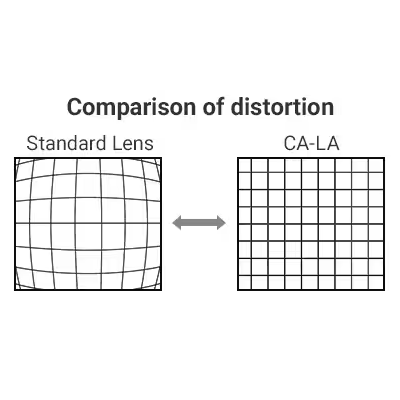
Lens Distortion is one of the most important optical characteristics affecting image quality and measurement accuracy in industrial vision systems. Whether used in machine vision inspection, robotics, ADAS, medical imaging, or smart security applications, distortion directly influences how accurately a camera reproduces the real world.
Straight lines may appear curved, objects near the image edge may stretch, and dimensional measurements can become inaccurate if distortion is not properly controlled. While some distortion is unavoidable due to optical physics, understanding its causes allows engineers to select the right industrial lens and optimize overall imaging performance.
This guide explains what causes lens distortion, the different distortion types, how distortion impacts industrial imaging systems, and how to reduce it through proper lens selection and optical design.
If you are new to industrial optics, we recommend first reading Lens Basics, which introduces the fundamental concepts of focal length, field of view, sensor compatibility, and industrial imaging systems.
What Is Lens Distortion?
Lens Distortion is an optical phenomenon where a lens fails to reproduce straight lines accurately. Instead of maintaining the original geometry of an object, the optical system bends or warps image edges, causing visible shape deformation.
Unlike image blur or focus errors, distortion does not necessarily reduce sharpness. Instead, it changes the spatial relationship between objects and pixels, making precise measurement more difficult.
For consumer photography, slight distortion is often acceptable or even unnoticed. However, in industrial applications such as automated inspection or robot navigation, even small distortion values can significantly reduce positioning accuracy.
Modern industrial optics therefore prioritize low distortion designs that preserve image geometry while maintaining high resolution across the entire sensor.
Why Does Lens Distortion Occur?
Lens distortion is primarily caused by the physical limitations of optical design. Light rays entering different areas of a lens travel through multiple glass elements before reaching the image sensor. Because these rays do not always converge perfectly, geometric deformation occurs.
Several optical parameters contribute to distortion, including focal length, field of view, sensor size, lens structure, and manufacturing precision.
1. Lens Optical Design
Every camera lens contains multiple optical elements designed to focus light efficiently. These elements must balance numerous optical characteristics including resolution, chromatic aberration, illumination, and distortion.
Wide-angle designs typically require stronger curved elements to achieve larger viewing angles. Although these elements increase coverage, they also introduce greater geometric distortion.
Modern aspherical lenses significantly reduce distortion compared with traditional spherical optics, making them popular choices for machine vision and industrial inspection.
2. Focal Length
F.l. is one of the biggest factors influencing lens distortion.
| Focal Length | Typical Field of View | Distortion Level |
|---|---|---|
| 2.8 mm | Ultra Wide | High |
| 4 mm | Wide | Medium |
| 8 mm | Standard | Low |
| 12 mm | Narrow | Very Low |
| 25 mm+ | Telephoto | Minimal |
Generally speaking, shorter focal lengths produce larger viewing angles but introduce more noticeable barrel distortion. Longer focal lengths provide more natural image geometry and lower distortion.
To better understand focal length selection, visit our Lens Selection Guide.
3. Field of View (FOV)
A larger field of view requires incoming light rays to travel through more extreme angles inside the optical system. These rays become increasingly difficult to project accurately onto a flat image sensor, resulting in edge distortion.
This explains why ultra-wide surveillance cameras or action cameras often display obvious barrel distortion near image borders.
When designing industrial systems, engineers should balance coverage requirements with measurement accuracy.
Calculate the appropriate viewing angle using the FOV Calculator.
4. Sensor Size Compatibility
Lens distortion is also influenced by sensor size compatibility.
A lens optimized for one sensor format may produce increased distortion or reduced edge quality when paired with a larger sensor.
Proper matching between image circle and sensor dimensions helps maintain consistent image geometry across the entire frame.
Learn more about sensor compatibility in our Sensor Guide.
5. Manufacturing Precision
Industrial lenses are manufactured with tighter tolerances than consumer lenses. High precision polishing, accurate optical alignment, and advanced coating technologies minimize distortion while improving overall image consistency.
Low-cost lenses often prioritize affordability over geometric accuracy, making them unsuitable for precision inspection applications.
Common Types of Lens Distortion
Lens distortion is generally classified into three primary categories.
| Distortion Type | Appearance | Typical Applications |
|---|---|---|
| Barrel Distortion | Straight lines curve outward | Wide-angle cameras |
| Pincushion Distortion | Straight lines curve inward | Telephoto optics |
| Mustache Distortion | Mixed barrel and pincushion | Complex optical systems |
Barrel Distortion
Barrel distortion is the most common type found in industrial wide-angle lenses.
Objects near image edges appear stretched outward, causing square objects to appear rounded. This effect increases as field of view expands.
Machine vision systems requiring dimensional measurement often specify low distortion lenses with values below 1% or even below 0.5%.

Barrel Distortion
Pincushion Distortion
Pincushion distortion causes image edges to bend inward toward the center.
This distortion typically appears in longer focal length optics where magnification increases near image boundaries.
Although less common in industrial cameras, pincushion distortion still affects precision positioning and image stitching applications.

Pincushion Distortion
Mustache Distortion
Mustache distortion combines both barrel and pincushion distortion characteristics.
The image first curves outward and then inward, creating a complex wave-shaped geometry that is more difficult to correct using software calibration.
High-end industrial optical systems often use advanced aspherical elements to minimize this effect.

Mustache Distortion
How Lens Distortion Affects Industrial Vision Systems
The impact of Lens Distortion extends far beyond visual appearance. In industrial automation, AI imaging, and intelligent inspection, geometric accuracy directly determines system reliability.
Machine Vision Inspection
Machine vision systems rely on accurate pixel-to-distance conversion for dimensional measurement.
Distortion introduces measurement errors, especially near image boundaries, reducing inspection consistency and repeatability.
Explore related industrial applications: Machine Vision Solutions.
Robotics Vision
Robot navigation systems depend on accurate environmental perception.
If lens distortion changes object geometry, localization algorithms may generate incorrect spatial coordinates, affecting motion planning and navigation accuracy.
Learn more: Robotics Vision Solutions.
ADAS and Autonomous Driving
Advanced driver assistance systems continuously estimate lane positions, pedestrian locations, and obstacle distances.
Poor geometric accuracy caused by lens distortion can reduce object detection reliability, making low distortion optics an essential component of automotive imaging systems.
Discover: ADAS Camera Lens Solutions.
How Is Lens Distortion Measured?
Understanding the amount of Lens Distortion is just as important as understanding its causes. In industrial vision systems, distortion is typically expressed as a percentage that indicates how much an image deviates from its ideal geometric representation.
The lower the distortion value, the more accurately straight lines and object dimensions are preserved. High-precision machine vision systems often require distortion values below 1%, while metrology and semiconductor inspection applications may require values below 0.1%.
| Measurement Method | Description | Typical Application |
|---|---|---|
| Grid Chart Test | Analyzes straight-line deviation | Machine Vision Calibration |
| Software Calibration | Corrects image geometry mathematically | AI Vision Systems |
| MTF Analysis | Evaluates optical performance and distortion | Optical Laboratory Testing |
| Checkerboard Calibration | Measures pixel displacement | Robotics & 3D Vision |
Although software calibration can compensate for distortion, selecting a high-quality industrial lens with inherently low distortion always produces more reliable and repeatable imaging results.
How to Reduce Lens Distortion
Completely eliminating distortion is nearly impossible because every optical system has physical limitations. However, engineers can significantly reduce distortion through proper lens selection and system optimization.
Choose a Low Distortion Lens
Industrial low distortion lenses use optimized optical structures and precision manufacturing processes to minimize geometric errors while maintaining high resolution across the entire image.
Select the Appropriate Focal Length
Ultra-wide-angle lenses naturally produce greater barrel distortion. Choosing a slightly longer focal length often improves geometric accuracy without sacrificing imaging performance.
Match the Sensor Size
A properly matched sensor and image circle reduce edge deformation and improve overall image consistency.
Optimize Working Distance
Working distance affects magnification and viewing angle, both of which influence perceived distortion. Proper optical configuration helps maintain consistent measurement accuracy.
Perform Camera Calibration
Calibration software removes residual distortion through mathematical correction, making it especially useful for machine vision and robotics applications.
Lens Selection Guide for Different Industrial Applications
Different industrial environments require different levels of distortion control. Selecting the right lens depends on imaging accuracy, field of view, sensor size, and environmental requirements.
| Application | Recommended Lens Type | Priority |
|---|---|---|
| Machine Vision Inspection | Low Distortion FA Lens | ★★★★★ |
| Robotics Vision | M12 Industrial Lens | ★★★★★ |
| ADAS Cameras | Wide Angle Low Distortion Lens | ★★★★★ |
| Medical Imaging | High Resolution Lens | ★★★★☆ |
| Smart Security | IR Corrected Lens | ★★★★☆ |
| Drone Imaging | Lightweight M12 Lens | ★★★★☆ |
If your application requires precise dimensional measurement or AI-based object detection, low distortion performance should always be one of the highest priorities during lens selection.
Industrial Applications Where Low Lens Distortion Matters
Machine Vision Inspection
Automated inspection systems measure dimensions, detect defects, and verify assembly quality. Even small distortion values may produce measurement errors across thousands of inspection cycles.
Learn more about Machine Vision Lens Solutions.
Medical Imaging
Medical cameras require consistent geometry to assist image interpretation and diagnostic accuracy. Low distortion optics improve imaging reliability and reduce visual artifacts.
Related solution: Medical Imaging Solutions.
Smart Security
Wide-angle security cameras often experience barrel distortion. Modern low distortion optics improve facial recognition accuracy and object tracking performance.
Related solution: Smart Security Solutions.
Drone Imaging
Aerial mapping and surveying require accurate image geometry for stitching and measurement. Distortion correction improves mapping precision and reduces processing errors.
Related solution: Drone Imaging Solutions.
Related Knowledge Resources
To better understand industrial optics, we recommend exploring the following technical resources:
Frequently Asked Questions
Q: What causes Lens Distortion?
A: Lens distortion is caused by optical design limitations, focal length, field of view, sensor compatibility, and manufacturing precision that alter the geometric projection of light onto an image sensor.
Q: Why do wide-angle lenses have more distortion?
A: Wide-angle lenses bend incoming light at larger angles, making it more difficult to maintain straight-line geometry across the entire image.
Q: Can Lens Distortion be completely eliminated?
A: No. Every optical system has some level of distortion, but high-quality industrial lenses and calibration software can reduce it significantly.
Q: What is barrel distortion?
A: Barrel distortion causes straight lines to curve outward and is commonly found in wide-angle lenses.
Q: What is pincushion distortion?
A: Pincushion distortion bends image edges inward and typically appears in telephoto optical systems.
Q: Does Lens Distortion affect AI vision systems?
A: Yes. Distortion changes object geometry and spatial relationships, reducing positioning accuracy and measurement consistency.
Q: How is Lens Distortion measured?
A: It is typically measured using grid charts, checkerboard calibration, MTF testing, or software calibration algorithms.
Q: Which industrial applications require low distortion lenses?
A: Machine vision inspection, robotics, ADAS, medical imaging, drone mapping, and intelligent security systems all benefit from low distortion optics.
Conclusion
Understanding Lens Distortion is essential for designing reliable industrial imaging systems. Distortion originates from optical structure, focal length, field of view, sensor compatibility, and manufacturing precision, all of which influence image geometry and measurement accuracy.
By selecting an appropriate industrial lens, matching the correct sensor size, optimizing focal length, and performing proper calibration, engineers can significantly improve imaging performance and reduce geometric errors.
Whether developing machine vision inspection equipment, robotics platforms, ADAS cameras, medical imaging devices, or smart security systems, choosing a low distortion optical solution provides better accuracy, higher reliability, and improved AI vision performance.
Explore additional resources through our Lens Basics, Lens Selection Guide, and Distortion Guide to build a deeper understanding of industrial optical imaging.