


How Does Resolution Influence Lens Choice?
07/06/2026
Does Focal Length Affect Distortion?
07/08/2026
What causes lens distortion is a common question in industrial imaging and machine vision applications. Lens distortion occurs when an optical system cannot perfectly reproduce the geometry of a real object onto the camera sensor. As a result, straight lines may appear curved, object dimensions may change, and image accuracy can be reduced.
In consumer photography, distortion may only affect image appearance. However, in industrial vision systems, distortion can directly impact measurement accuracy, object recognition, camera calibration, and automated inspection reliability.
Understanding the causes of lens distortion helps engineers select suitable optical components, improve imaging performance, and choose the right lens solution for demanding applications.
For a complete overview of distortion types, measurement methods, and correction techniques, visit our Optical Distortion Guide .
What Is Lens Distortion?
Lens distortion is an optical phenomenon where the position of objects in an image changes compared with their actual geometric location. Unlike image blur, distortion does not reduce sharpness directly. Instead, it changes the shape, size, and position of objects within the image.
A theoretically perfect lens should project a three-dimensional scene onto a flat image sensor without changing object geometry. However, real optical systems contain multiple lens elements, and light rays passing through different areas of the lens may not converge perfectly.
This optical limitation creates geometric errors, which are commonly known as lens distortion.
In machine vision applications, even small amounts of distortion can cause inaccurate measurements. This is especially important in applications such as precision inspection, robotics guidance, and automated quality control.
What Causes Lens Distortion?
What causes lens distortion is usually related to several factors, including optical design limitations, lens structure, focal length, sensor matching, and manufacturing tolerance.
1. Optical Design Limitations
Every lens system has optical limitations. Light rays entering different parts of the lens may travel through different optical paths, making it difficult to achieve perfect projection.
Advanced optical design techniques are used to minimize these errors through:
- Optimized lens element arrangement
- Aspherical optical elements
- Specialized glass materials
- Precision optical simulation
- Advanced coating technologies
Learn more about how optical engineering affects lens performance in our Optical Design Guide .
2. Lens Element Structure
The number, shape, and arrangement of lens elements strongly influence distortion performance.
Wide-angle lenses usually require stronger optical correction because they capture a larger field of view. Without proper correction, image edges may experience stronger geometric deformation.
3. Focal Length and Field of View
Focal length is one of the most important factors affecting distortion. Short focal length lenses typically provide wider viewing angles but may introduce greater distortion, especially near image edges.
Before selecting a lens, engineers should evaluate the relationship between focal length, sensor size, and field of view.
Use our FOV Calculator to estimate imaging coverage and select a suitable lens configuration.
4. Sensor Size Compatibility
Lens and sensor matching is another important factor. If a lens does not properly support the camera sensor size, edge performance may decrease and distortion may become more noticeable.
A correct sensor-lens combination ensures that the entire image area receives consistent optical performance.
Read our Image Sensor Guide to understand sensor formats and lens compatibility.
Common Types of Lens Distortion
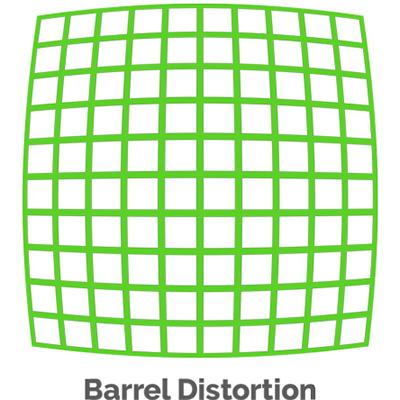
Different optical designs create different distortion patterns. The most common types include barrel distortion, pincushion distortion, and mustache distortion.
| Distortion Type | Main Cause | Image Effect |
|---|---|---|
| Barrel Distortion | Wide-angle optical design | Straight lines bend outward |
| Pincushion Distortion | Telephoto optical design | Straight lines bend inward |
| Mustache Distortion | Combination of multiple optical errors | Complex geometric deformation |
Perspective distortion should be separated from optical distortion because it is mainly caused by camera position and viewing angle rather than lens design.
How Lens Distortion Affects Machine Vision Applications
Lens distortion can significantly influence industrial imaging accuracy. Different industries have different distortion requirements depending on their inspection objectives.
Machine Vision Inspection
In automated inspection systems, distortion can create measurement errors and reduce defect detection accuracy.
Learn more about industrial imaging solutions: Machine Vision Solutions .
Robotics Vision
Robots rely on accurate image information for positioning and navigation. Excessive distortion can affect object localization and movement accuracy.
Explore: Robotics Vision Solutions .
Medical Imaging
Medical imaging systems require accurate geometric representation because image distortion may affect analysis and measurement results.
Learn more: Medical Imaging Solutions .
Smart Security
Security cameras with wide viewing angles require distortion control to maintain accurate object recognition.
Explore: Smart Security Solutions .
Lens Parameters That Influence Distortion
| Parameter | Effect on Distortion |
|---|---|
| Focal Length | Short focal lengths usually create stronger edge distortion. |
| Field of View | Wider FOV increases distortion correction requirements. |
| Sensor Size | Incorrect matching may reduce image accuracy. |
| Optical Design | Advanced lens structures improve distortion control. |
Choosing the right parameters is an important part of the lens selection process. Follow our Lens Selection Guide for a complete selection workflow.
How to Reduce or Correct Lens Distortion
There are two common approaches to reducing distortion: optical correction and software correction.
Optical Correction
- Uses optimized lens structures
- Maintains image resolution
- Provides higher measurement accuracy
- Suitable for precision machine vision applications
Software Correction
- Uses calibration algorithms
- Can compensate existing distortion
- Requires additional processing
- May reduce image quality after correction
How to Choose a Low Distortion Lens
Selecting a low distortion lens requires evaluating application requirements, sensor compatibility, field of view, and accuracy expectations.
- Define your imaging application
- Select the appropriate sensor size
- Calculate required field of view
- Determine acceptable distortion level
- Select a suitable lens design
For precision applications, engineers often choose Low Distortion Lens solutions to improve measurement accuracy and image reliability.
Frequently Asked Questions
Q: What causes lens distortion?
A: Lens distortion is caused by optical design limitations, lens element structure, focal length, sensor matching, and projection errors inside the optical system.
Q: Does lens quality affect distortion?
A: Yes. Higher quality optical designs usually provide better distortion correction, but all lenses have some level of optical limitations.
Q: How does distortion affect machine vision?
A: Distortion can reduce measurement accuracy, affect object recognition, and increase calibration complexity.
Q: What lens has the lowest distortion?
A: Telecentric lenses and specialized low distortion lenses usually provide the highest geometric accuracy.
Q: Can software remove lens distortion?
A: Software correction can compensate distortion, but optical correction is preferred for precision industrial applications.
Conclusion
Lens distortion is an important factor in industrial imaging performance. Optical design, focal length, sensor size, and lens selection all influence how accurately a lens reproduces real-world objects.
For machine vision systems that require precise measurement and reliable image analysis, choosing the correct optical solution is essential. Understanding what causes lens distortion helps engineers select better lenses and achieve higher imaging accuracy.
Need Help Choosing a Low Distortion Lens?
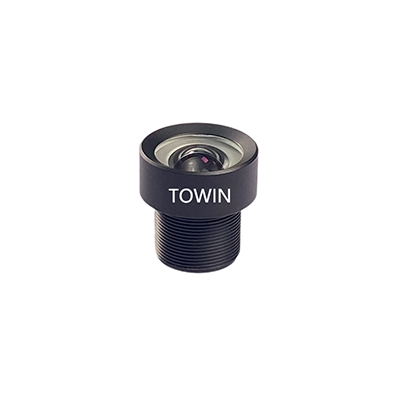
TOWIN provides industrial optical lens solutions including low distortion lenses, M12 lenses, FA lenses, and customized optical designs for machine vision applications.
Contact our optical engineers for:
- Sensor and lens matching
- FOV evaluation
- Distortion analysis
- Custom optical design support