


How to Choose a Lens for a 1/1.8-Inch Sensor
10/09/2026
What Camera Lens Do I Need for Machine Vision? The answer depends on your application, camera sensor size, required field of view (FOV), working distance, resolution, and acceptable image distortion. Choosing the right lens means balancing these parameters rather than selecting a lens based on focal length or megapixel rating alone.
For example, a lens used for PCB inspection may need high resolution and low distortion, while a robotics vision system may prioritize a wide field of view, compact dimensions, and reliable object positioning. A camera used for dimensional measurement may require tighter geometric accuracy than a camera used for general monitoring.
This guide explains how to choose an industrial camera lens step by step, compare common lens types, calculate an initial focal length, and identify the information needed before selecting a specific model.
If you are new to industrial optics, start with the TOWIN Lens Basics Guide before moving on to the selection process.
Quick Answer: How Do I Choose a Machine Vision Lens?
To select the right machine vision lens, begin with the imaging task and the camera you plan to use. Determine the required FOV and working distance, confirm the sensor size, estimate the focal length, and then check resolution, distortion, aperture, mount, and environmental requirements.
Use this practical selection sequence:
- Application: Define what the camera needs to inspect, measure, recognize, or locate.
- Sensor size: Confirm the camera sensor format and active dimensions.
- Field of view: Determine the area that must appear in the image.
- Working distance: Measure the distance between the lens and the target.
- Focal length: Estimate the focal length required for the desired coverage.
- Resolution: Check whether the lens can resolve the required object details.
- Distortion: Define how accurately the system must reproduce object geometry.
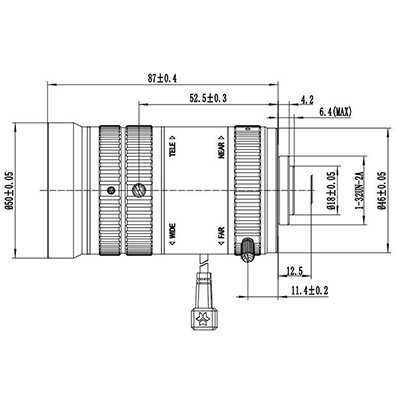
- Mechanical fit: Confirm the mount, lens dimensions, and installation constraints.
For a more detailed selection workflow, see the Machine Vision Lens Selection Guide.
What Factors Determine Which Camera Lens You Need?
Several optical and mechanical parameters determine whether a lens will work correctly in a machine vision system. These factors are interconnected, so they should be evaluated together.
| Parameter | Question to Ask | Why It Matters |
|---|---|---|
| Sensor Size | What sensor format does the camera use? | Determines image-circle compatibility and affects FOV. |
| Field of View | How much of the target must be visible? | Defines the required imaging coverage. |
| Working Distance | How far is the camera from the object? | Constrains focal length and installation geometry. |
| Focal Length | What focal length provides the required coverage? | Works with sensor size and working distance to determine FOV. |
| Resolution | What is the smallest feature that must be detected? | Determines the required imaging detail. |
| Distortion | Does the application require accurate dimensions or coordinates? | Influences geometric measurement and positioning accuracy. |
| Aperture | How much light is available, and what depth of field is needed? | Affects exposure, depth of field, and image quality. |
| Lens Mount | What mechanical interface does the camera support? | Ensures compatibility with the camera assembly. |
Use the Sensor Guide to understand sensor formats and the relationship between camera sensors and lens compatibility.
Step 1: Define Your Machine Vision Application
Before comparing lenses, identify the task the imaging system must perform. Different applications have different optical priorities.
| Application | Primary Lens Requirements |
|---|---|
| PCB Inspection | High resolution, appropriate FOV, consistent image quality |
| Dimensional Measurement | Low distortion, suitable resolution, reliable calibration |
| Robotics Vision | FOV, working distance, object localization, compact integration |
| OCR and Code Reading | Readable detail, suitable working distance, adequate lighting |
| Factory Automation | Sensor compatibility, resolution, repeatable imaging |
| Smart Traffic | Target distance, field coverage, aperture, environmental conditions |
| Embedded Vision | Compact size, low weight, suitable sensor coverage |
A lens optimized for one application is not automatically the best choice for another. For example, a very wide-angle lens may be useful when a robot must observe a large area, but a dimensional inspection system may need a narrower field of view and better geometric control.
Explore TOWIN Machine Vision Solutions to learn more about lens requirements for industrial inspection and automation.
Step 2: Match the Lens to the Camera Sensor
Sensor compatibility is one of the first technical requirements to verify when choosing a machine vision lens.
The lens must provide an image circle that covers the camera sensor. If the image circle is too small, the image may show dark corners or incomplete coverage. A lens that covers a larger sensor may also work on a smaller sensor, provided the optical, mechanical, and imaging requirements are satisfied.
Common industrial camera sensor formats include 1/2.8-inch, 1/2-inch, 2/3-inch, 1-inch, 1.1-inch, and 4/3-inch formats. These format labels are nominal classifications; actual sensor dimensions should be checked in the camera datasheet.
When matching a lens to a sensor, verify:
- Sensor format and active dimensions
- Lens image-circle coverage
- Required horizontal and vertical FOV
- Resolution and pixel size
- Image quality across the full sensor area
Do not assume that a lens suitable for one sensor format will produce the same FOV or edge performance on another sensor.
For more details, read the TOWIN Sensor Guide.
Step 3: Determine the Required Field of View
Field of view describes the width and height of the real-world area captured by the camera. It is one of the most important parameters in machine vision lens selection.
For example, an inspection camera may need to capture an entire 120 mm-wide component, while a close-up inspection system may only need to image a small defect area. These two applications may require different focal lengths and optical configurations.
To determine the required FOV:
- Measure the width and height of the target area.
- Add enough margin to account for positioning variation and the inspection process.
- Confirm the camera sensor dimensions.
- Use the working distance to estimate the required focal length.
- Verify that the selected lens covers the target area without unwanted cropping.
You can use the TOWIN FOV Calculator to estimate field of view from sensor size, focal length, and working distance.
Remember that the required FOV should be large enough to capture the target but not unnecessarily large if doing so reduces the image detail available for inspection.
Step 4: Determine the Working Distance
Working distance is the distance from the lens to the object being imaged. It affects focal length selection and determines whether the camera can be installed in the available space.
In industrial equipment, working distance may be constrained by conveyor height, robot movement, safety enclosures, lighting, or the physical dimensions of the inspection station.
Consider two systems that need to capture the same 200 mm-wide area. One camera may be installed 300 mm from the object, while another must be installed 600 mm away. The two systems may require different focal lengths to achieve the same coverage.
Before choosing a lens, document:
- Minimum and maximum working distance
- Available space for the camera and lens
- Required FOV at the installation distance
- Possible movement of the target or camera
- Lighting and enclosure constraints
Working distance should be considered alongside sensor size and FOV, not as an isolated specification.
Step 5: Choose the Appropriate Focal Length
Focal length helps determine how much of a scene the camera captures. With the same sensor size and working distance, a shorter focal length generally provides a wider FOV, while a longer focal length provides a narrower FOV.
For an initial estimate, a simplified thin-lens approximation for object coverage is:
f ≈ (S × WD) / W
Where:
- f = approximate focal length
- S = active sensor dimension corresponding to the coverage being calculated
- WD = working distance
- W = required object coverage in the same direction
For example, suppose a camera has an active sensor width of 7.2 mm, the working distance is 500 mm, and the required horizontal coverage is 250 mm.
f ≈ (7.2 × 500) / 250 = 14.4 mm
This gives an approximate starting point, not a guaranteed final lens specification. The actual result depends on optical geometry, focusing distance, lens design, and the camera’s effective sensor dimensions.
Use the TOWIN Focal Length Calculator to estimate a focal length for your imaging configuration.
The final lens must still be checked for sensor coverage, distortion, resolution, aperture, and mechanical compatibility.
Step 6: Match Lens Resolution to Camera Resolution
Camera megapixel rating is an important consideration, but it does not tell you everything about image quality. The lens must resolve enough detail for the camera and application to meet the required performance.
For example, an inspection system that must detect a very small surface defect may require more resolving power than a system that only needs to determine whether a large object is present.
When evaluating resolution, consider:
- Camera megapixel rating and pixel size
- Minimum feature size that must be detected
- Object coverage and resulting pixels per unit length
- Lens resolution across the image field
- Lighting, focus, motion, and image-processing requirements
A high-megapixel camera cannot compensate for insufficient optical resolution. Likewise, a high-resolution lens cannot overcome inadequate lighting or a poorly designed inspection setup.
Choose a lens that meets the actual detail requirements of the application rather than selecting it by megapixel rating alone.
Step 7: Determine Whether You Need a Low Distortion Lens
Lens distortion changes the geometric relationship between the object and its image. It becomes especially important when the vision system measures dimensions, determines precise coordinates, or compares object geometry across the image.
For general presence detection, moderate distortion may be acceptable. For precision inspection, PCB measurement, or dimensional metrology, lower distortion may be necessary.
When assessing distortion, check:
- The maximum distortion specified in the lens datasheet
- The application’s allowable measurement error
- Distortion near the center and edges of the image
- The calibration method and measurement workflow
- Whether a conventional lens or telecentric system is more appropriate
There is no single distortion percentage that is suitable for every machine vision application. The required value depends on the measurement tolerance and complete optical system.
Read the TOWIN Lens Distortion Guide for more information about distortion types, evaluation, and correction.
If geometric accuracy is a major requirement, explore the Low Distortion Lens range.
Step 8: Select the Right Aperture and Depth of Field
Aperture affects how much light reaches the sensor and influences depth of field. The appropriate aperture depends on illumination, exposure time, working distance, target depth, and the image detail required.
A lower F-number generally allows more light to reach the sensor, but it does not automatically provide the best overall image quality. Depth of field and optical performance must also be considered.
For machine vision systems with targets at different heights or depths, sufficient depth of field may be essential to keep relevant features in focus.
Check the following before choosing the aperture:
- Available illumination
- Required exposure time
- Target depth variation
- Required image sharpness
- Lens performance at the intended aperture
For systems operating under changing light conditions, also consider whether a fixed iris or adjustable iris is more suitable.
Which Machine Vision Lens Type Should You Choose?
After defining the optical requirements, compare the available lens types. Mount type, optical design, and lens function are different selection dimensions, so they should not be treated as mutually exclusive categories.
| Lens Type | Typical Use | Important Considerations |
|---|---|---|
| M12 / S-Mount | Compact cameras and embedded vision systems | Size, sensor coverage, FOV, and optical performance |
| C-Mount | Industrial cameras and factory automation | Sensor format, resolution, working distance, and lens specifications |
| CS-Mount | Compatible industrial or security camera systems | Mechanical interface and required optical performance |
| Low Distortion Lens | Measurement and geometry-sensitive inspection | Distortion specification, resolution, and calibration |
| Fixed Focal Length Lens | Systems with a stable imaging configuration | Correct focal length and installation distance |
| Varifocal or Zoom Lens | Applications requiring adjustable framing or focal length | Adjustment range, optical quality, and mechanical constraints |
M12 Lenses for Compact Machine Vision
M12 lenses are compact, threaded lenses commonly used in board-level cameras and embedded vision systems. They can be suitable when installation space, size, and weight are important.
However, M12 is a mount format rather than a guarantee of optical performance. Resolution, distortion, sensor compatibility, and FOV must still be verified for the selected model.
Explore the TOWIN M12 Lens range for compact imaging applications.
C-Mount Lenses for Industrial Imaging
C-Mount lenses are widely used in industrial cameras and machine vision systems. They offer a broad range of focal lengths and optical configurations, making them useful for many factory automation and inspection applications.
When choosing a C-Mount lens, verify the sensor format, image circle, resolution, distortion, aperture, and required working distance. The mount must also match the camera’s mechanical interface.
Browse TOWIN C-Mount Lenses to compare options for industrial imaging.
When Should You Choose a Low Distortion Lens?
Consider a low distortion lens when the system needs accurate object dimensions, stable geometric relationships, or precise positioning from image data.
For less demanding applications, a standard industrial lens may already provide sufficient performance. The best choice depends on the application requirements, not simply on the product category name.
For demanding dimensional measurement, a telecentric lens may also be worth evaluating because telecentric optical designs are intended to reduce perspective-related magnification changes. Whether one is necessary depends on the measurement setup and accuracy target.
How to Choose a Lens for Different Machine Vision Applications
PCB and Electronics Inspection
PCB inspection often requires the system to resolve small components, solder joints, markings, and surface defects. Choose a lens based on the smallest feature that must be detected, the target area, sensor size, and required working distance.
Low distortion may be important when the system also measures component positions or dimensions. Resolution, lighting, and focus must be evaluated together.
Dimensional Measurement
Dimensional measurement requires careful control of image geometry. Determine the allowable measurement error first, then select a lens with suitable distortion performance, resolution, and image coverage.
Calibration and mechanical stability also affect the final result. For very demanding measurement tasks, evaluate whether a telecentric system is more appropriate than a conventional lens.
Robotics Vision
Robotics applications may require the camera to identify objects, estimate their positions, guide a robot arm, or navigate around obstacles. The required FOV, working distance, image detail, and physical camera placement are therefore important.
Compact M12 lenses may be suitable for space-constrained systems, while other configurations may be needed for longer working distances or different sensor formats.
Learn more about TOWIN Robotics Vision Solutions.
Factory Automation and General Inspection
Automated inspection systems commonly balance FOV, resolution, exposure, distortion, and cycle time. The lens should provide enough detail for the inspection algorithm while covering the required object area.
Explore TOWIN Machine Vision Solutions for industrial imaging applications.
Smart Traffic and Long-Distance Imaging
Traffic monitoring and intelligent transportation systems may require a lens to image targets at a relatively long distance. FOV, focal length, aperture, sensor performance, and environmental conditions all influence the selection.
Explore TOWIN Smart Traffic Solutions for application-specific optical considerations.
Common Mistakes When Choosing a Machine Vision Lens
1. Choosing a Lens Based Only on Focal Length
Focal length alone does not determine whether a lens will work. Sensor size, FOV, working distance, resolution, and image-circle compatibility must also be checked.
2. Assuming More Megapixels Always Means Better Results
A high-resolution camera needs suitable optics, correct focus, appropriate lighting, and enough pixels on the target feature. The camera’s megapixel rating alone does not guarantee successful inspection.
3. Ignoring Distortion
Distortion may have little impact on some detection tasks but can significantly affect dimensional measurement and precise positioning. Match the distortion requirement to the application.
4. Ignoring Working Distance and Installation Space
A lens that provides the correct FOV in theory may not fit the available mechanical space. Confirm the camera position, lens dimensions, target movement, and lighting arrangement before final selection.
5. Selecting a Lens Without Testing the Application
Optical specifications provide a starting point, but real-world performance also depends on the camera, lighting, mounting stability, and image-processing method. Whenever possible, validate the selected lens using representative samples and the actual inspection setup.
What Information Should You Prepare Before Selecting a Lens?
Preparing a concise set of application parameters makes lens selection more efficient and reduces the risk of choosing an unsuitable model.
| Information | Example or Description |
|---|---|
| Application | PCB inspection, dimensional measurement, robotics, OCR |
| Camera Model | Camera manufacturer and model, if already selected |
| Sensor Size | Actual sensor format and dimensions |
| Camera Resolution | Megapixel rating and pixel size, if available |
| Required FOV | Target area width and height |
| Working Distance | Distance from the lens to the target |
| Required Detail | Smallest feature that must be detected or measured |
| Distortion Requirement | Required geometric accuracy or measurement tolerance |
| Environment | Lighting, temperature, dust, moisture, and vibration |
| Mechanical Constraints | Mount type, available space, and maximum lens dimensions |
Once these details are available, the candidate lens range can be narrowed down more systematically.
Frequently Asked Questions
Q1: What camera lens do I need for machine vision?
A: Choose a lens based on your application, sensor size, FOV, working distance, resolution, distortion requirements, and camera mount. Start by defining the target area and required image detail, then calculate the initial focal length and verify the optical specifications.
Q2: How do I choose the right focal length for a machine vision camera?
A: Determine the active sensor dimensions, required FOV, and working distance. Use these values to estimate the focal length, then confirm the result against the actual lens datasheet and imaging configuration.
Q3: How does sensor size affect lens selection?
A: Sensor size affects the FOV produced by a given focal length and determines the image-circle coverage required from the lens. Always verify the actual sensor dimensions and lens compatibility before selecting a model.
Q4: How do I calculate the field of view of a machine vision lens?
A: FOV depends on sensor dimensions, focal length, and object distance. You can estimate the coverage using a suitable optical calculation tool, then verify it against the lens datasheet or a practical test.
Use the TOWIN FOV Calculator to begin your calculation.
Q5: What is the difference between M12 and C-Mount lenses?
A: M12 lenses use a compact threaded mount commonly found in embedded and board-level cameras. C-Mount lenses are widely used in industrial cameras. Neither mount automatically guarantees better image quality; the appropriate choice depends on camera compatibility, optical requirements, and installation constraints.
Q6: Do I need a low distortion lens for machine vision?
A: A low distortion lens is worth considering when geometric accuracy matters, particularly for dimensional measurement, precision inspection, and coordinate-based positioning. For general detection tasks, a standard lens may be sufficient if its performance meets the application requirements.
Q7: How do I match lens resolution to camera resolution?
A: Consider camera pixel size, the smallest target feature, lens resolving power, and the required inspection accuracy. A high-megapixel camera needs optics and an imaging setup capable of delivering the necessary detail.
Q8: What information should I provide when requesting a lens recommendation?
A: Provide the application, camera model, sensor size, required FOV, working distance, resolution, minimum feature size, distortion tolerance, environmental conditions, and mechanical constraints. Photos, drawings, or sample images can also help clarify the imaging requirements.
Conclusion: Find the Right Lens for Your Machine Vision System
What Camera Lens Do I Need for Machine Vision? The right choice is the lens that matches your application, sensor, FOV, working distance, resolution, distortion tolerance, and mechanical constraints.
Follow this selection sequence:
Application → Sensor Size → FOV → Working Distance → Focal Length → Resolution → Distortion → Aperture → Mount → Validation
Use the TOWIN Lens Selection Guide to review the full process, the FOV Calculator to estimate coverage, and the Focal Length Calculator to estimate the focal length required by your setup.
You can then compare available M12 Lenses, C-Mount Lenses, and CS-Mount Lenses based on your camera and application requirements.
If you need assistance identifying a suitable optical configuration, contact TOWIN with your sensor size, required FOV, working distance, resolution, and application details.
Ultimately, answering What Camera Lens Do I Need for Machine Vision requires evaluating the complete imaging system—not just choosing a focal length or a megapixel rating. A systematic selection process helps you identify a lens that meets your optical, mechanical, and application requirements.