

Security CCTV camera lens debugging method (II)
02/27/2020The home security market cannot be underestimated
03/01/2020Choosing the right CCTV lens focal length is essential for achieving the required field of view, monitoring distance, and image coverage. A lens with a shorter focal length captures a wider scene, while a longer focal length provides a narrower view of a more distant subject.
However, selecting a CCTV lens is not simply a matter of choosing between 2.8mm, 4mm, or 12mm. The image sensor size, installation distance, horizontal field of view (HFOV), and monitoring requirements must also be considered.
In this guide, we explain how to choose CCTV lens focal length, compare 2.8mm vs 4mm lenses, understand the relationship between focal length and viewing angle, and calculate the field of view for different monitoring distances.
Quick Answer:
- 2.8mm lens: Generally suitable for wide-area monitoring, indoor spaces, and entrances.
- 4mm lens: Provides a narrower view for more concentrated coverage.
- 6mm–8mm lens: Suitable for applications requiring a more focused field of view.
- 12mm lens: Provides a narrower viewing angle for more distant or specific monitoring areas.
- 2.8–12mm varifocal lens: Allows focal length adjustment when the required field of view needs to be fine-tuned.
Actual viewing angles depend on sensor dimensions and lens optical design.
1. What Is CCTV Lens Focal Length?
CCTV lens focal length is the distance, measured in millimeters (mm), from the lens’s principal plane to the image plane when the lens is focused at infinity. It is one of the most important optical specifications affecting the camera’s field of view.
In general, focal length determines how much of a scene a camera can capture when the sensor size and camera position remain unchanged.
- Short focal length: Captures a wider field of view and covers a larger area.
- Long focal length: Captures a narrower field of view and makes distant subjects occupy more of the image.
For example, a 2.8mm CCTV lens generally captures a wider scene than a 4mm lens when both are used with the same image sensor.
However, focal length alone cannot determine the exact viewing angle. Sensor dimensions must also be considered.
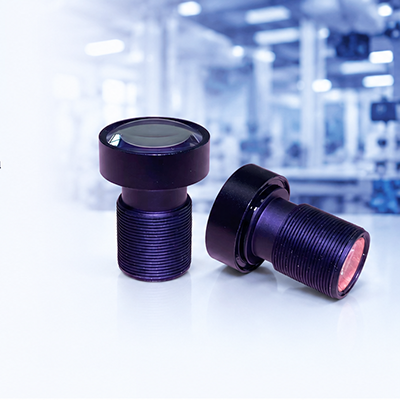
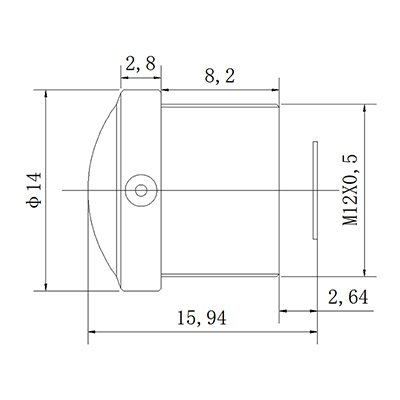
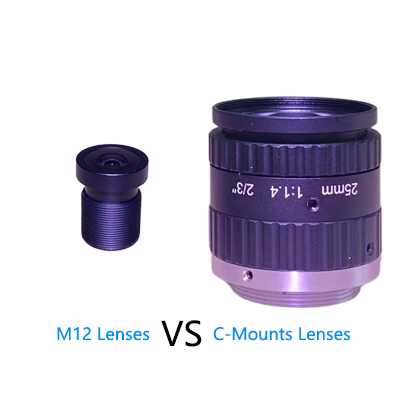
CCTV CAMERA LENS
2. 2.8mm vs 4mm CCTV Lens: What Is the Difference?
One of the most common questions when selecting a security camera lens is whether to choose a 2.8mm or 4mm lens. Both focal lengths are widely used in surveillance systems, but they serve different monitoring requirements.
2.1 2.8mm CCTV Lens: Wider Field of View
A 2.8mm lens generally provides a wider field of view, making it useful when the camera needs to cover a relatively large area from a fixed installation position.
Typical applications include:
- Indoor rooms and offices
- Retail stores and small commercial spaces
- Building entrances and reception areas
- General indoor security monitoring
Its wide viewing angle helps capture more of the surrounding environment. However, because the scene is spread across a wider image, individual objects may occupy fewer pixels than they would with a longer focal length under the same conditions.
2.2 4mm CCTV Lens: More Focused Coverage
A 4mm CCTV lens generally provides a narrower field of view than a 2.8mm lens used with the same sensor.
This makes it useful for monitoring specific areas where a wider view is not necessary.
Typical applications include:
- Building entrances and access points
- Corridors and passageways
- Specific sections of parking areas
- Monitoring defined areas within commercial facilities
A 4mm lens can provide a more concentrated image of the target area. However, the actual level of detail also depends on sensor resolution, camera installation distance, and subject size.
2.3 2.8mm vs 4mm CCTV Lens Comparison
| Comparison | 2.8mm Lens | 4mm Lens |
|---|---|---|
| Focal Length | 2.8mm | 4mm |
| Field of View | Generally wider | Generally narrower |
| Coverage | Larger area | More concentrated area |
| Image Composition | More surrounding scene | More focused scene |
| Typical Applications | Rooms, stores, entrances | Corridors, access points, defined areas |
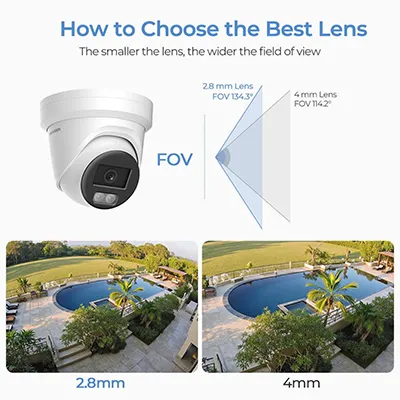
2.8mm vs 4mm CCTV lens comparison
2.4 Which CCTV Lens Should You Choose: 2.8mm or 4mm?
The choice depends on the size and layout of the monitoring area.
Choose a 2.8mm lens when you need to capture a wider scene from a fixed camera position. Choose a 4mm lens when you want a narrower view focused on a specific area.
If the installation distance, monitoring area, or required field of view is uncertain, a varifocal lens may provide greater flexibility than a fixed focal length lens.
3. How Do Sensor Size and Focal Length Affect the CCTV Lens Angle of View?
When choosing a CCTV lens, it is important to understand that the angle of view depends on both focal length and image sensor dimensions.
Two lenses with the same focal length can produce different viewing angles when paired with different image sensors.
For example, a lens designed for a 1/2-inch sensor may produce a different horizontal field of view from the same focal length lens used with a 1/3-inch sensor.
3.1 Understanding Horizontal, Vertical, and Diagonal FOV
There are three commonly used measurements when evaluating a CCTV lens:
- Horizontal Field of View (HFOV): The width of the scene captured by the camera.
- Vertical Field of View (VFOV): The height of the scene captured by the camera.
- Diagonal Field of View (DFOV): The diagonal angle across the image.
For most surveillance installations, horizontal field of view is particularly useful when determining how much of a room, corridor, or outdoor area can be monitored.
3.2 How to Calculate CCTV Lens Angle of View
For an ideal rectilinear lens, the approximate angle of view can be calculated using:
FOV = 2 × arctan (Sensor Dimension / 2f)
f = focal length of the lens
Sensor Dimension = active sensor width, height, or diagonal
To calculate horizontal FOV, use the active sensor width. To calculate vertical FOV, use the active sensor height.
For example, if the active sensor width is 6.4mm:
- A 2.8mm lens produces an approximate horizontal angle of view of 97°.
- A 4mm lens produces an approximate horizontal angle of view of 77°.
These are illustrative calculations based on an ideal rectilinear optical model. Actual product specifications may differ because of optical distortion, image-circle coverage, and the manufacturer’s measurement method.
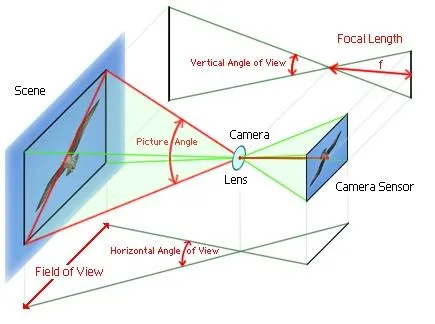
CCTV lenses sensor size and angle of view
For more detailed optical calculations, use the TOWIN FOV Calculator to estimate the field of view based on your lens and camera specifications.
4. How Does CCTV Lens Focal Length Affect Monitoring Distance?
Monitoring distance is another important consideration when selecting a CCTV lens. However, there is no universal distance limit for a particular focal length.
The usable monitoring distance depends on several factors, including:
- Lens focal length
- Image sensor dimensions
- Camera resolution and pixel density
- Size and contrast of the target object
- Lighting and environmental conditions
- The required level of identification or recognition detail
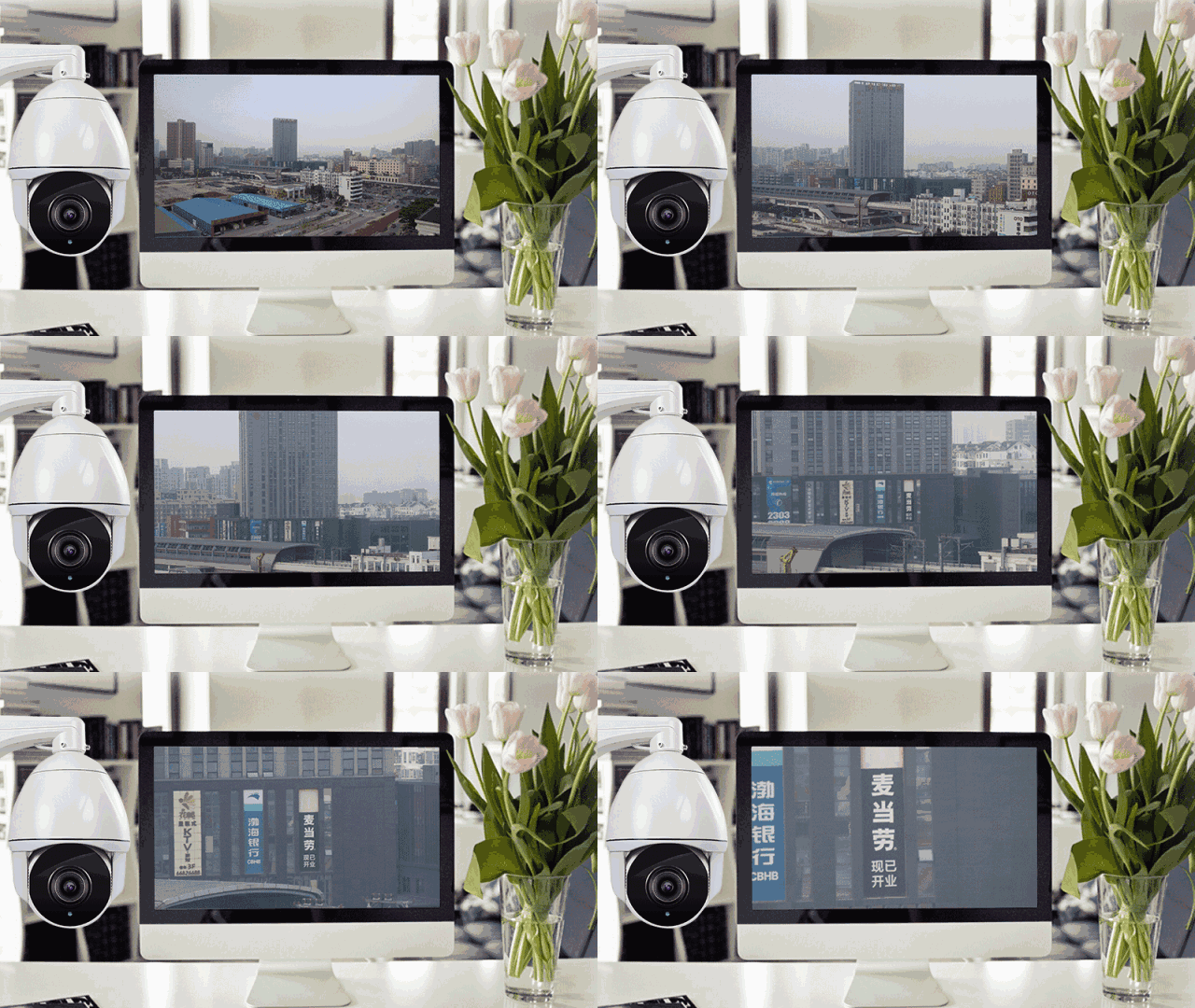
A longer focal length generally provides a narrower field of view and makes a distant object occupy a larger portion of the image. However, it also reduces the total scene coverage.
4.1 How to Calculate Field of View at Different Distances
For a simplified rectilinear optical system, the approximate scene width at a given distance can be calculated using:
Scene Width ≈ Distance × Sensor Width / Focal Length
All measurements must use the same units.
For example, assume a camera uses a sensor with an active width of 6.4mm and is installed 10 meters from the monitoring area.
| Focal Length | Approx. Scene Width | Coverage |
|---|---|---|
| 2.8mm | 22.86m | Wider |
| 4mm | 16.00m | Narrower |
| 8mm | 8.00m | More focused |
| 12mm | 5.33m | Narrower |
Note: These figures are simplified geometric estimates, not guaranteed product coverage specifications. Actual coverage depends on the lens’s optical design and the usable sensor area.
4.2 How to Choose a Lens for Different Monitoring Distances
When selecting a CCTV lens, consider both the distance to the target and the width of the area that needs to be monitored.
- Short-distance monitoring: Wide-angle lenses can help capture more of a small room or indoor space.
- Medium-distance monitoring: 4mm–8mm lenses may be suitable when a more focused view is required.
- Longer-distance monitoring: Longer focal lengths may be necessary to capture smaller or more distant targets.
There is no fixed focal-length-to-distance conversion that works for every camera. Always calculate the required field of view before selecting the lens.
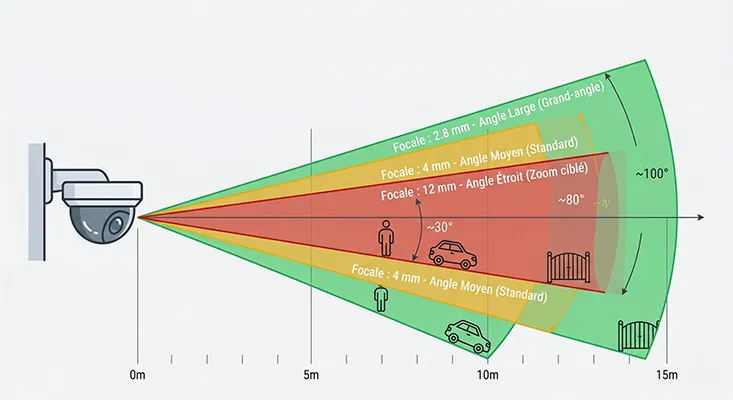
CCTV lens field of view at different distances
5. How to Choose CCTV Lens Focal Length for Different Applications
The best CCTV lens focal length depends on the monitoring objective. A lens designed to capture a large indoor area may not be suitable for monitoring a narrow entrance or a distant target.
5.1 Indoor Surveillance
Indoor surveillance often requires a relatively wide field of view to capture rooms, offices, shops, and other enclosed spaces. Shorter focal lengths such as 2.8mm may be suitable when broad scene coverage is the priority.
5.2 Building Entrances and Corridors
Building entrances and corridors may require more concentrated coverage. A 4mm or longer focal length can be considered depending on the camera position, corridor width, and required image detail.
5.3 Parking Lots and Outdoor Areas
Parking lots and outdoor surveillance areas can have different monitoring requirements. A wide-angle lens may cover a large area, while a longer focal length may be more appropriate for monitoring a particular entrance or distant section.
5.4 Long-Distance Monitoring
For long-distance monitoring, selecting a longer focal length can help narrow the viewing angle and increase the apparent size of distant objects. However, the lens should also be matched to the camera sensor and the required resolution.
For applications involving traffic monitoring or specialized security systems, lens selection should also consider optical distortion, illumination, resolution, and environmental conditions.
Explore TOWIN Smart Security Lens Solutions for more information about optical requirements in surveillance applications.
6. Fixed Focal vs. Varifocal CCTV Lenses
Another important decision is whether to choose a fixed focal length lens or a varifocal lens.
6.1 Fixed Focal Length CCTV Lens
A fixed focal length lens has a constant focal length, such as 2.8mm, 4mm, 6mm, or 8mm. Its field of view cannot be optically adjusted by changing the focal length.
Fixed focal lenses are useful when the camera installation position and required field of view are already known.
Advantages include:
- Simple optical configuration
- Consistent focal length
- Suitable for installations with defined monitoring requirements
- Available in different focal lengths and sensor formats
Explore TOWIN Fixed Focal CCTV and Megapixel Lenses to compare available specifications.
6.2 Varifocal CCTV Lens
A varifocal lens allows the focal length to be adjusted within a specified range. For example, a 2.8–12mm varifocal lens can provide different fields of view without replacing the lens.
This flexibility is useful when the camera’s final installation position or monitoring area may need adjustment.
Advantages include:
- Adjustable field of view
- Greater flexibility during installation
- Suitable for changing monitoring requirements
- Can cover both wide-angle and narrower viewing needs within its optical range
TOWIN 2.8–12mm Varifocal CCTV Lens
TOWIN offers C-Mount varifocal CCTV lenses for surveillance applications requiring adjustable focal lengths.
- Focal Length: 2.8–12mm
- Sensor Format: 1/2″
- Horizontal FOV: 100°–31°
- Maximum Aperture: F1.6
- Mount: C-Mount
These specifications refer to the C-Mount model C281212M2 listed in the TOWIN product catalog. Always confirm sensor compatibility and the complete specification sheet before ordering.
7. How to Select the Right CCTV Lens for Your Camera
Before purchasing a CCTV lens, it is important to evaluate the complete camera system rather than choosing a focal length independently.
Use the following checklist to narrow down your lens requirements.
7.1 Confirm the Image Sensor Size
Check the camera’s sensor format and active imaging dimensions. The lens must provide sufficient image-circle coverage for the sensor to avoid unwanted vignetting.
7.2 Determine the Required Field of View
Measure the width and height of the area that needs to be monitored. Calculate the required horizontal and vertical viewing angles based on the installation distance.
7.3 Select the Appropriate Focal Length
Compare the calculated field of view with the available focal lengths. Choose a shorter focal length for wider coverage or a longer focal length for more concentrated monitoring.
7.4 Check Resolution and Optical Performance
Make sure the lens resolution is compatible with the camera sensor. Other optical parameters, including distortion, relative illumination, and aperture, should also be considered according to the application.
7.5 Confirm the Lens Mount
Check whether your camera requires a C-Mount, CS-Mount, or another interface. The mount must be mechanically compatible with the camera, and the optical system must meet the required back focal distance and imaging specifications.
For a more comprehensive selection process, read the Industrial Lens Selection Guide.
8. Frequently Asked Questions About CCTV Lens Focal Length
Q1: What is the difference between a 2.8mm and a 4mm CCTV lens?
A: A 2.8mm lens generally provides a wider field of view, while a 4mm lens provides a narrower and more concentrated view when used with the same sensor. The right choice depends on the monitoring area’s size, camera position, and required image detail.
Q2: Is a 2.8mm CCTV lens better than a 4mm lens?
A: Neither is universally better. A 2.8mm lens is generally more suitable for wide-area coverage, while a 4mm lens may be more appropriate when monitoring a specific area. The best option depends on the installation requirements.
Q3: What is the viewing angle of a 2.8mm CCTV lens?
A: The viewing angle depends on the image sensor size and optical design. A 2.8mm lens generally provides a wide field of view, but its exact horizontal, vertical, and diagonal angles should be confirmed using the manufacturer’s specifications.
Q4: What is the viewing angle of a 4mm CCTV lens?
A: A 4mm lens generally provides a narrower field of view than a 2.8mm lens on the same sensor. For example, TOWIN lists a 4mm C-Mount lens with a 1/2-inch sensor format and a 78° horizontal field of view.
Q5: What is the difference between a 4mm and a 12mm CCTV lens?
A: A 4mm lens generally captures a wider scene, while a 12mm lens provides a narrower viewing angle. A 12mm lens may be more suitable when the camera needs to concentrate on a distant or specific monitoring area.
Q6: How do I calculate the field of view of a CCTV lens?
A: The approximate field of view angle can be calculated using the sensor dimension and focal length. The scene width at a particular distance can also be estimated using the sensor width, focal length, and object distance. A dedicated FOV calculator can simplify this process.
Q7: Should I choose a fixed focal or varifocal CCTV lens?
A: Choose a fixed focal lens when the installation position and required viewing angle are already known. Choose a varifocal lens when you need flexibility to adjust the field of view during installation or operation.
9. Find the Right CCTV Lens for Your Application
Selecting the right CCTV lens requires more than choosing a focal length based on distance alone. Sensor size, field of view, installation conditions, resolution, and application requirements all influence the final optical configuration.
At TOWIN, we provide industrial optical lens solutions, including fixed focal and varifocal CCTV lenses for different imaging requirements. Our product range covers different focal lengths, sensor formats, and optical configurations.
Whether you need a wide-angle lens for indoor surveillance or a varifocal lens for adjustable monitoring coverage, selecting the correct optical specifications is essential for achieving reliable imaging performance.
Need Help Selecting a CCTV Lens?
Share your camera sensor size, required focal length, installation distance, and target field of view with our team. TOWIN can help you identify suitable lens specifications for your imaging application.