


TOF Lens – S08012004812IR
08/31/2025
Fisheye Lens – CCL1301820MPF67
09/01/2025
Low Distortion Lens – S16012702212IR
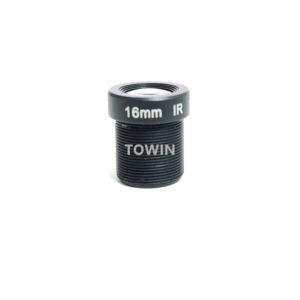
16mm M16 low distortion lens for 1/2.7″ 3MP sensors, featuring F1.2 aperture, 28° FOV and 6G optics for compact industrial imaging.
S16012702212IR is 3-Megapixel Low-distortion lens with 1/2.7″ format, 16mm F1.2 M16x0.5 mount, and 28° diagonal field of view for security surveillance.
| IMAGE FORMAT | 1/2.7″ |
| FOCAL LENGTH | 16mm |
| F.O.V. | 28°(D) |
| 23°(H) | |
| 17°(V) | |
| RESOLUTION | 3 Megapixel |
| DISTORTION | <-6.8% |
| APERTURE | F1.2 |
| MOUNT | M16x0.5 |
| IRIS | Fixed |
| M.O.D. | 0.2m |
| T.T.L. | 35.8mm |
| B.F.L. | 6mm |
| STRUCTURE | 6G |
16mm M16 Low Distortion Industrial Lens
This 16mm low distortion lens is designed for 1/2.7″ imaging sensors and 3-megapixel camera systems that require a compact fixed focal length with strong low-light performance. Featuring an F1.2 aperture, 28° diagonal FOV, and 6G low distortion optical construction, it provides controlled image coverage for compact industrial, surveillance, and embedded imaging applications.
Product Highlights at a Glance
- 16mm fixed focal length for controlled target-area coverage.
- F1.2 large aperture for strong light-gathering performance.
- 3MP resolution support for detailed 1/2.7″ imaging.
- 6G low distortion optical design for controlled image geometry.
- 0.2m M.O.D. for relatively close-range imaging applications.
16mm M16 Low Distortion Lens Applications
Core Application Scenes
This 16mm M16 low distortion lens is designed for camera systems that need a defined, moderately narrow viewing area rather than an ultra-wide scene. Its 28° diagonal field of view allows the camera to concentrate on a specific target zone, making it suitable for fixed-position imaging where excessive peripheral coverage is unnecessary.
The F1.2 aperture is one of the key performance characteristics of this lens. It provides strong light-gathering capability for compact camera systems operating in changing illumination conditions, helping maintain useful image brightness without requiring an extremely short focal length.
With a 0.2m minimum object distance, the lens can also be considered for relatively close-range inspection and monitoring. The 3MP resolution specification provides a practical balance between image detail and system requirements for applications that do not require high-end machine vision resolutions.
The M16 × 0.5 mount differentiates this lens from standard M12, C-Mount, and CS-Mount products. It is therefore suitable for camera designs that use a larger threaded mechanical interface or require compatibility with an existing M16-based optical assembly.
For applications where geometric accuracy is important, the Distortion Guide can help engineers understand how lens distortion affects image geometry and system performance. For broader lens-selection requirements, the Lens Selection Guide provides additional guidance on focal length, sensor format, and application requirements.
Compatible Device List
- Compact Surveillance Cameras: Suitable for fixed-position cameras requiring a controlled field of view and strong low-light capability.
- Embedded Industrial Cameras: The M16 × 0.5 interface can be integrated into specialized camera housings and embedded imaging equipment.
- Close-Range Monitoring Systems: The 0.2m M.O.D. supports applications where the camera operates relatively close to the monitored target.
- Inspection and Detection Modules: The fixed 16mm focal length can concentrate imaging on a defined target region in compact inspection systems.
- Low-Light Imaging Equipment: The F1.2 aperture makes the lens suitable for applications where available illumination is limited or variable.
- OEM Camera Assemblies: The 6G optical construction and M16 mechanical interface provide a practical foundation for customized camera configurations.
Designed for fixed-position industrial imaging, compact surveillance, and close-range low-light camera applications.
For projects where the required field of view or focal length needs to be verified before integration, engineers can use the FOV Calculator to evaluate the relationship between sensor size, focal length, and image coverage.
Frequently Asked Questions
Q: What sensor format is this 16mm lens designed for?
A: The lens is designed for a 1/2.7″ image format and supports 3-megapixel imaging.
Q: What is the field of view of this lens?
A: The specified field of view is 28° diagonal, 23° horizontal, and 17° vertical.
Q: Is this a low distortion lens?
A: Yes. The lens uses a 6G low distortion optical structure and has a specified distortion of less than -6.8%.
Q: What is the advantage of the F1.2 aperture?
A: F1.2 provides a relatively large aperture and strong light-gathering capability, making the lens suitable for imaging systems operating under low or variable illumination.
Q: What is the minimum object distance of this lens?
A: The specified minimum object distance is 0.2m, allowing the lens to be used for relatively close-range imaging applications.
Q: What mount does this lens use?
A: It uses an M16 × 0.5 threaded mount. This makes it different from standard M12, C-Mount, and CS-Mount configurations.
Q: Can this lens be used for machine vision?
A: It can be considered for selected compact industrial inspection and machine vision applications where 3MP resolution, a 16mm fixed focal length, and controlled distortion are sufficient for the imaging task.
Q: How can I determine whether this 16mm focal length is suitable for my camera system?
A: Focal length selection depends on sensor size, working distance, and required field of view. The Lens Selection Guide and Focal Length Calculator can help evaluate these parameters. For application-specific requirements, you can also contact TOWIN for optical selection support.
Online contact