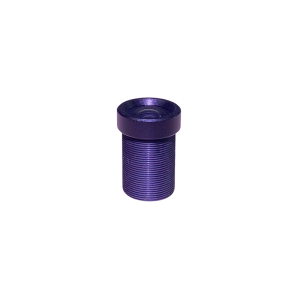



Low Distortion Lens – S16012002320
08/27/2025
Low Distortion Lens – S16012302348F
08/27/2025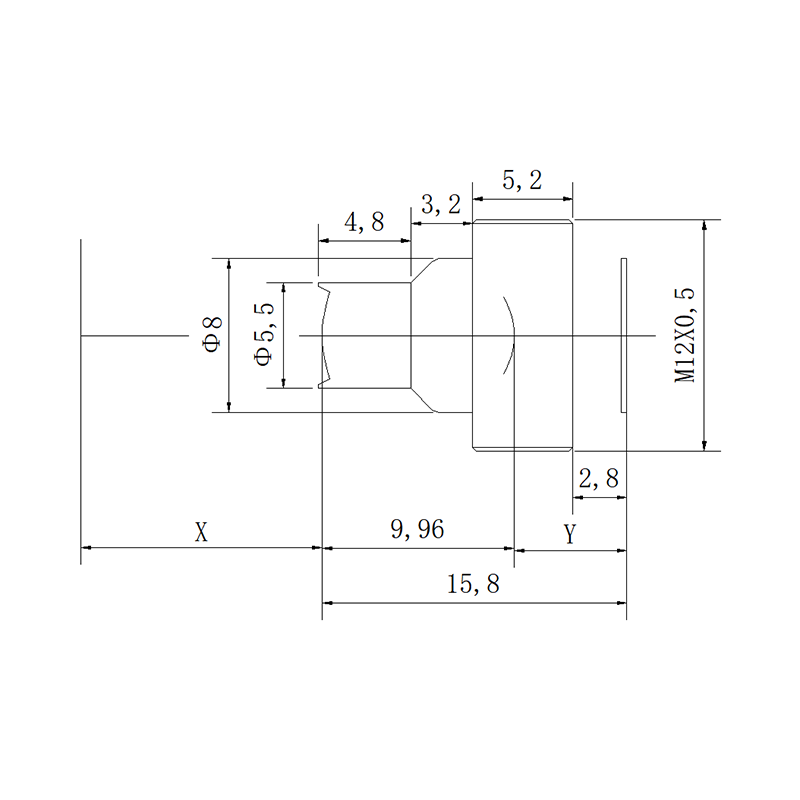
Low Distortion Lens – S16012302329
16mm 5MP M12 low distortion lens with <1% distortion, F2.9 aperture, 0.1m MOD, and support for 1/2.3″ and 1/3.2″ sensors.
S16012302329 is Low-distortion 5-Megapixel M12-mount machine vision lens for 1/2.3″ and 1/3.2″ sensors, featuring 29° diagonal F.O.V., F2.9 aperture, and 0.1m MOD.
| IMAGE FORMAT | 1/2.3″ |
| FOCAL LENGTH | 16mm |
| F.O.V.@1/2.3 | 29°(D) |
| 23°(H) | |
| 17.5°(V) | |
| F.O.V. @1/3.2″ | 21.5°(D) |
| 17.5°(H) | |
| 13°(V) | |
| RESOLUTION | 5MP |
| DISTORTION | <-1% |
| APERTURE | F2.9 |
| MOUNT | M12X0.5 |
| IRIS | Fixed |
| M.O.D. | 0.1m |
| B.F.L. | 5.9mm |
| CONSTRUCTION | 4G |
16mm M12 Low Distortion Lens
This 16mm M12 low distortion lens is designed for compact imaging systems that require 5MP resolution, controlled distortion, and a stable medium-angle field of view. With less than 1% distortion, F2.9 aperture, and support for both 1/2.3″ and 1/3.2″ sensors, it provides consistent image performance for embedded vision, inspection, recognition, and fixed-position imaging applications.
The M12X0.5 mount, 0.1m minimum object distance, and 5.9mm back focal length make this lens suitable for space-constrained camera designs where optical performance and mechanical integration are both important.
Product Highlights at a Glance
- 5MP optical resolution for detailed image capture and visual recognition.
- Less than 1% distortion helps maintain accurate object shapes across the image.
- 16mm fixed focal length provides a controlled field of view for targeted imaging.
- F2.9 aperture provides a practical balance between light transmission and depth of field.
- M12X0.5 compact mount supports integration into small embedded camera systems.
16mm M12 Low Distortion Lens Applications
Core Application Scenes
The 16mm focal length provides a relatively focused field of view, making this lens suitable when the camera needs to capture a defined target area rather than a large surrounding scene. The <1% distortion specification helps reduce geometric deformation, which is useful when object shape and position need to remain visually consistent.
For compact machine vision systems, this lens can be used for component observation, object identification, basic dimensional analysis, barcode or code recognition, and fixed-area inspection. Its 5MP resolution provides more image detail than entry-level embedded lenses while maintaining the compact form factor of an M12 optical system. Explore the Machine Vision Solutions for related industrial imaging applications.
The lens supports both 1/2.3″ and 1/3.2″ sensors, with the field of view changing according to sensor size. This flexibility makes it useful for OEM camera designs and embedded visual sensing platforms where different image sensors may be required. For optical system planning, the Sensor Guide can help with sensor and lens matching.
Designed for compact inspection and fixed-position imaging applications.
Compatible Device List
- Embedded Vision Cameras – suitable for compact camera modules used in recognition and visual monitoring systems.
- Machine Vision Cameras – suitable for basic inspection, component identification, and image-based quality checks.
- AI Vision Devices – provides 5MP image data for object recognition and visual analysis.
- Barcode & Code Readers – the controlled field of view can be useful for targeted code-reading applications.
- Industrial Inspection Equipment – suitable for fixed camera installations where moderate working distances and controlled distortion are required.
- OEM Camera Modules – the M12X0.5 mount and 5.9mm BFL support compact mechanical integration.
When selecting a 16mm lens, the actual sensor format, working distance, target size, and required field of view should be considered together. The FOV Calculator can be used to estimate the relationship between sensor size, focal length, and field of view.
Frequently Asked Questions
Q: What type of lens is this 16mm M12 lens?
A: It is a fixed focal length M12 lens designed for 5MP imaging, with less than 1% distortion and a 16mm focal length.
Q: What sensors can this lens support?
A: The lens provides specified FOV values for both 1/2.3″ and 1/3.2″ image formats. The actual usable image circle and camera configuration should be confirmed for a specific sensor.
Q: Is this lens suitable for machine vision?
A: Yes, it can be used for compact and general-purpose machine vision applications such as component identification, inspection, code recognition, and fixed-area imaging. For demanding metrology or high-precision inspection, the complete optical and camera system should be evaluated together.
Q: What does the <1% distortion specification mean?
A: Geometric distortion is controlled below 1%, preserving natural object shapes and suiting applications where image geometry matters.
Q: Is this a wide-angle lens?
A: No. With a 29° diagonal FOV on a 1/2.3″ sensor, this lens is better described as a focused or moderate-FOV lens rather than a wide-angle lens.
Q: What is the minimum object distance of this lens?
A: The M.O.D. is 0.1m, meaning the lens is specified for imaging objects from approximately 100mm away under the applicable focusing conditions.
Q: What is the advantage of the 5.9mm BFL?
A: A 5.9mm back focal length can provide flexibility when integrating the lens with compact camera modules and sensor assemblies. Mechanical compatibility should be checked for the specific camera design.
Q: Does this lens have a fixed or adjustable iris?
A: It uses a fixed iris with an F2.9 aperture. This provides a predefined optical configuration for applications with controlled or reasonably stable lighting conditions.
Online contact