


Low Distortion Lens – S18012701820
11/06/2025
Low Distortion Lens – M702714006920
11/07/2025
Low Distortion Lens – M605114004020F
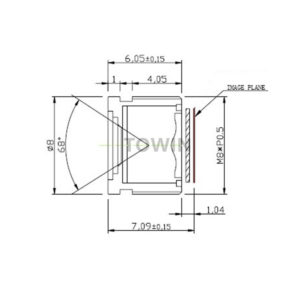
5.1mm M6 low distortion miniature lens for 1/4″ sensors, featuring <0.4% TV distortion, F2.0 aperture, 0.1m M.O.D., 6.91mm T.T.L., and optional 8.5mm × 8.5mm VCM holder.
M605114004020F is 5.1mm Low-distortion 2-Megapixel lens with 1/4″ M6X0.35 mount , 46° FOV F2.0 aperture, IRCF, for security or machine vision applications.
| IMAGE FORMAT | Max Φ5.0, 1/4″ |
| FOCAL LENGTH | 5.1mm |
| F.O.V. (1/4″) | 46°(D=4.50) |
| 40°(H=3.84) | |
| 25°(V=2.40) | |
| RESOLUTION | 2 MegaPixel |
| TV DISTORTION | <0.4% |
| APERTURE | F2.0 |
| MOUNT | M6X0.35 |
| M.O.D. | 0.1m |
| T.T.L. | 6.91mm |
| STRUCTURE | With IRCF |
| OPTIONAL: | 8.5mmX8.5mm VCM Holder |
5.1mm M6 Low Distortion Miniature Machine Vision Lens
TOWIN’s 5.1mm M6 miniature lens is designed for compact imaging systems requiring a small mechanical footprint, 2MP resolution, and controlled image distortion. With a 1/4″ image format, F2.0 aperture, <0.4% TV distortion, and 0.1m M.O.D., this 5.1mm M6 low distortion lens is suitable for embedded machine vision, compact inspection cameras, and space-constrained imaging devices.
M6 Low Distortion Miniature Lens Core Highlights
- M6 × 0.35 miniature mount for highly compact optical assemblies.
- 2MP resolution supports detailed imaging for embedded vision and inspection applications.
- <0.4% TV distortion provides controlled image geometry for measurement and recognition tasks.
- F2.0 aperture provides efficient light transmission for compact imaging systems.
- 0.1m M.O.D. and 6.91mm T.T.L. support short-distance imaging where installation space is limited.
- Optional 8.5mm × 8.5mm VCM holder enables integration into compact camera module designs.
Compact M6 Optical Design for Embedded Vision
The combination of a 5.1mm focal length, 1/4″ image format, and M6 × 0.35 mount makes this lens particularly suitable for optical systems where conventional M12 or larger machine vision lenses may occupy too much space. Its 6.91mm total track length and optional 8.5mm × 8.5mm VCM holder provide additional flexibility for miniature camera assemblies.
For applications where image geometry is important, the lens provides less than 0.4% TV distortion, helping maintain more consistent object shapes across the image. The F2.0 aperture also provides a practical balance between compact optical construction and light-gathering capability.
When selecting a lens for a specific sensor and working distance, engineers can use the FOV Calculator to evaluate the relationship between sensor size, focal length, and field of view. For broader optical matching considerations, the Lens Selection Guide provides additional selection criteria.
5.1mm M6 Low Distortion Miniature Lens Applications
This M6 miniature machine vision lens is designed for imaging systems where optical performance must be combined with a very small mechanical package.
Recommended applications include:
- Compact machine vision cameras
- Embedded machine vision systems
- Miniature inspection cameras
- PCB and electronic component inspection
- Compact object recognition systems
- Barcode and code-reading modules
- Small-format industrial cameras
- Embedded monitoring and imaging equipment
- Robotic vision modules with limited installation space
- Compact AI vision camera modules
Compatible device types include:
- 1/4″ image sensors
- Compact CMOS camera modules
- Embedded vision boards
- Miniature industrial cameras
- VCM-based camera assemblies
- Space-constrained inspection devices
Designed for compact embedded vision applications, the optional 8.5mm × 8.5mm VCM holder can help integrate the optical assembly into camera-module designs where PCB area and lens height are restricted.
For projects involving compact robotic imaging, the Robotics Vision provides additional information about optical requirements in robotic vision systems. For general industrial inspection applications, see TOWIN’s Machine Vision.
Optical Performance & Lens Selection
With a 46° diagonal field of view on a 1/4″ sensor, this lens provides a moderate viewing range while maintaining a compact 5.1mm optical design. The 40° horizontal and 25° vertical FOV can be used to estimate the observable area according to the camera’s working distance.
The <0.4% TV distortion specification makes this lens particularly relevant when image shape consistency matters. Engineers working with dimensional inspection or geometric recognition can also refer to TOWIN’s Distortion Guide to understand how lens distortion affects imaging accuracy.
The lens uses an IRCF structure, which means an IR-cut filter is included in the optical structure. This should be distinguished from an IR-corrected optical design; the specification does not indicate that the lens is optimized for infrared wavelength correction.
Frequently Asked Questions
Q1: What sensor size is compatible with this 5.1mm M6 lens?
A: The lens is designed for a maximum image format of Φ5.0 and is specified for a 1/4″ sensor.
Q2: What is the field of view of the 5.1mm M6 lens?
A: On a 1/4″ sensor, the lens provides a 46° diagonal FOV, 40° horizontal FOV, and 25° vertical FOV.
Q3: Is this a low distortion lens?
A: Yes. The lens has a TV distortion specification of less than 0.4%, making it suitable for applications where controlled geometric distortion is important.
Q4: Is the lens an IR corrected lens?
A: No IR correction is specified. The product is listed as With IRCF, meaning an IR-cut filter is included. An IR-cut filter should not automatically be interpreted as IR-corrected optics.
Q5: What is the minimum object distance of this lens?
A: The M.O.D. is 0.1m, allowing the lens to support relatively close-range imaging applications.
Q6: What makes this lens suitable for miniature camera modules?
A: Its M6 × 0.35 mount, 6.91mm T.T.L., compact image format, and optional 8.5mm × 8.5mm VCM holder make it suitable for space-constrained camera designs.
Q7: Is the aperture adjustable?
A: No. The lens uses a fixed F2.0 aperture and fixed iris configuration.
Q8: Can this lens be customized for an OEM camera project?
A: TOWIN can evaluate optical and mechanical requirements such as sensor format, focal length, holder configuration, field of view, and installation constraints for OEM/ODM projects. Contact TOWIN through the Contact TOWIN to discuss project requirements.
Expanded Product Description
The 5.1mm M6 2MP Low Distortion Miniature Lens is engineered for compact imaging systems using 1/4″ sensors where limited installation space requires a small optical package without sacrificing controlled image quality. With a 5.1mm focal length, 46° diagonal field of view, F2.0 aperture, and <0.4% TV distortion, it provides a practical optical solution for embedded machine vision, miniature inspection cameras, electronic component inspection, and compact AI vision modules.
Its M6 × 0.35 mount and 6.91mm T.T.L. allow the lens to fit into highly space-constrained camera architectures. The 0.1m M.O.D. supports close-range imaging, while the optional 8.5mm × 8.5mm VCM holder provides additional mechanical integration options for compact camera modules. With its combination of miniature dimensions, fixed focal length, 2MP resolution, and low distortion performance, this lens is designed for OEM and embedded vision systems requiring a compact and controlled optical solution.
For engineers comparing miniature optical formats, TOWIN’s M8/M7/M6/M5/M3.5 Small Mount Lenses category provides additional small-mount lens options.
Online contact