


What Sensor Sizes Can M12 Lenses Support?
07/25/2026
What Lens Is Used in Automotive Cameras? Complete ADAS Camera Lens Selection Guide
07/27/2026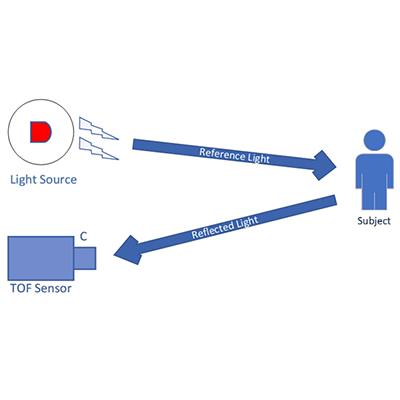
TOF Lens Work is based on precise infrared light control, signal capture, and depth calculation in a Time-of-Flight sensing system. Unlike conventional imaging lenses, a TOF lens is specially designed to support accurate distance measurement and 3D perception.
As robotics, AI vision, autonomous systems, and industrial automation continue to develop, TOF cameras require optical solutions that can deliver stable depth information in different environments.
A high-performance TOF lens affects critical factors such as infrared transmission efficiency, distortion control, sensor compatibility, and depth measurement accuracy. Understanding how a TOF lens works helps engineers select the right optical solution for their applications.
This article explains the working principle of TOF lenses, optical structure, key performance parameters, selection methods, and how professional TOF lens solutions support modern 3D vision systems.
Explore TOWIN’s complete solution: TOF Lens for 3D Depth Sensing Cameras
What Is a TOF Lens?
A TOF lens is an optical lens designed specifically for Time-of-Flight (TOF) cameras. It works together with an infrared emitter and TOF sensor to capture reflected infrared signals and generate accurate depth information.
Unlike standard camera lenses that mainly focus on producing clear two-dimensional images, TOF lenses are optimized for depth sensing performance.
| Feature | Standard Imaging Lens | TOF Lens |
|---|---|---|
| Main Function | Capture 2D images | Capture depth information |
| Light Source | Visible light | Infrared light (850nm / 940nm) |
| Optimization Goal | Image quality | Distance measurement accuracy |
| Coating | Visible spectrum coating | IR optimized coating |
How Does a TOF Lens Work?
To understand TOF Lens Work, it is important to understand how a complete TOF imaging system measures distance.
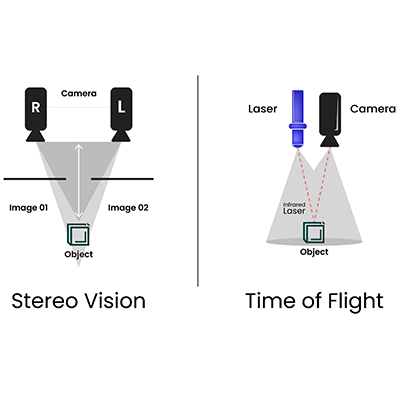
A TOF system calculates depth by measuring the time required for infrared light to travel from the camera to an object and return to the sensor.
The TOF Imaging Process
- The infrared emitter sends modulated infrared light toward an object.
- The infrared light reflects from the object surface.
- The TOF lens collects the returning infrared signal.
- The TOF sensor measures the phase difference or travel time.
- The system calculates distance and generates a depth map.
TOF Working Principle Diagram
TOF Camera
Infrared Emitter
        ↓
850nm / 940nm IR Light
        ↓
Object Surface
        ↓
Reflected Infrared Signal
        ↓
TOF Lens
        ↓
TOF Sensor
        ↓
Depth Information
Why Is the Lens Important in a TOF System?
Although the TOF sensor performs distance calculation, the optical lens directly affects the quality and reliability of the captured infrared signal.
A properly designed TOF lens improves:
- Infrared transmission efficiency
- Signal uniformity
- Depth measurement accuracy
- Sensor compatibility
- 3D reconstruction quality
For industrial and embedded applications, selecting a dedicated TOF Lens Product is essential for achieving stable depth sensing performance.
The Optical Structure of a TOF Lens
A TOF lens requires specialized optical design because it operates with infrared signals rather than visible light. The lens structure must ensure efficient infrared transmission, accurate focusing, and compatibility with the TOF sensor.
Unlike traditional imaging lenses, TOF lenses are optimized for both optical performance and depth measurement accuracy.
Main Components of a TOF Lens
| Component | Function |
|---|---|
| Optical Elements | Focus infrared signals onto the TOF sensor and maintain image quality. |
| IR Coating Layer | Improves transmission efficiency at 850nm or 940nm infrared wavelengths. |
| Low Distortion Design | Reduces geometric errors and improves depth measurement accuracy. |
| CRA Optimization | Ensures proper matching between lens output angles and sensor pixels. |
| Mechanical Barrel | Provides stable installation and supports compact camera integration. |
How Optical Design Influences TOF Performance
The optical design of a TOF lens directly affects the quality of infrared signals received by the sensor.
Important optical factors include:
- Infrared transmission efficiency
- Lens distortion control
- Field of view accuracy
- Relative illumination performance
- Sensor compatibility
For different applications, engineers need to balance optical performance, size requirements, and system integration needs.
Learn more about professional TOF optical solutions: TOWIN TOF Lens Solutions
850nm vs 940nm TOF Lens: Which Wavelength Is Better?
The infrared wavelength is one of the most important factors affecting TOF system performance. Most TOF cameras use either 850nm or 940nm infrared illumination.
Both wavelengths have advantages, and the best choice depends on the application environment, safety requirements, and sensing conditions.
| Feature | 850nm TOF Lens | 940nm TOF Lens |
|---|---|---|
| Infrared Visibility | Slightly higher visibility | Almost invisible to human eyes |
| Eye Safety | Good | Excellent |
| Infrared Efficiency | Generally higher transmission efficiency | Requires optimized IR optical design |
| Outdoor Performance | Suitable for controlled environments | Better resistance to environmental light |
| Typical Applications | Industrial inspection and indoor 3D scanning | Robotics, biometrics, smart devices |
When Should You Choose 850nm TOF Lenses?
850nm TOF lenses are commonly selected for applications where infrared efficiency and sensing performance are priorities.
Typical applications include:
- Indoor 3D scanning
- Industrial measurement
- Machine vision inspection
- Controlled environment robotics
When Should You Choose 940nm TOF Lenses?
940nm TOF lenses are widely adopted for systems that require higher eye safety and better integration with human-facing applications.
Typical applications include:
- Face recognition
- Autonomous robots
- AMR navigation
- Smart home devices
- Outdoor depth sensing systems
For more information about infrared wavelength selection: 850nm and 940nm TOF Lens Selection Guide
Key Optical Parameters Affecting TOF Lens Performance
A TOF lens is not only defined by wavelength. Optical parameters such as distortion, CRA, MTF, and infrared transmission directly influence depth accuracy and system reliability.
1. Infrared Transmission
Infrared transmission determines how efficiently the lens transfers 850nm or 940nm signals to the TOF sensor.
Higher infrared transmission improves:
- Signal strength
- Detection distance
- Depth measurement stability
2. Distortion Control
Distortion can introduce measurement errors in 3D sensing systems.
Low distortion TOF lenses help maintain accurate spatial information and improve depth reconstruction quality.
3. CRA (Chief Ray Angle) Optimization
CRA describes the angle at which light reaches the sensor pixels.
Proper CRA matching helps:
- Improve sensor efficiency
- Reduce edge performance loss
- Maintain image uniformity
4. MTF Performance
MTF (Modulation Transfer Function) represents lens resolution capability.
Although TOF systems focus on depth information, sufficient optical resolution is still important for accurate signal capture.
5. Relative Illumination
Relative illumination describes brightness consistency across the image area.
Balanced illumination helps TOF cameras achieve more reliable depth measurement, especially in wide-angle applications.
Explore optical performance testing: TOF Lens Optical Performance Verification
TOF Lens vs Standard Lens: What Is the Difference?
Although TOF lenses and standard camera lenses may look similar in appearance, their optical design goals are completely different.
A standard lens focuses mainly on producing clear 2D images, while a TOF lens is designed to support accurate depth measurement by optimizing infrared signal collection and sensor matching.
| Feature | Standard Imaging Lens | TOF Lens |
|---|---|---|
| Primary Purpose | Capture color or monochrome images | Capture depth information |
| Light Spectrum | Visible wavelength | Infrared wavelength (850nm / 940nm) |
| Optical Coating | Visible light coating | IR optimized coating |
| Main Performance Focus | Sharpness and image quality | Depth accuracy and signal reliability |
| Sensor Matching | General camera sensors | TOF depth sensors |
| Typical Applications | Photography, monitoring, imaging | 3D vision, robotics, AI sensing |
Using a standard lens in a TOF system may reduce infrared efficiency, increase measurement errors, and affect depth reconstruction accuracy.
Therefore, dedicated TOF camera lenses are recommended for professional 3D sensing applications.
How to Choose the Right TOF Lens?
Selecting the correct TOF lens requires understanding the relationship between the lens, TOF sensor, infrared wavelength, and application requirements.
A suitable lens should not only match the camera specification but also provide reliable optical performance in the final operating environment.
TOF Lens Selection Workflow
- Select the TOF Sensor
Identify sensor size, pixel size, and infrared sensitivity. - Confirm the Operating Wavelength
Choose between 850nm and 940nm depending on application requirements. - Define Field of View (FOV)
Select wide-angle or narrow-angle designs based on coverage requirements. - Match Sensor Size
Ensure the lens image circle covers the entire sensor area. - Evaluate Optical Performance
Check distortion, CRA, MTF, and infrared transmission. - Select the Lens Model
Choose the final TOF lens according to mechanical and system requirements.
1. Select the TOF Sensor
Sensor compatibility is one of the most important factors when choosing a TOF lens.
The lens must match:
- Sensor format
- Pixel size
- Active sensor area
- Image circle requirement
Common TOF sensor formats include:
| Sensor Size | Typical Application |
|---|---|
| 1/4 inch | Compact embedded TOF cameras |
| 1/3 inch | Industrial and smart devices |
| 1/2 inch | Higher resolution depth sensing systems |
TOWIN provides compact TOF Lens Products designed for different sensor formats and integration requirements.
2. Confirm the Infrared Wavelength
The selected wavelength directly affects TOF system performance.
| Requirement | Recommended Choice |
|---|---|
| Human-facing applications | 940nm TOF Lens |
| Face recognition | 940nm TOF Lens |
| Outdoor depth sensing | 940nm TOF Lens |
| Industrial indoor inspection | 850nm TOF Lens |
| Controlled environment measurement | 850nm TOF Lens |
3. Define the Field of View (FOV)
Field of View determines how much area the TOF camera can observe.
Different applications require different FOV designs.
| Application | Recommended FOV |
|---|---|
| Robot Navigation | Wide FOV |
| AMR Obstacle Detection | Wide FOV |
| 3D Measurement | Medium FOV |
| Precision Detection | Narrow FOV |
4. Evaluate Optical Performance
After confirming the basic requirements, engineers should evaluate the optical performance of the selected TOF lens.
Important parameters include:
- IR transmission efficiency
- Distortion performance
- CRA matching
- MTF performance
- Relative illumination
These parameters determine whether the lens can provide stable depth information under real-world conditions.
Learn more about: TOF Lens Optical Design and Performance Verification
Recommended TOF Lens Specifications
TOF lens specifications vary depending on sensor type and application. The following parameters represent common requirements for embedded and industrial depth sensing systems.
| Parameter | Typical Specification |
|---|---|
| Mount | M12 × 0.5 |
| Wavelength | 850nm / 940nm Infrared |
| Sensor Compatibility | 1/4″, 1/3″, 1/2″ Sensors |
| Field of View | 60° – 150° |
| Distortion | Low Distortion Design |
| Applications | Robotics, 3D Vision, AI Vision, Smart Devices |
Applications of TOF Lens in 3D Vision Systems
TOF lenses are widely used in applications that require accurate depth information and real-time environmental perception. With advantages such as compact size, infrared optimization, and reliable distance measurement, TOF optical solutions support many emerging intelligent systems.
TOF Lens for Robotics and Autonomous Systems
Robots need accurate environmental perception to perform navigation, obstacle avoidance, and autonomous movement.
TOF lenses help robotic systems achieve:
- Real-time depth perception
- Obstacle detection
- SLAM navigation
- Object recognition
Wide-angle TOF lens designs are commonly selected for robotics because they provide larger scene coverage and reliable depth information.
TOF Lens for Industrial 3D Vision
Industrial automation systems use TOF cameras for accurate object detection and three-dimensional measurement.
Typical applications include:
- Robot picking
- Factory automation
- 3D inspection
- Quality control
In industrial environments, low distortion and stable optical performance are essential for achieving accurate measurement results.
Explore related solutions: Machine Vision Lens Solutions
TOF Lens for Face Recognition and Biometrics
Facial recognition systems require accurate depth sensing while operating safely near users.
940nm TOF lenses are widely used in biometric applications because they provide excellent eye safety and invisible infrared illumination.
Common applications include:
- Face authentication terminals
- Access control systems
- Smart devices
- Human-machine interaction systems
TOF Lens for Smart Devices and AI Vision
The development of artificial intelligence has increased demand for compact 3D sensing modules.
TOF lenses provide depth information that helps AI systems understand:
- Object distance
- Spatial position
- Environmental structure
Why Choose TOWIN TOF Lens Solutions?
Selecting the right optical partner is important for developing reliable TOF camera systems. TOWIN provides professional optical solutions designed for industrial, embedded, and AI vision applications.
Advanced Infrared Optical Design
TOF systems require precise infrared optimization. TOWIN designs lenses for both 850nm and 940nm applications to achieve stable signal transmission and reliable depth measurement.
- 850nm infrared optimization
- 940nm infrared optimization
- Low distortion optical design
- Sensor matching optimization
M12 Standard Mount Support
Many embedded TOF cameras require compact optical modules. M12 lenses provide a flexible mechanical interface and are widely used in compact vision systems.
TOWIN supports M12 TOF lens designs for different sensor sizes and application requirements.
Learn more: M12 Lens Solutions
OEM and ODM Customization
Different TOF applications may require customized optical specifications. TOWIN provides OEM and ODM services including:
- Customized focal length
- Customized field of view
- Sensor compatibility optimization
- Optical structure customization
- Prototype development
From optical design to mass production, TOWIN supports customers in developing reliable TOF imaging systems.
Optical Performance Verification
Professional TOF lens development requires optical testing to ensure consistent performance.
Important verification items include:
- MTF testing
- Distortion measurement
- Relative illumination analysis
- CRA evaluation
- Infrared transmission testing
Frequently Asked Questions
1. How does a TOF lens work?
A TOF lens works by collecting reflected infrared signals from objects and transmitting them to a TOF sensor. The system calculates distance by measuring the travel time or phase difference of infrared light.
2. What wavelength does a TOF lens use?
Most TOF lenses operate at 850nm or 940nm infrared wavelengths. The correct wavelength depends on application requirements such as eye safety, environment, and sensing distance.
3. Why does a TOF camera need a special lens?
A dedicated TOF lens is optimized for infrared transmission, distortion control, and sensor matching. A standard imaging lens may not provide the optical performance required for accurate depth measurement.
4. What parameters should I consider when selecting a TOF lens?
Important parameters include sensor size, wavelength, field of view, distortion, CRA, MTF performance, and infrared transmission efficiency.
5. Can TOF lenses support M12 mounts?
Yes. Many compact TOF cameras use M12 lens designs because they provide small size, flexible integration, and compatibility with embedded vision systems.
6. Can TOWIN customize TOF lenses?
Yes. TOWIN provides customized TOF lens solutions including optical design, sensor matching, mechanical optimization, and OEM/ODM production support.
Conclusion
Understanding how a TOF lens works is essential for selecting the right optical solution for modern 3D vision systems.
A TOF system depends on the cooperation between infrared illumination, optical lens design, and depth sensors. The lens plays a critical role in controlling infrared transmission, reducing distortion, and ensuring accurate depth information.
By evaluating key parameters such as wavelength, sensor compatibility, field of view, CRA, and optical performance, engineers can select a TOF lens that meets their application requirements.
TOWIN provides professional TOF lens solutions for robotics, industrial automation, AI vision, and embedded 3D sensing applications, including 850nm and 940nm designs, M12 mounting options, and customized optical development.
Ultimately, understanding TOF Lens Work helps engineers build more reliable depth sensing systems and select the right optical solution for next-generation intelligent devices.
Explore TOWIN TOF solutions: TOF Lens for 3D Depth Sensing