


Small MOQ optical lens supplier
10/09/2025
Low Dispersion Glass in Optical Lenses: A Guide to Lens Dispersion
10/09/2025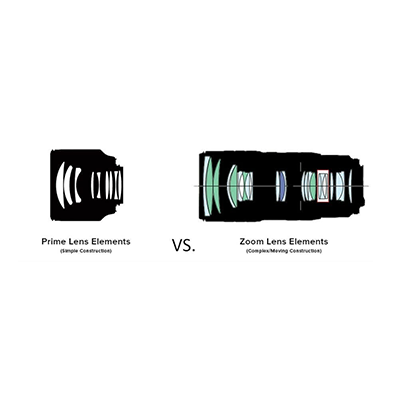
Choosing between a fixed focal length lens and a zoom lens is an important decision when designing an industrial imaging or machine vision system. Both lens types can capture clear images, but they differ in focal length flexibility, optical design, adjustment methods, and suitability for specific inspection tasks.
A fixed focal length lens vs zoom lens comparison should consider more than image quality alone. Engineers also need to evaluate field of view (FOV), working distance (WD), sensor size, resolution, distortion, and whether the imaging setup requires frequent changes in viewing angle.
For machine vision applications with a fixed camera position and consistent inspection area, a fixed focal length lens is often a practical choice. A varifocal or zoom lens may be more suitable when the viewing range needs to be adjusted. Understanding the differences between these lens types helps engineers select the right machine vision lens solution for their applications.
Fixed Focal Length vs Zoom Lenses: Quick Comparison
Choose a fixed focal length lens when the camera position, working distance, and field of view remain consistent. It is commonly used in repeatable industrial inspection and measurement systems.
Choose a varifocal lens when the focal length and field of view need to be adjusted during installation or maintenance, without replacing the lens.
Choose a zoom lens when the system needs a wider focal length adjustment range, particularly when viewing conditions or target distances change during operation.
1. What Is a Fixed Focal Length Lens?
A fixed focal length lens is an optical lens with a single, non-adjustable focal length. Unlike a zoom lens, it cannot change its focal length to provide different fields of view.
For example, a 6mm, 12mm, 16mm, or 25mm industrial lens maintains its specified focal length. To change the field of view, the engineer generally needs to select a different focal length or modify the camera’s position and optical configuration.
Fixed focal length lenses are widely used in machine vision because many industrial inspection systems operate under controlled conditions. Once the camera position, working distance, and inspection area are established, the optical configuration can remain unchanged throughout production.
Key Characteristics of Fixed Focal Length Lenses
- Constant focal length: The lens does not provide optical zoom adjustment.
- Consistent field of view: The viewing angle remains unchanged when the camera and target positions are fixed.
- Application-specific optical design: The lens can be optimized for a particular sensor format, focal length, and imaging requirement.
- Repeatable imaging setup: Suitable for inspection systems with stable camera positions and working distances.
- Fewer focal-length adjustment mechanisms: The design can be simpler than an equivalent adjustable-focal-length lens, although construction varies by model.
However, fixed focal length does not mean fixed focus. A fixed focal length lens can still have an adjustable focus mechanism. The focal length determines the optical geometry, while focusing adjusts the position of the image plane to obtain a sharp image.
Common Industrial Applications
Fixed focal length lenses are commonly considered for:
- Automated optical inspection (AOI).
- Dimensional measurement and precision inspection.
- Barcode and OCR recognition.
- Electronic component inspection.
- Manufacturing defect detection.
- Robotic positioning and object recognition.
For applications requiring different sensor formats and focal lengths, explore TOWIN C-Mount industrial lenses, which include fixed focal length options for machine vision, factory automation, and industrial imaging.
2. What Is a Zoom Lens?
A zoom lens is an optical lens that allows its effective focal length to change within a specified range. By adjusting the zoom mechanism, users can change the field of view without physically replacing the lens.
For example, a 2.8–12mm zoom lens provides an adjustable focal length range. At the shorter focal length, it captures a wider field of view. At the longer focal length, it captures a narrower field of view and provides greater optical magnification at the same working distance.
Zoom lenses are useful in imaging systems where viewing conditions are not completely fixed or where operators need to adjust the viewing area without changing the camera installation.
Key Characteristics of Zoom Lenses
- Adjustable focal length: Users can select different focal lengths within the lens’s specified range.
- Variable field of view: The viewing area changes as the focal length changes.
- Flexible imaging: One lens can cover multiple viewing configurations.
- More complex optical mechanisms: Zoom designs typically require coordinated optical elements and mechanical adjustments.
- Application-dependent performance: Resolution, distortion, aperture, and focus behavior should be evaluated across the entire zoom range.
Common Industrial Applications
- Industrial monitoring systems.
- Traffic monitoring and intelligent transportation systems.
- Variable-distance observation.
- Security imaging.
- Applications requiring adjustable magnification.
When selecting an industrial zoom lens, engineers should check its focal length range, sensor compatibility, optical resolution, distortion, aperture, and focusing behavior.
3. Fixed Focal Length vs Varifocal vs Zoom Lenses
Fixed focal length, varifocal, and zoom lenses are related but technically different optical designs. Understanding their differences is important when selecting an industrial lens.
| Comparison | Fixed Focal Length | Varifocal | Zoom |
|---|---|---|---|
| Focal Length | Fixed | Adjustable | Adjustable |
| Field of View | Fixed for a given setup | Adjustable | Adjustable |
| Focus After Adjustment | Focus is set for the working distance | Usually requires refocusing | Depends on parfocal or varifocal design |
| Optical Complexity | Generally simpler | Depends on design | Generally more complex |
| Installation | Requires correct initial selection | Flexible adjustment | Flexible optical adjustment |
| Typical Applications | Fixed inspection stations | Surveillance and installation adjustment | Variable-view imaging systems |
What Is the Difference Between Varifocal and Zoom Lenses?
A varifocal lens allows the user to adjust focal length, but changing focal length generally changes the focus position. The user usually needs to refocus after making a zoom adjustment.
A parfocal zoom lens is designed to maintain focus as focal length changes, within its specified operating conditions. This feature can be important in systems that require continuous zoom adjustment without repeated focusing.
However, not every lens marketed as a zoom lens is parfocal. Always verify the optical and mechanical specifications rather than assuming that all adjustable-focal-length lenses maintain focus automatically.
For adjustable industrial lens options, see TOWIN C-Mount varifocal lenses.
4. Fixed Focal Length vs Zoom Lenses for Machine Vision
In machine vision applications, lens selection directly affects image quality, measurement accuracy, inspection coverage, and system stability.
The choice between a fixed focal length lens and a zoom lens should be based on the inspection requirements rather than assuming that one design is always superior.
Advantages of Fixed Focal Length Lenses in Machine Vision
1. Consistent imaging geometry
When the camera, target, and lighting positions remain fixed, a fixed focal length lens provides a consistent optical configuration. This is useful for repeatable inspection and measurement tasks.
2. Application-specific optical performance
A fixed focal length lens can be designed for a particular sensor size, resolution, field of view, and working distance. Its performance should be evaluated using parameters such as MTF, distortion, relative illumination, and edge sharpness.
3. Simplified system configuration
Once the appropriate focal length and focus position have been established, the system does not need routine focal-length adjustments. This can simplify installation and production-line maintenance.
4. Suitable for repeatable inspection
Fixed focal length lenses are often appropriate for automated inspection systems where the same target area must be captured consistently throughout production.
Advantages of Zoom Lenses in Machine Vision
1. Flexible field of view
A zoom lens allows engineers to adjust the viewing area without replacing the lens. This is useful during installation, commissioning, and applications with changing observation requirements.
2. Adaptability to different target sizes
When an imaging system needs to observe objects with different dimensions, adjustable focal length can provide greater flexibility.
3. Reduced need for lens replacement
A single zoom lens can cover a range of focal lengths, which may reduce the need to stock multiple lenses for different viewing configurations.
4. Flexible monitoring
Zoom lenses can be useful in monitoring systems where operators need to change the viewing angle or magnification according to the observation task.
Which Lens Is Better for Industrial Inspection?
For many fixed-position industrial inspection systems, a fixed focal length lens is a practical starting point because the working distance and field of view are known in advance.
If an applications where the field of view must be adjusted after installation, a varifocal or zoom lens may be more appropriate.
For more demanding applications, the decision should also consider image resolution, distortion, focus stability, environmental conditions, and the required inspection accuracy.
Learn more about industrial machine vision lens applications and how optical performance affects automated inspection systems.
5. How to Choose the Right Lens for Machine Vision
Selecting a fixed focal length lens or zoom lens requires evaluating the entire imaging system. The following parameters help engineers identify the appropriate optical configuration.
1. Field of View (FOV)
Field of view refers to the physical area captured by the camera. It is one of the most important factors when determining the required focal length.
A wider field of view generally requires a shorter focal length, while a narrower field of view generally requires a longer focal length, assuming the same sensor format and working distance.
For a simplified optical setup where the working distance is significantly greater than the focal length, an approximate relationship is:
FOV ≈ Sensor Dimension × WD / Focal Length
Simplified thin-lens approximation for preliminary estimation.
Actual FOV depends on the optical design, principal plane positions, distortion, and focusing distance. Use the manufacturer’s optical specifications or perform optical calculations for final selection.
Use the machine vision FOV calculator to estimate the required field of view for your imaging application.
2. Working Distance (WD)
Working distance is the distance between the front reference of the lens and the target object, according to the measurement convention used in the optical specification.
Different working distances can produce different imaging requirements. A longer working distance may require a longer focal length to maintain the same field of view, depending on the sensor size and optical geometry.
Before selecting a lens, determine the available installation space, target position, and required inspection coverage.
3. Sensor Size
The image circle of the lens must adequately cover the camera sensor. If the lens image circle is too small, the image may show vignetting or incomplete coverage.
Common industrial sensor formats include 1/2.8″, 1/1.8″, 2/3″, 1″, and larger formats. Lens compatibility should be checked against the actual sensor dimensions rather than relying only on the nominal format label.
Read the industrial camera sensor size guide to understand how sensor format affects lens selection.
4. Resolution and Optical Performance
The lens must provide sufficient resolving power for the camera sensor and inspection task. A high-resolution sensor cannot deliver its full imaging potential if the lens does not adequately resolve the required image detail.
Important optical specifications include:
- Lens resolution and MTF performance.
- Image sharpness across the full image field.
- Relative illumination and corner brightness.
- Chromatic aberration and optical consistency.
- Focus stability and mechanical repeatability.
For dimensional measurement and precision inspection, optical performance should be evaluated across the entire image area rather than only at the image center.
5. Distortion
Optical distortion changes the geometric position of image points. It can affect dimensional measurements, object positioning, and image calibration.
For applications involving precision measurement, engineers should evaluate distortion specifications and determine whether the remaining distortion can be adequately handled through system calibration.
Explore the industrial lens distortion guide to understand how distortion affects machine vision performance.
6. Aperture and Lighting Conditions
Aperture controls the amount of light passing through the lens and influences depth of field. A larger aperture can help in low-light conditions, but it may also reduce depth of field.
In industrial imaging, aperture selection should balance exposure, image sharpness, depth of field, and the available lighting system.
7. Lens Mount and Mechanical Compatibility
The lens mount must match the camera system. C-Mount and CS-Mount are common interfaces in industrial and surveillance imaging, but they have different flange focal distances and should not be treated as interchangeable without the appropriate optical and mechanical considerations.
Check mount type, flange focal distance, thread compatibility, mechanical clearance, and lens dimensions before purchasing.
6. Which Lens Should You Choose for Different Industrial Applications?
The most suitable lens depends on the inspection task, camera installation, target movement, and whether the field of view needs to change during operation.
| Application | Recommended Lens Type | Main Consideration |
|---|---|---|
| Automated optical inspection | Fixed focal length | Resolution and repeatability |
| Dimensional measurement | Fixed focal length | Low distortion and calibration |
| Robotic object recognition | Fixed or adjustable focal length | Working distance and changing viewpoints |
| Industrial monitoring | Varifocal or zoom | Adjustable field of view |
| Traffic monitoring | Fixed or adjustable focal length | Viewing distance and target coverage |
| Barcode and OCR inspection | Fixed focal length | Pixel density and image sharpness |
For robotic imaging applications, lens selection should also consider camera movement, target distance, and the required field of view. Explore TOWIN robotics vision lens solutions for more information.
7. TOWIN Fixed Focal Length and Varifocal Lens Options
TOWIN provides industrial optical lens options for machine vision, factory automation, industrial monitoring, and other imaging applications.
Different projects require different combinations of focal length, sensor coverage, resolution, distortion, aperture, and mechanical interface. Selecting the correct lens requires matching these specifications to the actual camera and application requirements.
C-Mount Industrial Lenses
TOWIN C-Mount lenses include fixed focal length and adjustable-focal-length options for industrial imaging, machine vision, factory automation, and traffic monitoring.
Depending on the model, available specifications include different focal lengths, sensor formats, megapixel ratings, apertures, and distortion characteristics.
For example, the C-Mount product range includes fixed focal length models as well as adjustable-focal-length products. Engineers can compare individual specifications to identify suitable options for their camera systems.
CS-Mount Fixed Focal Length Lenses
For applications using compatible CS-Mount camera systems, TOWIN CS-Mount fixed focal megapixel lenses provide different focal lengths and sensor-format options.
Before selecting a CS-Mount lens, verify the camera mount, flange focal distance, sensor format, required field of view, and resolution requirements.
C-Mount Varifocal Lenses
When adjustable focal length is required, TOWIN C-Mount varifocal lenses offer options with different focal length ranges and sensor compatibility.
These lenses can be considered for applications requiring flexible field-of-view adjustment. Check the individual product specifications for focal length range, aperture, resolution, focus adjustment, and distortion.
Need Help Selecting an Industrial Lens?
Choosing the correct lens involves more than comparing focal lengths. TOWIN can evaluate your application requirements, including sensor size, working distance, field of view, resolution, mount type, and optical performance.
For application-specific requirements, contact the TOWIN optical lens team to discuss a suitable industrial lens configuration.
8. Frequently Asked Questions
Q1: What Is the Difference Between a Fixed Focal Length Lens and a Zoom Lens?
A fixed focal length lens has one specified focal length and cannot optically zoom. A zoom lens allows users to adjust focal length within a specified range, changing the field of view without replacing the lens.
Q2: Are Fixed Focal Length Lenses Better Than Zoom Lenses for Machine Vision?
Not always. Fixed focal length lenses are often suitable for machine vision systems with stable camera positions, fixed working distances, and consistent inspection areas. Zoom lenses provide greater flexibility when the field of view needs to change. The best choice depends on the application and required optical performance.
Q3: What Is the Difference Between Fixed Focal Length and Varifocal Lenses?
A fixed focal length lens has a constant focal length. A varifocal lens allows focal length adjustment, but changing the focal length generally requires refocusing to maintain a sharp image.
Q4: When Should You Use a Zoom Lens in Industrial Imaging?
A zoom lens is useful when the imaging system requires different viewing angles or magnification levels without changing the lens. It can be suitable for industrial monitoring, traffic observation, and systems with variable imaging requirements.
Q5: How Do You Choose the Right Focal Length for a Machine Vision Camera?
Start by determining the sensor size, required field of view, and working distance. Then estimate the focal length and verify the lens resolution, image circle, distortion, aperture, and mount compatibility. A focal length calculator can help with preliminary selection.
Q6: How Does Sensor Size Affect Fixed Focal Length Lens Selection?
Sensor size affects the field of view produced by a given focal length. A larger sensor generally captures a wider image area with the same focal length, provided the lens image circle is large enough to cover the sensor. Always verify the lens’s supported sensor format.
Q7: Are C-Mount Lenses Available in Different Fixed Focal Lengths?
Yes. C-Mount lenses are available in various fixed focal lengths, sensor formats, and optical specifications. The appropriate model depends on the camera sensor, working distance, required field of view, and resolution requirements. Explore the TOWIN C-Mount lens range to compare available options.
Conclusion: Fixed Focal Length or Zoom Lens?
The choice between fixed focal length lenses and zoom lenses depends on the imaging requirements and operating conditions of the system.
Fixed focal length lenses are often a practical choice for machine vision and automated inspection systems where the camera position, working distance, and field of view remain consistent. Zoom and varifocal lenses provide greater flexibility when the viewing area needs to be adjusted.
Before making a decision, evaluate sensor size, focal length, field of view, working distance, resolution, distortion, and mechanical compatibility together.
Whether you need a fixed focal length C-Mount lens, a CS-Mount megapixel lens, or an adjustable-focal-length solution, selecting the right optical configuration is essential for reliable industrial imaging.
Looking for an industrial lens for your application? Explore TOWIN industrial C-Mount lenses or contact our team to discuss your lens requirements.