


Fixed Focal Length vs Zoom Lenses: Which Is Better for Machine Vision?
10/09/2025
M12 lenses with 1/2.5″ sensor compatibility
10/09/2025
Low dispersion glass plays an important role in modern optical lens design by helping control chromatic aberration and improve image quality. When light passes through a lens, different wavelengths can refract at different angles, causing colors to focus at slightly different positions. This phenomenon, known as optical dispersion, can reduce image sharpness and create unwanted color fringes.
In industrial imaging and machine vision systems, these optical effects can influence edge definition, color consistency, and the reliability of image analysis. Understanding lens dispersion, low dispersion optical materials, and aperture performance helps engineers select suitable lenses for demanding imaging applications.
This guide explains how low dispersion glass works, what the Abbe number means, how extra-low dispersion materials differ from conventional optical glass, and how these factors relate to industrial lens design.
1. What Is Lens Dispersion?
Lens dispersion is the phenomenon in which the refractive index of an optical material changes depending on the wavelength of light passing through it. Different wavelengths are therefore refracted by different amounts.
For example, blue light generally experiences a higher refractive index than red light in common optical glasses. As a result, different colors may not converge at exactly the same focal position after passing through a lens.
This wavelength-dependent behavior is called optical dispersion. It is a fundamental property of optical materials and must be considered when designing lenses for accurate imaging.
How Does Optical Dispersion Affect Image Quality?
When different wavelengths focus at different positions, the resulting image may exhibit chromatic aberration. Common symptoms include:
- Color fringes around high-contrast edges.
- Reduced image sharpness and contrast.
- Color separation near image details.
- Differences in focus between wavelengths.
- Reduced consistency in precision imaging applications.
These effects are particularly important in applications requiring accurate edge detection, fine-detail inspection, and consistent image reproduction.
To understand how optical aberrations influence overall image performance, explore our guide to
optical design for industrial vision systems.
2. What Is Low Dispersion Glass?
Low dispersion glass is optical glass designed to exhibit relatively small changes in refractive index across different wavelengths. Compared with conventional optical materials of similar design characteristics, it can help reduce chromatic aberration when incorporated into an appropriately optimized optical system.
Optical designers use different glass types with carefully selected refractive and dispersion properties to control how light travels through a lens assembly. By combining materials with different optical characteristics, designers can bring multiple wavelengths closer to a common focal position.
Common Types of Low Dispersion Optical Materials
Several categories of optical materials are used in lens design to manage dispersion and chromatic aberration.
| Material Type | Main Optical Characteristic | Typical Design Consideration |
|---|---|---|
| Conventional Optical Glass | Different refractive and dispersion properties depending on glass composition | Used in a wide range of standard optical designs |
| Low Dispersion Glass | Relatively low chromatic dispersion | Helps control wavelength-dependent focusing errors |
| ED Glass | Extra-low dispersion characteristics in specific glass formulations | Used in optical designs requiring improved chromatic correction |
| Fluorite-Based Optical Materials | Very low dispersion in suitable optical materials | Used in specialized optical designs with specific material and manufacturing requirements |
Material names and classifications can vary among manufacturers. Therefore, actual optical performance should be evaluated using refractive index, Abbe number, spectral transmission, and the complete lens design rather than relying on a material label alone.
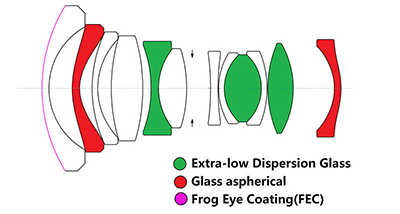
Low Dispersion Glass
3. How Does Low Dispersion Glass Reduce Chromatic Aberration?
Chromatic aberration occurs because different wavelengths of light do not follow exactly the same optical path through a dispersive lens system. This can produce different focal positions for different colors.
Low dispersion glass helps reduce this problem by limiting the variation in refractive index across the visible spectrum. In more advanced optical systems, designers combine different glass types to compensate for wavelength-dependent focusing errors.
Two Common Types of Chromatic Aberration
Longitudinal Chromatic Aberration
Longitudinal chromatic aberration occurs when different wavelengths focus at different positions along the optical axis. This can cause colored blur and reduced sharpness, especially around high-contrast details.
Lateral Chromatic Aberration
Lateral chromatic aberration occurs when different wavelengths produce slightly different image magnifications. It often appears as colored fringes toward the edges of an image.
Optical designers use material selection, lens element configuration, and optical optimization to control both types of chromatic aberration.
However, low dispersion glass alone does not eliminate all chromatic aberration. The final result depends on the complete optical prescription, including lens curvature, element spacing, material combinations, aperture, and operating wavelength.
4. Understanding the Abbe Number in Optical Glass
The Abbe number is an important parameter used to describe the dispersion characteristics of optical materials. It helps engineers compare how strongly different glasses disperse light.
For optical glasses characterized using the standard Fraunhofer spectral lines, the Abbe number is calculated as:
Vd = (nd – 1) / (nF – nC)
Where:
- nd: Refractive index at the helium d-line (587.6 nm).
- nF: Refractive index at the hydrogen F-line (486.1 nm).
- nC: Refractive index at the hydrogen C-line (656.3 nm).
In general, a higher Abbe number indicates lower dispersion over the specified spectral interval, while a lower Abbe number indicates higher dispersion.
Why Is the Abbe Number Important in Lens Design?
Optical engineers use the Abbe number together with refractive index to evaluate material combinations and design optical systems with improved chromatic correction.
However, the Abbe number does not describe every aspect of optical performance. It does not independently determine resolution, transmission, image contrast, or chromatic correction across all wavelengths.
For industrial imaging, material selection should also consider the operating wavelength, sensor response, optical configuration, and required image quality.
5. Low Dispersion Glass vs. Extra-Low Dispersion Glass
Low dispersion glass and extra-low dispersion glass are commonly discussed in optical engineering. Both refer to materials used to control chromatic dispersion, but the terms should not be treated as universal performance grades.
| Comparison | Low Dispersion Glass | Extra-Low Dispersion Glass |
|---|---|---|
| Dispersion | Relatively low dispersion | Designed for particularly low dispersion characteristics |
| Optical Design | Chromatic aberration control | More demanding chromatic correction requirements |
| Material Properties | Depends on glass composition | Depends on the specific ED formulation |
| Applications | General optical imaging systems | Specialized optical systems requiring improved color correction |
The actual difference between materials should be determined from their measured optical specifications, not simply from the ED or extra-low dispersion designation.
6. How Does Lens Dispersion Affect Industrial Imaging?
In industrial imaging, lens performance directly affects the quality of the optical information captured by the camera sensor. Although many machine vision systems use monochrome imaging, chromatic aberration can still affect focus and edge definition. In color imaging systems, it can also introduce unwanted color fringes.
Machine Vision and Automated Inspection
Machine vision systems often analyze small features, edges, surface defects, and geometric details. Uncontrolled chromatic aberration can reduce image contrast and affect the consistency of captured details.
Engineers should evaluate wavelength-dependent focus, image sharpness, distortion, and sensor compatibility when choosing an optical system for inspection.
Explore our machine vision lens solutions for industrial inspection, automated measurement, and factory automation applications.
High-Resolution Industrial Imaging
High-resolution cameras require optical systems capable of reproducing fine image details across the sensor area. Chromatic aberration can contribute to reduced edge sharpness and color fringing, particularly when the optical design is not properly optimized for the sensor and operating spectrum.
Lens resolution, MTF, sensor pixel size, image circle, and chromatic correction should therefore be evaluated together.
For applications requiring high-resolution industrial imaging, explore our C-Mount industrial lenses.
Color Imaging and Precision Measurement
Color imaging systems may be more sensitive to wavelength-dependent image differences. In applications such as color inspection, optical measurement, and scientific imaging, controlling chromatic aberration can help maintain consistent image reproduction.
The appropriate optical solution depends on the sensor’s spectral response, illumination source, measurement requirements, and working wavelength.
7. Low Dispersion and Wide Aperture: What Is the Relationship?
Low dispersion and wide aperture describe two different optical characteristics, Low dispersion relates to how an optical material refracts different wavelengths, while aperture determines how much light enters the lens.
A lens can have a wide aperture without using low dispersion glass, and a low dispersion optical design does not necessarily require a particularly large aperture.
What Is a Wide Aperture?
Aperture describes the effective opening through which light enters a lens. It is commonly expressed using the F-number:
F-number = Focal Length / Entrance Pupil Diameter
A smaller F-number indicates a larger relative aperture and generally allows more light to reach the image sensor.
For example, an F1.4 lens has a larger relative aperture than an F2.8 lens, assuming comparable transmission and operating conditions.
Why Is Aperture Important in Industrial Imaging?
- Low-light imaging: A larger aperture can help capture sufficient light in low-illumination environments.
- Exposure control: Aperture influences the available exposure and shutter-speed options.
- Depth of field: Aperture affects the range of object distances that appear acceptably sharp.
- Optical aberrations: Image quality can change with aperture because different ray bundles pass through the optical system.
A wide aperture can introduce additional optical design challenges. Spherical aberration, coma, astigmatism, and chromatic aberration must be controlled to maintain acceptable image quality.
Therefore, selecting a lens based only on its F-number is not sufficient. Engineers should evaluate aperture together with resolution, MTF, distortion, depth of field, and illumination requirements.
Learn more about fundamental optical parameters in our industrial lens basics guide.
8. How to Select an Optical Lens for Your Application
Selecting an industrial lens requires more than comparing glass materials or aperture specifications. The complete imaging system must be evaluated according to its optical, mechanical, and application requirements.
Step 1: Define the Imaging Requirements
Identify the target size, required field of view, working distance, illumination conditions, and inspection accuracy. These requirements determine the basic optical configuration.
Step 2: Match the Lens to the Camera Sensor
Check sensor format, pixel size, resolution, and spectral response. The selected lens must provide adequate image circle coverage and suitable optical performance for the camera.
Step 3: Evaluate Resolution and MTF
MTF describes how well a lens transfers image contrast at different spatial frequencies. It is an important indicator of image detail reproduction and should be considered alongside sensor pixel size and resolution.
Step 4: Consider Dispersion and Chromatic Aberration
For color imaging or applications with demanding focus requirements, evaluate chromatic aberration across the actual operating wavelength range. Low dispersion materials may be beneficial when the complete optical design requires improved chromatic correction.
Step 5: Evaluate Aperture and Depth of Field
Choose an aperture that provides sufficient light while maintaining the required depth of field and image quality. A larger aperture is not always the best choice for every industrial application.
Step 6: Verify the Complete Optical System
Final selection should consider distortion, relative illumination, working distance, mechanical dimensions, operating environment, and manufacturing requirements.
Follow our guide to choosing the right focal length for machine vision and industrial camera lens selection guide for more practical selection considerations.
9. Frequently Asked Questions About Low Dispersion Glass
Q1: What is low dispersion glass in optical lenses?
Low dispersion glass is optical glass with relatively small refractive-index changes across different wavelengths. It is used in optical designs to help reduce chromatic aberration and improve image quality.
Q2: How does low dispersion glass reduce chromatic aberration?
Low dispersion glass reduces wavelength-dependent refraction. When combined with other optical materials in a properly designed lens system, it helps bring different wavelengths closer to a common focal position.
Q3: What is the difference between ED glass and low dispersion glass?
ED stands for Extra-low Dispersion. It generally describes optical glass designed for particularly low dispersion characteristics. However, material classifications vary among manufacturers, so actual specifications should be checked.
Q4: What does the Abbe number tell us about optical glass?
The Abbe number describes the dispersion characteristics of an optical material over a defined spectral interval. In general, a higher Abbe number indicates lower dispersion.
Q5: Does low dispersion glass improve lens resolution?
Low dispersion glass can help improve image sharpness by reducing chromatic aberration. However, resolution also depends on lens design, MTF, manufacturing tolerances, sensor characteristics, and other optical aberrations.
Q6: Do all wide-aperture lenses use low dispersion glass?
No. Wide aperture and low dispersion are separate optical characteristics. Some wide-aperture lenses use low dispersion elements, while others rely on different optical configurations and material combinations.
Q7: Is low dispersion glass important for machine vision lenses?
It can be important in machine vision applications where chromatic aberration, wavelength-dependent focus, and image detail require careful control. Its importance depends on whether the system uses monochrome or color imaging and on its operating wavelength and accuracy requirements.
Q8: How do I choose the right industrial lens for my application?
Start with sensor size, field of view, working distance, resolution, and illumination requirements. Then evaluate aperture, distortion, MTF, chromatic aberration, and mechanical compatibility. The best lens is the one that meets the complete imaging requirements rather than maximizing a single specification.
10. Conclusion: Choosing the Right Low Dispersion Optical Design
Low dispersion glass is an important material consideration in optical lens engineering. By helping control chromatic aberration, it can support improved image sharpness, color consistency, and optical performance in demanding imaging systems.
However, material selection is only one part of successful optical design. Aperture, resolution, MTF, distortion, sensor compatibility, and operating wavelength must all be considered to achieve reliable imaging performance.
For industrial imaging applications, choosing the right lens requires a complete understanding of the camera, target, environment, and optical requirements.
Looking for the Right Industrial Lens Solution?
TOWIN provides industrial optical lens solutions for machine vision, robotics, AI imaging, automotive cameras, and other industrial applications. Our team can help evaluate sensor compatibility, focal length, field of view, resolution, distortion, and custom optical requirements.
Explore our
industrial lens products
or contact our engineering team to discuss your imaging project.