


What Causes Lens Distortion?
07/07/2026
What Is Low-Distortion Imaging?
07/09/2026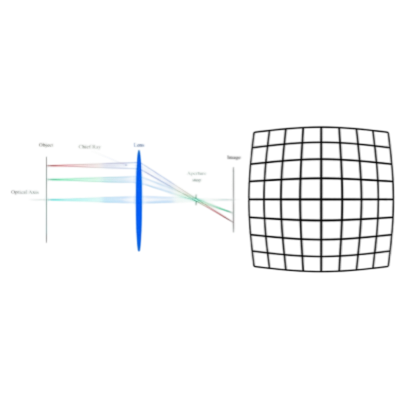
Does focal length affect distortion? This is one of the most frequently asked questions when selecting lenses for machine vision, industrial inspection, robotics, and smart imaging systems. Many people assume that shorter focal lengths automatically create distortion while longer focal lengths eliminate it. In reality, the relationship is much more complex.
Focal length influences the field of view and the apparent amount of distortion, but it is not the only factor that determines image geometry. Optical design, lens construction, sensor size, and camera position all contribute to the final imaging result.
In this guide, you’ll learn how focal length affects optical distortion, why wide-angle lenses usually exhibit stronger barrel distortion, when telephoto lenses still produce distortion, and how to choose the right lens for precision measurement applications.
If you’re new to geometric distortion, we recommend first reading our Lens Distortion Guide, which explains distortion types, measurement methods, and correction techniques in detail.
Quick Answer: Does Focal Length Affect Distortion?
Yes—but not directly.
Focal length itself does not generate optical distortion. Instead, different focal lengths are typically designed with different optical structures, resulting in varying distortion characteristics.
Generally speaking:
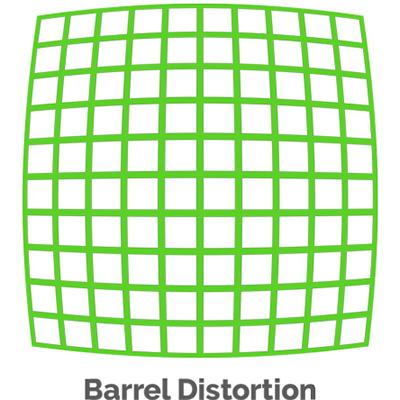
- Wide-angle lenses (short focal lengths) tend to produce more visible barrel distortion.
- Standard focal lengths usually provide balanced image geometry.
- Telephoto lenses often exhibit very low distortion but may introduce slight pincushion distortion depending on the optical design.
It is also important to distinguish between optical distortion and perspective distortion. Perspective changes are primarily caused by camera position rather than focal length.
- ✔ Optical distortion depends mainly on lens design.
- ✔ Perspective distortion depends mainly on camera distance.
- ✔ Wide-angle lenses usually show stronger barrel distortion.
- ✔ Low-distortion industrial lenses are optimized regardless of focal length.
Understanding the Relationship Between Focal Length and Distortion
To understand why focal length appears to affect distortion, it helps to examine what focal length actually changes inside an imaging system.
Focal length determines:
- Field of View (FOV)
- Magnification
- Working distance
- Viewing angle
- Lens optical complexity
As focal length becomes shorter, the viewing angle becomes wider. This requires incoming light rays to bend more aggressively toward the sensor, making optical correction significantly more difficult.
This is why ultra-wide lenses generally exhibit higher geometric distortion than longer focal length lenses.
| Focal Length | Typical Field of View | Common Distortion | Typical Applications |
|---|---|---|---|
| 2.8 mm | Very Wide | High Barrel Distortion | Security Cameras |
| 4 mm | Wide | Moderate Barrel Distortion | Robotics |
| 6 mm | Medium Wide | Low Distortion | Machine Vision |
| 8 mm | Standard | Very Low | Industrial Inspection |
| 16 mm | Narrow | Minimal Distortion | Measurement Systems |
| 25 mm | Telephoto | Very Low | Precision Metrology |
Keep in mind that these are general trends rather than fixed rules. Two different 4 mm lenses from different manufacturers may exhibit significantly different distortion performance because of differences in optical design.
Optical Distortion vs. Perspective Distortion
Many users confuse optical distortion with perspective distortion. Although they may appear similar, they are caused by completely different factors.
| Optical Distortion | Perspective Distortion |
|---|---|
| Caused by lens design | Caused by camera position |
| Curved straight lines | Objects appear stretched or compressed |
| Usually measured as a percentage | Cannot be expressed as optical distortion |
| Can often be corrected by calibration | Requires changing camera position |
| Affects dimensional accuracy | Affects visual appearance |
For a complete explanation of barrel distortion, pincushion distortion, mustache distortion, and measurement methods, see our Lens Distortion Guide.
Why Do Wide-Angle Lenses Show More Distortion?
Wide-angle lenses are designed to capture a much larger scene than standard or telephoto lenses. Covering a wider field of view requires incoming light rays to bend significantly before reaching the image sensor, increasing the difficulty of maintaining perfectly straight image geometry.
1. Larger Viewing Angle
A wider field of view means light enters the lens from much steeper angles. Optical engineers must balance resolution, brightness, aberration correction, and distortion simultaneously.
2. More Complex Optical Design
Wide-angle lenses often require multiple aspherical elements to compensate for distortion. Lower-cost lenses typically simplify this design, resulting in more visible barrel distortion.
3. Edge Ray Bending
The farther light rays travel from the optical center, the more difficult they become to control. This is why distortion is usually most noticeable near the image edges.
If your application requires precise measurements instead of maximum field of view, selecting a dedicated low-distortion lens is generally more important than simply choosing a longer focal length.
How Different Focal Lengths Compare
The following comparison provides a practical overview of distortion characteristics across common industrial focal lengths.
| Focal Length | Distortion Level | Field of View | Recommended Applications |
|---|---|---|---|
| 2.8 mm | High | Ultra Wide | Surveillance, Smart City |
| 4 mm | Moderate | Wide | Robotics, Mobile Vision |
| 6 mm | Low | Medium | Factory Automation |
| 8 mm | Very Low | Standard | Machine Vision Inspection |
| 12 mm | Ultra Low | Narrow | Precision Measurement |
| 25 mm | Minimal | Telephoto | Metrology & Laboratory Systems |
Choosing the correct focal length should always consider:
- Sensor size
- Working distance
- Required field of view
- Measurement accuracy
- Lens distortion specification
You can estimate the required viewing angle using our Interactive FOV Calculator, and learn how sensor size influences image coverage in our Sensor Size Guide.
Does a Longer Focal Length Always Mean Lower Distortion?
The short answer is no.
Although longer focal length lenses generally exhibit less visible geometric distortion, focal length alone does not determine distortion performance. The overall optical design is far more important.
For example, a poorly designed 25 mm lens may produce more distortion than a high-quality 6 mm industrial lens that has been specifically optimized for machine vision.
Several factors influence distortion performance:
- Optical design and lens architecture
- Number of aspherical lens elements
- Glass quality and manufacturing precision
- Sensor size compatibility
- Mechanical assembly accuracy
- Factory calibration and quality control
This is why industrial machine vision lenses often advertise a maximum distortion specification (such as <0.1%) instead of simply promoting a particular focal length.
How Does Focal Length Affect Machine Vision Accuracy?
In industrial imaging systems, distortion is more than a visual issue—it directly impacts measurement accuracy.
Applications such as:
- PCB inspection
- Semiconductor inspection
- OCR and barcode reading
- Robot guidance
- Dimensional metrology
- Automated optical inspection (AOI)
all require accurate image geometry.
Even a small amount of distortion can introduce measurable errors, especially near the edges of the image.
Example: PCB Measurement
| Measurement Item | Standard Lens | Low Distortion Lens |
|---|---|---|
| Actual PCB Width | 100 mm | 100 mm |
| Measured Width | 101.8 mm | 100.1 mm |
| Measurement Error | +1.8 mm | +0.1 mm |
| Distortion | 1.8% | 0.1% |
Although the difference appears small, a measurement error of nearly 2 mm may be unacceptable in precision manufacturing.
Industrial machine vision systems therefore prioritize low-distortion lenses, especially when performing:
- Dimension inspection
- Precision alignment
- Camera calibration
- Robot positioning
- Coordinate measurement
To understand how distortion is evaluated in laboratory testing, read our complete Lens Distortion Guide.
How to Choose the Right Focal Length for Low-Distortion Applications
Selecting a focal length should never be based solely on image size. Instead, engineers should consider the entire imaging system.
Step 1 — Determine Sensor Size
The sensor size determines the required image circle and influences the available field of view.
If you’re unsure which sensor matches your application, see our Sensor Size Guide.
Step 2 — Calculate the Required Field of View
The required field of view determines the approximate focal length.
Use our Interactive FOV Calculator to quickly estimate the correct focal length based on sensor size and working distance.
Step 3 — Define Measurement Accuracy
If your application requires dimensional measurement rather than simple image capture, distortion becomes a critical specification.
Look for published distortion values such as:
- <2%
- <1%
- <0.5%
- <0.1%
The lower the distortion, the higher the measurement accuracy.
Step 4 — Consider Working Distance
Sometimes increasing the working distance allows a longer focal length to achieve the same field of view while reducing optical challenges.
However, this approach depends on installation space and system layout.
Step 5 — Select an Industrial Low-Distortion Lens
Instead of choosing lenses purely by focal length, prioritize products specifically designed for machine vision and measurement applications.
| Application | Recommended Focal Length | Recommended Distortion |
|---|---|---|
| Smart Security | 2.8–4 mm | <3% |
| Robot Vision | 4–8 mm | <1% |
| Factory Automation | 6–12 mm | <0.5% |
| OCR / Code Reading | 8–16 mm | <0.3% |
| Precision Measurement | 12–25 mm | <0.1% |
↓
Sensor Size
↓
Working Distance
↓
Required Field of View
↓
Required Measurement Accuracy
↓
Choose a Low-Distortion Lens
Recommended Low-Distortion Lens Solutions
The best focal length depends on your application, but choosing a lens specifically engineered for industrial imaging is equally important.
| Lens Type | Advantages | Typical Applications |
|---|---|---|
| M12 Low-Distortion Lens | Compact, lightweight, low distortion | Embedded Vision, Robotics, AI Cameras |
| C-Mount Machine Vision Lens | High resolution, industrial standard | Inspection, AOI, Factory Automation |
| FA Lens | High optical precision | Industrial Vision Systems |
| Telecentric Lens | Near-zero distortion and constant magnification | Metrology and Precision Measurement |
If you’re selecting a lens for industrial applications, you may also find these resources helpful:
These guides explain how sensor size, focal length, resolution, distortion, and working distance work together when selecting the most suitable industrial lens.
Frequently Asked Questions
1. Does focal length affect distortion?
Yes, but indirectly. Focal length influences the field of view and the optical design required to produce the image. Wide-angle lenses generally exhibit more barrel distortion, while longer focal lengths often show less visible distortion. However, the overall optical design of the lens has a much greater impact than focal length alone.
2. Why do wide-angle lenses have more distortion?
Wide-angle lenses capture a much larger field of view, requiring light rays to bend at steeper angles before reaching the image sensor. This makes distortion correction more challenging, especially near the edges of the image. High-quality industrial wide-angle lenses use advanced optical designs and aspherical elements to minimize this effect.
3. Does zooming reduce distortion?
Not necessarily. Zooming in often reduces the visible appearance of barrel distortion because the field of view becomes narrower. However, the actual distortion characteristics depend on the lens design. Some zoom lenses may even introduce pincushion distortion at longer focal lengths.
4. Is perspective distortion the same as optical distortion?
No. Optical distortion is caused by the lens itself and changes the geometry of straight lines. Perspective distortion is caused by camera position and the distance between the camera and the subject. Changing focal length without moving the camera does not create perspective distortion.
5. What level of distortion is acceptable for machine vision?
The acceptable distortion depends on the application.
| Application | Recommended Distortion |
|---|---|
| General Surveillance | <3% |
| Robot Vision | <1% |
| OCR & Barcode Reading | <0.5% |
| Industrial Measurement | <0.1% |
| Precision Metrology | Near Zero (Telecentric) |
6. Which lens is best for precision measurement?
Applications requiring dimensional accuracy should use low-distortion machine vision lenses or telecentric lenses. These lenses are specifically designed to maintain consistent image geometry across the entire field of view.
Related Resources
To gain a deeper understanding of industrial optics and lens selection, explore these related resources:
- Lens Distortion Guide
- Field of View (FOV) Calculator
- Sensor Size Guide
- Industrial Lens Selection Guide
- Machine Vision Lens Solutions
- M12 Lens Solutions
Conclusion
Does focal length affect distortion? The answer is yes—but only indirectly. While shorter focal lengths often appear to produce more distortion and longer focal lengths generally exhibit better image geometry, the most important factor is still the optical design of the lens.
For industrial machine vision, robotics, factory automation, and precision measurement systems, selecting a high-quality low-distortion lens is far more important than choosing focal length alone. Engineers should evaluate focal length together with sensor size, working distance, field of view, resolution, and distortion specifications to achieve optimal imaging performance.
To further explore distortion types, measurement methods, and correction techniques, visit our Lens Distortion Guide. You can also use our FOV Calculator and Lens Selection Guide to choose the right industrial lens for your application.
Ultimately, understanding Does focal length affect distortion is the first step toward selecting the right lens for accurate, reliable, and high-performance machine vision systems.