


What is a SLAM Camera Lens? Complete Guide for Robotics Vision Systems
06/22/2026
Can Medical Imaging Lenses Support AI Diagnostics?
06/23/2026
Optical distortion is one of the most important image quality parameters in machine vision, industrial inspection, robotics, medical imaging, and intelligent transportation systems. When distortion occurs, straight lines appear curved, objects become stretched or compressed, and measurement accuracy can be significantly reduced.
Whether you are selecting a machine vision lens or designing an industrial camera system, understanding the causes of optical distortion helps improve calibration accuracy, reduce image errors, and achieve more reliable inspection results.
In this guide, we explain what optical distortion is, the major factors that cause it, different distortion types, and the key parameters engineers should evaluate when selecting an industrial lens.
If you are new to industrial optics, we also recommend reading our Industrial Lens Knowledge Center, which contains comprehensive resources on machine vision optics, lens selection, sensor compatibility, and optical design.
What Is Optical Distortion?
Optical distortion is a geometric imaging error that changes the shape or position of objects without affecting image sharpness. Unlike blur or focus errors, distortion changes the spatial relationship of pixels, causing straight lines to bend or objects to appear larger or smaller than they actually are.
In industrial measurement applications, even a small distortion percentage can lead to inaccurate dimensional inspection and calibration errors.
For a complete overview of industrial lens fundamentals, visit our Lens Basics Guide.
Why Optical Distortion Matters
- Improves measurement accuracy
- Reduces calibration complexity
- Enhances AI vision recognition performance
- Provides consistent object dimensions
- Improves robotic positioning precision
What Causes Optical Distortion?
There is no single reason behind optical distortion. Instead, it is usually the result of multiple optical and mechanical factors working together.
1. Lens Optical Design
Lens design is the primary factor influencing distortion performance. Wide-angle lenses typically exhibit more barrel distortion because peripheral light rays travel through the optical system at larger angles. Telephoto lenses, on the other hand, are more likely to produce pincushion distortion.
Modern industrial lenses often use multiple glass elements and aspherical optics to minimize distortion while maintaining image resolution.
Learn more about industrial optical structures in our Optical Design Guide.
2. Focal Length
F.l. has a direct relationship with distortion characteristics.
| Focal Length | Typical Distortion | Applications |
|---|---|---|
| 2.8mm – 6mm | Higher Barrel Distortion | Wide-angle Security Cameras |
| 8mm – 16mm | Moderate Distortion | Machine Vision |
| 25mm – 50mm+ | Lower Distortion | Precision Measurement |
Selecting the appropriate focal length requires balancing field of view, working distance, and measurement accuracy.
You can learn more in our Lens Selection Guide.
3. Sensor Size Compatibility
An industrial lens should always match the camera sensor size. When the image circle barely covers the sensor, edge distortion becomes more noticeable and image quality may decrease.
Choosing the correct sensor format significantly improves overall imaging performance.
Related reading: Sensor Size Guide.
4. Manufacturing Precision
Industrial lenses require extremely high manufacturing accuracy. Even small deviations in glass alignment, assembly tolerance, or lens centering can increase distortion.
High-quality FA lenses and machine vision lenses undergo strict quality control processes to ensure stable distortion performance throughout mass production.
5. Working Distance and Object Position
Objects located near the edge of the image or captured at extremely short working distances often appear more distorted than objects positioned near the optical center.
Proper system design helps reduce these geometric effects.
6. Digital Image Correction
Many AI cameras and machine vision systems apply software correction algorithms after image capture. Although digital correction can compensate for geometric distortion, optical correction remains the preferred solution because it preserves measurement accuracy and image resolution.
Common Types of Optical Distortion
Different lens designs produce different distortion characteristics. Understanding these patterns helps engineers select the appropriate lens for specific industrial applications.
| Distortion Type | Appearance | Common Applications |
|---|---|---|
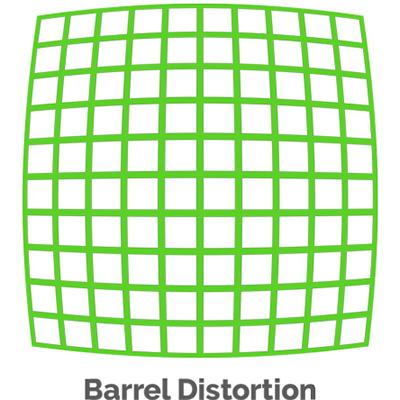
| Barrel Distortion | Straight lines curve outward | Wide-angle imaging |
| Pincushion Distortion | Straight lines curve inward | Telephoto optics |
| Mustache Distortion | Combination of barrel and pincushion | Ultra-wide industrial lenses |
Understanding these distortion patterns is especially important when selecting lenses for factory automation, robot guidance, and precision inspection systems.
For industrial applications, visit our Machine Vision Solutions.
Optical Distortion Parameter Comparison
When evaluating industrial lenses, engineers often compare TV distortion values together with calibration complexity and measurement performance.
| Parameter | Low Distortion Lens | Standard Lens |
|---|---|---|
| TV Distortion | <0.1% | 2% – 5% |
| Measurement Accuracy | Excellent | Moderate |
| Calibration Difficulty | Low | Higher |
| AI Vision Performance | Excellent | Good |
| Industrial Inspection | Highly Recommended | General Purpose |
For precision measurement applications, selecting a low distortion FA lens greatly improves dimensional consistency and reduces software correction requirements.
You may also find these resources helpful:
- FOV Calculator
- Optical Design Guide
- Sensor Size Guide
- Lens Selection Guide
- Distortion Guide
- Machine Vision Solutions
How Optical Distortion Affects Machine Vision Applications
Optical distortion directly influences the accuracy of industrial vision systems. While software calibration can compensate for some geometric errors, selecting a low distortion lens is still the most effective solution for precision imaging.
In AI inspection, robotics, medical imaging, and intelligent transportation systems, distortion may reduce measurement consistency and increase calibration complexity.
Factory Automation
Machine vision inspection systems rely on accurate edge detection and dimensional measurement. Even small distortion values can affect product inspection results and reduce manufacturing efficiency.
Learn more about industrial applications in our Machine Vision Solution.
Robotics Vision
Robot guidance systems require precise object positioning. Low distortion imaging improves localization accuracy and enables more reliable robotic operation.
Related reading: Robotics Vision Solution.
Medical Imaging
Medical imaging systems require high geometric fidelity. Distortion-free images improve diagnostic reliability and image consistency.
Explore: Medical Imaging Solution.
Smart Traffic & ADAS
Traffic monitoring and ADAS cameras often utilize wide-angle optics. Selecting low distortion lenses helps maintain accurate lane detection, object recognition, and image calibration.
How to Choose a Low Distortion Industrial Lens
Selecting the right industrial lens requires balancing sensor compatibility, focal length, field of view, and distortion performance.
Step 1 — Confirm Sensor Size
Choose a lens with an image circle that fully covers the camera sensor to minimize edge distortion.
Reference: Sensor Size Guide.
Step 2 — Calculate Field of View
Determine the required field of view before selecting focal length.
Useful tool: FOV Calculator.
Step 3 — Select the Proper Focal Length
Longer focal lengths generally produce lower distortion, while ultra-wide lenses require more optical correction.
Step 4 — Review TV Distortion Specification
For industrial measurement applications, lenses with TV distortion below 0.1% are typically recommended.
Step 5 — Evaluate Working Distance
Working distance affects perspective and distortion characteristics. Proper optical system design improves measurement consistency.
Step 6 — Consider Calibration Requirements
Choosing a low distortion lens reduces calibration complexity and improves long-term imaging stability.
For a complete selection process, visit our Industrial Lens Selection Guide.
Recommended Low Distortion Lens Solutions
Towin offers multiple industrial imaging solutions designed for precision measurement and AI vision applications.
| Lens Type | Typical Distortion | Applications |
|---|---|---|
| Low Distortion FA Lens | <0.1% | Machine Vision Inspection |
| M12 Lens | Low to Moderate | AI Cameras & Robotics |
| ITS Lens | Optimized | Traffic Monitoring |
| Custom Industrial Lens | Customized | OEM & Precision Imaging |
Explore additional resources:
Frequently Asked Questions
1. What causes optical distortion?
Optical distortion is mainly caused by lens design, focal length, sensor compatibility, manufacturing precision, and optical configuration.
2. Can optical distortion be completely eliminated?
No. However, high-quality industrial lenses and software calibration can reduce distortion to extremely low levels suitable for precision measurement.
3. Why do wide-angle lenses have more distortion?
Wide-angle optics bend peripheral light rays more aggressively, making barrel distortion more common.
4. What is TV distortion?
TV distortion measures how much a captured image deviates from the actual object geometry and is commonly expressed as a percentage.
5. Does sensor size affect distortion?
Yes. A mismatch between lens image circle and sensor size can increase edge distortion and reduce image quality.
6. What is the difference between barrel and pincushion distortion?
Barrel distortion bends straight lines outward, while pincushion distortion bends them inward.
7. Are low distortion lenses necessary for machine vision?
For dimensional inspection, metrology, and robot guidance, low distortion lenses significantly improve measurement accuracy.
8. How do I select the right industrial lens?
Consider sensor size, focal length, field of view, distortion specification, working distance, and application requirements.
9. Can software correction replace optical correction?
Software correction improves geometry but may reduce effective resolution. Optical correction remains the preferred solution for high-precision applications.
Conclusion
Optical distortion is an unavoidable characteristic of every imaging system, but understanding its causes allows engineers to make better lens selection decisions and improve imaging accuracy.
By evaluating lens design, focal length, sensor compatibility, manufacturing precision, and calibration requirements, users can significantly reduce distortion and achieve more reliable industrial vision performance.
To further improve your optical system design, explore the Industrial Lens Knowledge Center, learn from the Distortion Guide, review the Lens Selection Guide, or discover our Machine Vision Solutions. Choosing the right industrial lens is the most effective way to minimize optical distortion and maximize imaging performance.