


The Importance of ISO 9001 Certification in Optical Mfg
03/21/2026
Telephoto vs. Wide-Angle Lens: FOV Optimization Guide
03/23/2026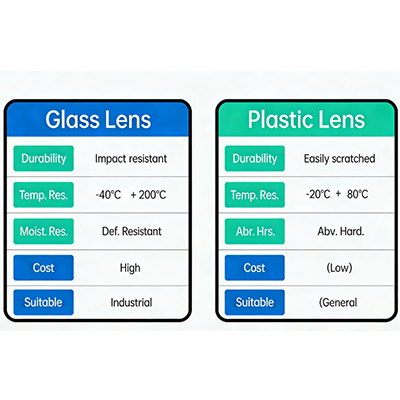
Table of Contents
Key Takeaways
- Glass lenses last significantly longer under harsh conditions, with superior scratch resistance, thermal stability, and optical lifespan; ideal for industrial, automotive, and outdoor surveillance.
- Plastic lenses offer better impact resistance, lighter weight, and lower cost, but degrade faster from scratches, heat, and UV exposure; suited for consumer electronics, lightweight devices, and high-volume projects.
- For long‑term durability: Choose glass. For cost, weight, and shatter resistance: Choose plastic. For best balance: Use glass‑plastic hybrid lenses.
Introduction
When designing cameras, vision systems, or optical devices, Glass vs. Plastic Lenses is one of the most critical decisions you’ll make. Many buyers ask: Which material is more durable? Which offers longer service life? Which fits my application and budget?
At TOWIN, a professional optical lens supplier, we design and manufacture both glass and plastic lenses for global customers. In this guide, we compare durability, performance, cost, and real‑world use cases to help you choose the right lens for long‑term reliability.
Glass vs. Plastic Lenses: Full Comparison
1. Core Durability Comparison Table
| Parameter | Glass Lenses | Plastic Lenses | Winner for Longevity |
| Scratch resistance | High (Mohs 5–7) | Low (Mohs 2–4) | Glass |
| Thermal stability | Excellent, stable up to 300–500°C | Poor, deforms above 80–120°C | Glass |
| UV resistance | Stable, needs coating for UV blocking | Degrades over time, yellows | Glass |
| Impact resistance | Brittle, prone to shattering | High, shatter‑proof | Plastic |
| Service life | 5–10+ years in harsh environments | 1–3 years in harsh environments | Glass |
| Weight | Heavier | Lighter (30–50% of glass) | Plastic |
2. Environmental Durability Breakdown
- Temperature resistance
- Glass: Stable in extreme heat/cold; no warping or optical shift.
- Plastic: Expands/contracts with temperature; deforms in high heat; loses focus clarity.
- Moisture & chemical resistance
- Glass: Inert, waterproof, chemical‑resistant.
- Plastic: Absorbs moisture; degraded by oils, solvents, and cleaning agents.
- Abrasion resistance
- Glass: Maintains surface smoothness for years.
- Plastic: Scratches easily; reduces image sharpness over time.
Key Properties of Glass Lenses
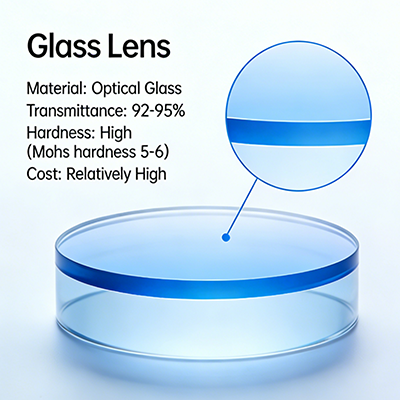
Glass lenses are made from high‑purity optical glass, engineered for stability and longevity.
Advantages
- Exceptional scratch resistance
- Excellent thermal and dimensional stability
- High light transmittance and optical clarity
- Long service life in industrial and outdoor environments
- Ideal for high‑resolution, low‑distortion, and IR‑corrected designs
Best For
- Industrial machine vision
- Automotive cameras
- Outdoor CCTV & surveillance
- Traffic monitoring (ITS lenses)
- High‑end medical and thermal imaging
Limitations
- Heavier than plastic
- Brittle under strong impact
- Higher material and processing cost
Key Properties of Plastic Lenses
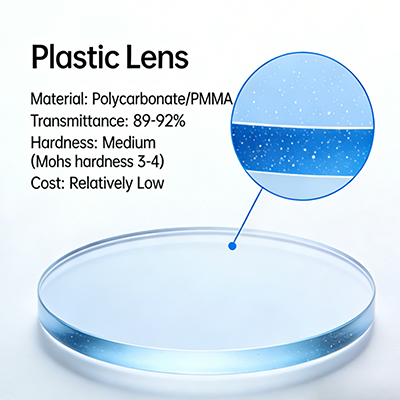
Plastic (polymer/resin) lenses use optical‑grade materials like PMMA, PC, and COC, molded for mass production.
Advantages
- Ultra‑lightweight for compact designs
- High impact resistance (shatter‑proof)
- Easy to mold into complex shapes
- Low cost for high‑volume production
- Good for consumer electronics and portable devices
Best For
- Webcams, dash cams, and home security cameras
- Mobile and lightweight imaging devices
- High‑volume, cost‑sensitive projects
- Toys, home electronics, and disposable devices
Limitations
- Low scratch resistance
- Poor heat and UV stability
- Prone to yellowing and deformation
- Shorter functional lifespan
Glass Lenses
Glass vs. Plastic Lenses: Cost Analysis
Cost Structure
- Glass lenses
- Higher raw material cost
- Complex grinding and polishing process
- Higher tooling investment
- Better long‑term value due to longer life
- Plastic lenses
- Lower material cost
- Fast injection molding
- Lower tooling cost
- Lower upfront price; higher replacement cost over time
Total Cost of Ownership (TCO)
- Short lifecycle (1–2 years): Plastic is cheaper.
- Long lifecycle (3+ years): Glass has lower TCO.
- High durability requirement: Glass reduces downtime and replacement costs.
Ideal Application Scenarios
Choose Glass Lenses When
- You need 3+ years of service life
- Used outdoors, in vehicles, or industrial environments
- High temperature, dust, or vibration
- High resolution and stable optics required
- Applications: Machine vision, automotive, ITS, surveillance
Choose Plastic Lenses When
- Budget is limited
- Weight and size are critical
- High volume and short product cycle
- Indoor, low‑abuse consumer devices
- Applications: Webcams, home electronics, toys
Hybrid Glass‑Plastic Lenses
- Balance of durability, weight, and cost
- High‑resolution miniaturized designs
- Most modern camera modules (M12/board lenses)
Plastic Lenses
Quick Selection Flowchart
1. What’s your sensor size?
- Small (1/4″–1/3″): Plastic or hybrid
- Medium (1/2.3″–1/2″): Hybrid
- Large (1/1.8″ and above): Glass
2. What’s your budget?
- Low: Plastic
- Mid: Hybrid
- High: Glass
3. What’s your application environment?
- Harsh (outdoor/industrial/automotive): Glass
- Mild (indoor/consumer): Plastic
4. How long do you need it to last?
- <2 years: Plastic
- 2–5 years: Hybrid
- 5+ years: Glass
Final Rule: For maximum longevity → Glass. For cost and weight → Plastic. For balance → Hybrid.
FAQs
Q: Do glass lenses really last longer than plastic lenses?
A: Yes. Glass resists scratches, heat, and UV far better. In harsh environments, glass lasts 2–5x longer than plastic.
Q: Are plastic lenses easier to break?
A: No. Plastic has much higher impact resistance; it bends rather than shatters.
Q: Which is better for M12/board lenses?
A: Many TOWIN M12 lenses use hybrid design for sharpness, durability, and compactness.
Q: Can plastic lenses be coated to last longer?
A: Yes. Hard‑coated and anti‑scratch plastic lenses improve durability but still don’t match glass.
Q: Which is better for day/night IR cameras?
A: Glass performs better for IR correction and long‑term stability.
Conclusion
When comparing Glass vs. Plastic Lenses for durability and service life, glass lenses clearly last longer and perform better under stress. Plastic lenses excel at low cost, light weight, and shatter resistance.
At TOWIN, we provide full‑range optical lenses: M12/S‑mount, C‑mount, CS‑mount, fisheye, wide‑angle, low‑distortion, and TOF lenses in glass, plastic, and hybrid designs. We help you select the most durable and cost‑effective solution.
If you need long‑lasting lenses for industrial, automotive, or surveillance use, glass is the top choice. For consumer and lightweight projects, plastic offers great value.
Need help selecting glass or plastic lenses for your project? Contact TOWIN at info@towin‑elec.com for professional design and manufacturing support.