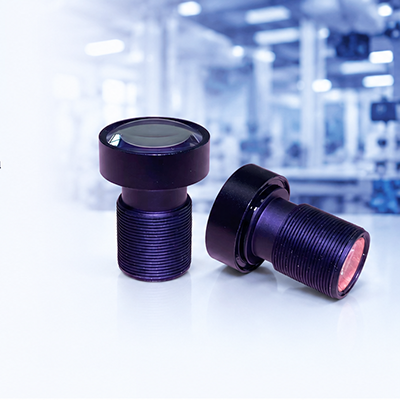



High-resolution CS-Mount lenses for machine vision
11/13/2025
What size is a M12 lenses?
11/13/2025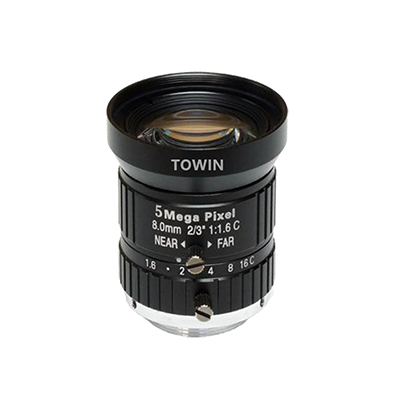
When selecting an industrial camera lens, you may come across the term C-Mount. But what does C Mount mean in lenses, and why is it widely used in machine vision, industrial inspection, and scientific imaging?
A C-Mount lens refers to a standardized threaded lens mounting interface that connects a lens to a compatible camera. It features a 1-inch diameter thread with 32 threads per inch and a standard flange focal distance of 17.526 mm.
For industrial imaging systems, understanding the C Mount standard is essential for ensuring mechanical compatibility, accurate focusing, and reliable image performance. This guide explains the C Mount definition, technical specifications, C Mount vs CS-Mount differences, and how to select the right C-Mount industrial lens for your application.
1. What Does C-Mount Mean in Lenses?
A C-Mount lens is a camera lens designed with a standardized threaded interface for connecting to compatible cameras.
The C-Mount standard is widely used in industrial cameras, machine vision systems, CCTV equipment, and microscopy. Its threaded connection provides a practical and secure way to attach a lens to a camera.
The key characteristics of a C-Mount include:
- Thread diameter: 1 inch (25.4 mm)
- Thread specification: 1″-32 UN
- Thread pitch: 32 threads per inch (approximately 0.794 mm)
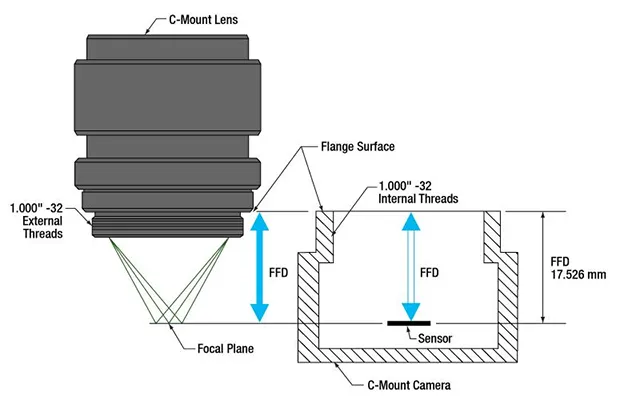
- Flange focal distance: 17.526 mm (0.690 inch)
The flange focal distance is the distance from the lens mounting reference surface to the camera’s image plane when the lens is correctly mounted.
Unlike focal length, which determines the angle of view and image magnification, flange focal distance is a mechanical mounting specification.
In industrial imaging, this distinction is important because a lens may have the correct focal length and sensor coverage but still fail to achieve proper focus if its mounting standard is incompatible with the camera.
2. C-Mount Lens Technical Specifications
Understanding the technical specifications of C-Mount lenses helps engineers select compatible lenses for different industrial cameras.
2.1 C-Mount Thread Size
C-Mount uses a standardized 1-inch thread with 32 threads per inch.
The nominal thread diameter is 25.4 mm, and the thread pitch is approximately 0.794 mm.
This standardized threaded interface allows C-Mount lenses to be installed on compatible industrial cameras without requiring a special mounting adapter.
When selecting a lens, always confirm that both the camera and lens use the same mounting interface.
2.2 C-Mount Flange Focal Distance
The standard C-Mount flange focal distance is 17.526 mm.
This measurement represents the distance between the lens mounting reference surface and the camera sensor’s image plane.
It ensures that the lens can be positioned correctly relative to the image sensor to achieve the designed focusing range.
It is important not to confuse flange focal distance with back focal length.
- Flange Focal Distance (FFD): The distance from the mounting reference surface to the image plane.
- Back Focal Length (BFL): The distance from the rear optical surface of the lens to the image plane.
These measurements describe different optical and mechanical relationships and should not be used interchangeably.
2.3 C-Mount Lens and Sensor Size Compatibility
C-Mount is a mounting standard, not a sensor-size specification.
A C-Mount lens can be designed for different sensor formats, depending on its optical design and image circle.
Common industrial camera sensor formats include:
- 1/2.5-inch
- 1/1.8-inch
- 2/3-inch
- 1-inch
- 4/3-inch
Not every C-Mount lens supports every sensor size.
For example, a lens designed for a 1/2.5-inch sensor may produce vignetting when used with a larger sensor.
Therefore, the lens image circle must be large enough to cover the camera sensor’s active area.
For high-resolution machine vision applications, engineers should also consider lens resolution, pixel size, distortion, and relative illumination.
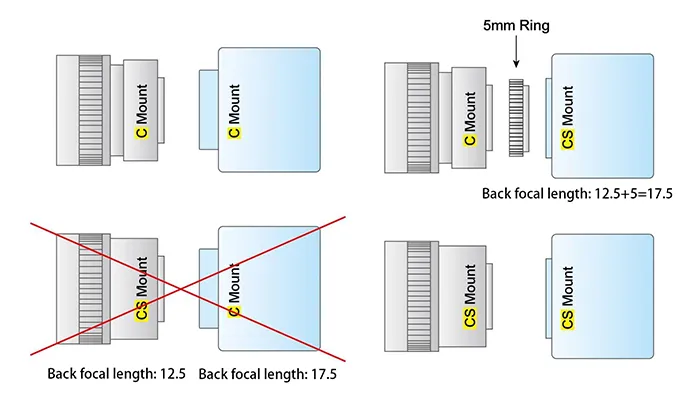
C-Mount and CS-Mount Compatibility
3. C-Mount vs CS-Mount: What Is the Difference?
C-Mount and CS-Mount are two closely related threaded mounting standards commonly found in industrial and security cameras.
Both use the same nominal 1-inch diameter, 32-threads-per-inch interface. However, their flange focal distances are different.
| Specification | C-Mount | CS-Mount |
|---|---|---|
| Thread diameter | 25.4 mm | 25.4 mm |
| Thread specification | 1″-32 UN | 1″-32 UN |
| Flange focal distance | 17.526 mm | 12.526 mm |
| Difference | — | 5 mm shorter |
| Typical applications | Machine vision, industrial imaging, microscopy | CCTV and compact imaging systems |
Can You Use a C-Mount Lens on a CS-Mount Camera?
Yes. A C-Mount lens can generally be used on a CS-Mount camera by installing a 5 mm C/CS spacer or adapter ring between the lens and camera.
This spacer compensates for the difference in flange focal distance and allows the lens to achieve the correct focusing position.
Can You Use a CS-Mount Lens on a C-Mount Camera?
Generally, no.
A CS-Mount lens is designed for a shorter flange focal distance. A conventional adapter cannot move the lens close enough to the sensor on a standard C-Mount camera.
Check the lens and camera mounting standards before installation.
4. Where Are C-Mount Lenses Used?
C-Mount lenses are widely used in industrial and scientific imaging because they offer a standardized mechanical connection and are available in a broad range of optical configurations.
4.1 Machine Vision and Factory Automation
In machine vision systems, C-Mount lenses are commonly used for automated inspection, measurement, positioning, and defect detection.
Users can integrate them with industrial cameras to capture detailed images of components moving along production lines.
Typical applications include:
- Automated optical inspection (AOI)
- Component measurement
- Surface defect detection
- Barcode and character recognition
- Electronic component inspection
For these applications, lens resolution, focal length, distortion, and depth of field should be matched to the inspection requirements.
4.2 Industrial Inspection
Industrial inspection systems often require consistent image quality and accurate object measurement.
C-Mount lenses are available in different focal lengths, apertures, and optical configurations, making them suitable for various inspection distances and fields of view.
Low-distortion lenses are particularly useful when image geometry and dimensional measurement accuracy are important.
4.3 Traffic Monitoring and Intelligent Transportation Systems
Designers also deploy C-Mount lenses in certain traffic monitoring and intelligent transportation systems (ITS).
Depending on the camera configuration, they can support:
- Vehicle identification
- License plate recognition
- Traffic flow monitoring
- Roadside surveillance
These applications may require specific focal lengths, wide operating temperature ranges, and appropriate optical performance under different lighting conditions.
4.4 Microscopy and Scientific Imaging
Designers commonly use C-Mount interfaces for microscopy cameras and scientific imaging equipment.
They allow compatible optical systems to connect to digital cameras for image capture, documentation, and analysis.
The appropriate lens or optical adapter depends on the microscope’s optical configuration and required field of view.
5. How to Choose the Right C-Mount Lens
Selecting a C-Mount lens involves more than checking whether the thread fits the camera.
Evaluate the following factors before choosing a lens.
5.1 Check the Camera Sensor Size
The lens image circle must cover the active area of the camera sensor.
If the image circle is too small, the resulting image may show dark corners or vignetting.
Always check the manufacturer’s specified sensor format before selecting a lens.
5.2 Select the Appropriate Focal Length
Focal length determines the angle of view and affects the field of view at a given working distance.
A shorter focal length generally provides a wider field of view, while a longer focal length provides a narrower field of view.
The correct focal length depends on:
- Camera sensor dimensions
- Working distance
- Object dimensions
- Required field of view
5.3 Match Lens Resolution to Camera Resolution
For high-resolution industrial cameras, lens resolution should be sufficient to support the sensor’s imaging requirements.
Consider the sensor pixel size, megapixel rating, optical MTF performance, and the level of detail required for inspection.
A high-megapixel camera alone does not guarantee high image detail if the lens cannot resolve the corresponding spatial frequencies.
5.4 Consider Aperture and Lighting Conditions
Aperture affects the amount of light reaching the sensor, depth of field, and image sharpness.
A larger maximum aperture (lower F-number) can help in low-light conditions.
However, the optimal working aperture should also consider depth of field, optical aberrations, and the available lighting.
5.5 Evaluate Distortion and Other Optical Characteristics
For precision measurement and machine vision applications, distortion can influence measurement accuracy.
Other important factors include:
- Relative illumination
- Chromatic aberration
- Chief ray angle (CRA)
- Working wavelength
- Depth of field
- Operating temperature
The final selection should be based on the complete imaging system rather than the mount type alone.
C-Mount Configuration and Flange Focal Distance
6. Frequently Asked Questions About C-Mount Lenses
Q1: What does C Mount mean in lenses?
A: C Mount refers to a standardized threaded lens mounting interface. It uses a 1-inch diameter thread with 32 threads per inch and has a standard flange focal distance of 17.526 mm.
Q2: What is the standard C Mount thread size?
A: The standard C Mount thread has a nominal diameter of 1 inch (25.4 mm) and 32 threads per inch, designated 1″-32 UN.
Q3: What is the flange focal distance of a C Mount lens?
A: The standard C-Mount flange focal distance is 17.526 mm. We measure it from the lens mounting reference surface to the image plane.
Q4: What is the difference between C-Mount and CS-Mount?
A: Both use the same nominal 1″-32 threaded interface, but their flange focal distances differ. C-Mount is 17.526 mm, while CS-Mount is 12.526 mm.
Q5: Can a C-Mount lens be used on a CS-Mount camera?
A: Yes. We generally use a standard 5 mm C/CS spacer to compensate for the flange focal distance difference.
Q6: Are all C-Mount lenses compatible with 1-inch sensors?
A: No. C-Mount describes the mechanical mounting interface, not the supported sensor format. The lens must have an image circle large enough to cover the sensor.
Q7: Are C-Mount lenses suitable for machine vision?
A: Yes. C-Mount lenses are widely used in machine vision because of their standardized threaded interface and availability in different focal lengths, sensor formats, and optical configurations. The appropriate lens should be selected according to the camera and inspection requirements.
7. Find the Right C-Mount Lens for Your Application
Understanding what C-Mount means in lenses is an important first step when designing an industrial imaging system.
However, selecting the right lens also requires evaluating sensor size, focal length, resolution, working distance, distortion, and lighting conditions.
TOWIN provides a range of C-Mount industrial lenses for machine vision, industrial inspection, traffic monitoring, and other imaging applications.
Explore our C-Mount industrial lens collection to find optical solutions for your camera and application requirements.
If your project requires a specific sensor format, focal length, resolution, or optical configuration, contact our team to discuss your lens requirements.