Machine Vision Lens Manufacturer: How to Choose the Right Industrial Vision Lens Partner
07/23/2026
What Sensor Sizes Can M12 Lenses Support?
07/25/2026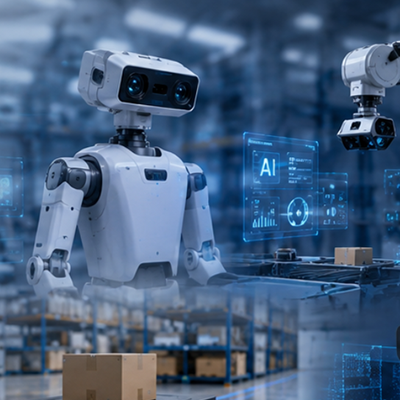
A robotic camera lens is a critical optical component that enables intelligent robots to capture accurate images, understand their surroundings, and make autonomous decisions. From AGV navigation and AMR logistics robots to robotic arms and AI vision systems, the performance of the lens directly affects image quality, positioning accuracy, and system reliability.
As robotics technology continues to evolve, vision systems require lenses with higher resolution, lower distortion, wider field of view, and better compatibility with modern CMOS sensors. Selecting the right lens is essential for achieving stable and precise robotic perception.
This guide explains the key optical requirements, lens types, selection methods, and application considerations to help engineers choose the most suitable optical solution for robotics applications.
For a complete overview of optical solutions designed specifically for intelligent robots, visit our Robotics Vision Lens Solutions page.
What Is a Robotic Camera Lens?
A robotic camera lens is an optical lens designed for robot vision systems, where cameras are used for navigation, object recognition, inspection, positioning, and depth perception. Unlike consumer camera lenses, robotic lenses are engineered to meet industrial requirements such as compact integration, high image accuracy, and long-term reliability.
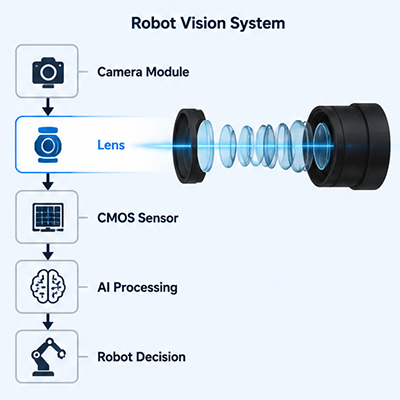
A complete robotic vision system usually consists of several key components:
- Lens: Captures and focuses optical information from the environment.
- Camera Module: Converts optical signals into digital images.
- CMOS Sensor: Determines resolution, sensitivity, and image quality.
- AI Processing Unit: Analyzes image data for recognition and decision-making.
- Robot Control System: Executes movement and operational decisions.
The optical performance of the lens influences every stage of this process. Poor distortion control or insufficient resolution may reduce navigation accuracy, affect AI recognition performance, or introduce errors in robotic positioning.
How a Robotic Vision System Works
The imaging process of a typical robotic vision system follows this workflow:
↓
Robotic Camera Lens
↓
CMOS Image Sensor
↓
Image Processing & AI Analysis
↓
Robot Navigation and Decision
For compact embedded robotics applications, M12 lenses are widely used because of their small size, lightweight design, and compatibility with various image sensors.
Why Is Lens Selection Important for Robot Vision Systems?
The lens is often the first component that determines whether a robot can accurately perceive its environment. A properly selected optical system improves navigation stability, object recognition accuracy, and overall system performance.
1. Accurate Navigation and SLAM Performance
Autonomous robots often rely on SLAM (Simultaneous Localization and Mapping) technology to understand their position and build environmental maps. Lens distortion can introduce measurement errors and affect mapping accuracy.
For SLAM-based robots, engineers usually require:
- Low optical distortion
- High MTF performance
- Stable image quality across the entire field of view
- Compact integration with embedded cameras
Low distortion optical designs are especially important for navigation robots, mapping systems, and precision positioning applications.
2. Wide Field of View for Environmental Awareness
Mobile robots such as AGVs and AMRs need to detect obstacles, paths, and surrounding objects in complex environments. A wider field of view allows robots to capture more visual information with fewer cameras.
Wide-angle robotic lenses are commonly used for:
- Warehouse navigation
- Autonomous transportation systems
- Indoor service robots
- Mobile inspection platforms
3. High Resolution for AI Recognition
Modern AI robots depend on detailed image information for object classification, defect detection, and intelligent decision-making. A lens with high resolution and strong MTF performance helps maintain image clarity and recognition accuracy.
High-performance optical designs are especially important for:
- Industrial robot inspection
- AI vision systems
- Precision robotic arms
- Automated quality control
4. Depth Perception for 3D Robotics
Many advanced robots require depth information to understand object distance and spatial relationships. Stereo vision and Time-of-Flight (TOF) systems depend on specialized optical designs to achieve accurate depth measurement.
For 3D sensing applications, TOWIN provides dedicated TOF lens solutions optimized for infrared wavelengths such as 850nm and 940nm.
Robotic Camera Lens Requirements by Application
| Application | Main Optical Requirement | Recommended Lens Feature |
|---|---|---|
| AGV Navigation | Wide viewing area and stable imaging | Wide-angle M12 lens |
| AMR Robots | Compact design and reliable performance | Low distortion robotic lens |
| SLAM Navigation | High accuracy mapping | Low distortion lens |
| Robot Arm Inspection | High resolution imaging | High MTF industrial lens |
| 3D Vision Robots | Depth measurement | Stereo / TOF lens |
Understanding application requirements is the first step in selecting the correct optical solution. Engineers should consider sensor size, field of view, distortion level, mounting method, and environmental conditions before choosing a robotic vision lens.
Key Optical Parameters to Consider When Choosing a Robotic Camera Lens
Selecting the correct robotic camera lens requires a detailed understanding of optical performance parameters. Different robot applications have different imaging requirements, and the lens must be matched with the camera sensor, working environment, and vision algorithm.
The most important parameters include resolution, sensor compatibility, field of view, distortion, mounting type, and environmental reliability.
| Optical Parameter | Recommended Range | Why It Matters in Robotics |
|---|---|---|
| Resolution | 2MP – 25MP | Higher resolution improves object recognition, measurement accuracy, and AI detection performance. |
| Sensor Size Compatibility | 1/4″ – 1/1.7″ | Ensures the lens matches the CMOS sensor and avoids image quality loss. |
| Field of View (FOV) | 60° – 200° | Determines how much environment the robot can perceive. |
| Distortion | <0.5% – 1% | Critical for SLAM navigation, mapping, and precision positioning. |
| Lens Mount | M12 / C-Mount | Determines mechanical integration and system flexibility. |
| Infrared Support | 850nm / 940nm | Required for TOF and depth sensing applications. |
| Operating Temperature | -40℃ ~ 85℃ | Ensures reliable operation in industrial and outdoor environments. |
For more information about optical specifications and lens selection principles, refer to our Industrial Lens Selection Guide .
Types of Robotic Camera Lenses
Different robotic systems require different optical solutions. The best lens choice depends on the robot type, imaging distance, sensor size, and application requirements.
| Lens Type | Best Applications | Main Advantages |
|---|---|---|
| M12 Lens | AGV, AMR, embedded robots, compact vision systems | Small size, lightweight design, easy integration, flexible focal length options |
| Low Distortion Lens | SLAM navigation, mapping, measurement systems | Improves positioning accuracy and reduces image correction errors |
| Wide Angle Lens | Robot navigation, warehouse automation, mobile robots | Provides a larger field of view for environmental perception |
| Stereo Vision Lens | 3D robots, depth perception systems | Supports binocular vision and depth calculation |
| TOF Lens | AI robots, autonomous systems, 3D sensing | Optimized for infrared depth sensing applications |
| C-Mount Lens | Industrial robots, precision inspection systems | High optical performance and flexible system integration |
For compact robotic platforms, M12 lens solutions are commonly selected because they provide a balance between optical performance, size, and cost.
For industrial inspection and high-precision applications, machine vision lens solutions can provide higher resolution and optical accuracy.
How to Choose a Robotic Camera Lens?
Choosing the right lens for a robotic vision system requires a systematic approach. Engineers should evaluate the application requirements first, then select the optical specifications that match the camera system.
Step 1: Identify the Robot Application
The first step is determining the robot’s working environment and purpose.
- AGV / AMR: Require wide field of view and reliable navigation.
- Robot Arms: Require high resolution and accurate positioning.
- SLAM Robots: Require low distortion and stable image geometry.
- AI Robots: Require high-quality images for recognition algorithms.
Step 2: Match the Camera Sensor Size
The lens must cover the entire sensor area to avoid vignetting and maintain image quality.
| Sensor Size | Recommended Lens Selection |
|---|---|
| 1/4″ | Compact M12 lenses for embedded robotics |
| 1/3″ | Standard robotics vision lenses |
| 1/2.7″ | Balanced resolution and field coverage |
| 1/1.8″ – 1/1.7″ | High-resolution robotic vision systems |
Step 3: Define the Required Field of View
Field of view determines how much of the environment the robot can observe.
- Wide FOV: Suitable for navigation and obstacle detection.
- Medium FOV: Suitable for general robot vision tasks.
- Narrow FOV: Suitable for detailed inspection and long-distance imaging.
Step 4: Evaluate Distortion Requirements
Distortion is one of the most important optical factors in robotics applications.
- SLAM navigation: Distortion below 1%
- Precision measurement: Distortion below 0.5%
- General monitoring: Distortion below 2%
Low distortion optical design improves image accuracy and reduces the need for software correction.
Step 5: Select the Correct Lens Mount
Mount selection depends on system size, optical requirements, and integration conditions.
| Mount Type | Application Advantage |
|---|---|
| M12 Mount | Compact, lightweight, ideal for embedded robot cameras |
| C-Mount | Higher precision and industrial compatibility |
Step 6: Validate Image Quality
Before mass deployment, engineers should evaluate:
- MTF performance
- Resolution capability
- Relative illumination
- Color consistency
- Temperature reliability
A complete optical validation process helps ensure stable performance in real-world robotic environments.
TOWIN Robotic Camera Lens Solutions
After understanding the application requirements and optical parameters, engineers can select the most suitable lens solution based on robot type, imaging environment, and system performance requirements.
TOWIN provides customized optical solutions for AGV, AMR, SLAM navigation, AI robotics, and embedded vision systems. Our robotic lens designs focus on high resolution, low distortion, compact integration, and reliable industrial performance.
Explore our complete Robotics Vision Lens Solutions to learn more about optical solutions for intelligent robotic systems.
M12 Lens for Compact Robotic Vision Systems
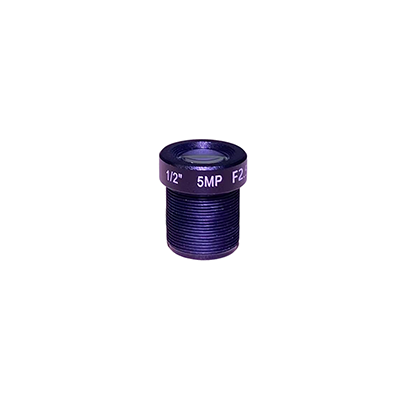
M12 lenses are one of the most widely used optical solutions in embedded robotics because of their compact structure, lightweight design, and flexible compatibility with different CMOS sensors.
| Parameter | Specification |
|---|---|
| Sensor Compatibility | 1/4″ – 1/1.7″ |
| Resolution | 2MP – 20MP |
| Focal Length | 1.8mm – 50mm |
| Field of View | 30° – 200° |
| Mount | M12×0.5 |
| Applications | AGV, AMR, embedded robots |
Typical applications include:
- Autonomous mobile robots
- Warehouse robots
- Indoor navigation systems
- Compact AI vision devices
Learn more about available models through our M12 Lens Products page.
Low Distortion Lens for SLAM and Precision Robotics
SLAM-based robots require accurate image geometry to build reliable maps and calculate their position. Traditional lenses with high distortion may introduce measurement errors and reduce navigation accuracy.
TOWIN low distortion robotic lenses are designed for applications requiring:
- Accurate environmental mapping
- Stable feature recognition
- Reduced image correction requirements
- High edge-to-edge image quality
Low distortion designs are especially suitable for:
- SLAM navigation robots
- Autonomous delivery robots
- Inspection robots
- Precision positioning systems
Wide Angle Lens for Robot Navigation
Mobile robots operating in dynamic environments require a wide visual range to detect obstacles, recognize pathways, and make navigation decisions.
Wide-angle robotic lenses provide:
- Larger environmental coverage
- Reduced blind areas
- Improved obstacle detection capability
- Better perception efficiency
They are commonly used in:
- AGV navigation systems
- AMR warehouse robots
- Security patrol robots
- Service robots
Stereo and TOF Lens Solutions for 3D Robotics
Advanced robots increasingly rely on depth information for object recognition, navigation, and interaction. Stereo vision and TOF systems require specialized optical designs to achieve accurate depth measurement.
TOWIN provides TOF lens solutions optimized for infrared sensing applications, including 850nm and 940nm wavelength systems.
Typical applications include:
- Humanoid robots
- AI service robots
- Autonomous navigation systems
- 3D object recognition platforms
Robotic Camera Lens Applications
Different robotic applications have different optical requirements. Selecting the right lens according to the working environment helps improve system performance and reliability.
AGV Navigation Robots
AGV systems require stable navigation performance in warehouses, factories, and logistics environments.
Lens Requirements:
- Wide field of view
- Low distortion
- Compact size
- Reliable industrial operation
Recommended Solution:
M12 wide-angle robotic lens
AMR Autonomous Mobile Robots
AMR robots require real-time environmental perception to avoid obstacles and optimize movement paths.
Lens Requirements:
- High image consistency
- Fast response imaging
- Compact camera integration
Recommended Solution:
Compact M12 lens with low distortion design
SLAM Navigation Robots
SLAM systems depend on accurate feature extraction and image geometry. Optical distortion directly affects mapping and localization performance.
Lens Requirements:
- Distortion below 1%
- High MTF performance
- Stable edge image quality
Recommended Solution:
Low distortion robotics vision lens
Industrial Robot Arms
Robot arms used in inspection and manufacturing require precise image acquisition for positioning and quality control.
Lens Requirements:
- High resolution
- Accurate imaging
- Low optical error
Recommended Solution:
Industrial machine vision lens
For precision inspection applications, explore our Machine Vision Lens Solutions .
Custom Robotics Camera Lens Development
Not every robotic vision system can be optimized with standard lenses. Different robots may require customized optical solutions based on sensor selection, mechanical limitations, field of view, and operating environment.
TOWIN provides custom robotic camera lens development services for AI robotics, autonomous navigation systems, and embedded vision platforms.
Our Robotics Lens Development Capabilities
| Capability | Application Value |
|---|---|
| FOV Optimization | Design the correct viewing angle for navigation and inspection tasks. |
| Low Distortion Optical Design | Improve SLAM accuracy and image measurement performance. |
| Sensor Matching Support | Optimize lens performance with selected CMOS sensors. |
| IR Filter Customization | Support TOF and infrared imaging applications. |
| Compact Mechanical Integration | Enable smaller embedded robotic camera designs. |
| Temperature Reliability Design | Ensure stable operation in industrial environments. |
Robotics Lens Development Process
TOWIN follows a complete optical development workflow:
↓
2. Optical Design
↓
3. Simulation & Optimization
↓
4. Prototype Development
↓
5. Sensor Matching Validation
↓
6. Reliability Testing
↓
7. Mass Production
From initial optical design to production validation, TOWIN works with robotics manufacturers and AI solution providers to develop reliable and scalable optical systems for next-generation intelligent machines.
For advanced optical engineering information, visit our Optical Design Guide to understand how lens performance is optimized for industrial applications.
Frequently Asked Questions
What is a robotic camera lens?
A robotic camera lens is an optical component designed for robot vision systems, including AGV, AMR, SLAM navigation, AI robots, and industrial automation platforms. It provides the image quality, field of view, and optical accuracy required for robots to perceive and interact with their environment.
What lens is commonly used in AGV and AMR robots?
AGV and AMR robots commonly use compact M12 lenses because they provide flexible focal lengths, small mechanical size, and compatibility with embedded camera systems. Wide-angle and low distortion M12 lenses are often selected for autonomous navigation applications.
What lens is best for SLAM navigation systems?
SLAM navigation systems typically require low distortion lenses with high MTF performance. Reduced distortion improves image geometry accuracy and helps robots achieve more reliable mapping and localization.
Can M12 lenses be used for robotic vision applications?
Yes. M12 lenses are widely used in robotic vision systems because of their compact design, lightweight structure, and compatibility with various CMOS sensors. They are commonly used in AGV, AMR, embedded robots, and AI vision platforms.
How do I choose the right lens for a robot camera?
Choosing a lens for a robot camera requires evaluating the application, sensor size, field of view, distortion requirement, lens mount, resolution, and operating environment. A proper optical selection process ensures better image quality and system reliability.
What is the difference between M12 and C-Mount lenses for robotics?
M12 lenses are generally preferred for compact embedded robotics due to their small size and easy integration, while C-Mount lenses are commonly used in industrial robots requiring higher optical precision and flexible mechanical configuration.
Conclusion: Choosing the Right Robotic Camera Lens Solution
The optical system is one of the most important components in modern robotics. A properly selected lens improves navigation accuracy, object recognition capability, depth perception, and overall robot performance.
When selecting a robotic camera lens, engineers should carefully evaluate key factors including sensor compatibility, resolution, field of view, distortion control, mounting method, and environmental requirements.
From compact M12 solutions for AGV and AMR robots to low distortion lenses for SLAM navigation and infrared lenses for 3D sensing systems, TOWIN provides reliable optical solutions designed for next-generation intelligent machines.
Explore our complete Robotics Vision Lens Solutions or contact our optical engineering team for customized lens development support.