


Best Low Distortion Lens Manufacturer for Industrial Use
05/10/2026
Best supplier of wide-angle lenses for dashcams and action cameras
05/12/2026
Key Takeaways
- An Industrial camera lens determines image quality, field of view, distortion, and inspection accuracy in machine vision systems.
- Choosing the correct lens requires matching:
- Sensor size
- Focal length
- Resolution
- Mount type
- Working distance
- Application requirements
- Low distortion lenses are ideal for precision measurement and inspection.
- C-mount lenses are the most common standard in industrial imaging applications.
- Higher megapixel cameras require higher-resolution industrial lenses.
- Wide-angle lenses provide larger viewing areas, while long focal lengths offer greater magnification.
- Proper lens selection improves:
- Imaging accuracy
- Production efficiency
- Automation reliability
- System stability
Introduction
Choosing the right Industrial camera lens is one of the most important steps in building a reliable machine vision system. Whether used in factory automation, robotics, barcode scanning, semiconductor inspection, or intelligent transportation, the lens directly affects image sharpness, distortion, accuracy, and overall system performance.
Many imaging problems in industrial applications are not caused by the camera itself, but by incorrect lens selection. Issues such as blurred images, poor edge clarity, inaccurate measurements, limited field of view, and compatibility problems often result from choosing the wrong lens parameters.
This guide explains how to choose the best industrial camera lens based on:
- Sensor size
- Focal length
- Resolution
- Distortion
- Aperture
- Mount type
- Application environment
By understanding these key factors, engineers, OEM manufacturers, and automation integrators can improve imaging performance and reduce system design risks.
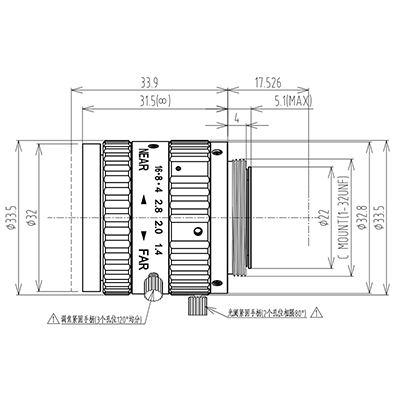
16mm FA Industrial Lens Low Distortion Scanning Lens
What Is an Industrial Camera Lens?
An industrial camera lens is a high-precision optical lens designed for machine vision and industrial imaging systems. Compared with consumer camera lenses, industrial lenses provide:
- Higher imaging accuracy
- Better optical consistency
- Lower distortion
- Greater durability
- Stable long-term performance
Industrial lenses are widely used in:
- Automated inspection
- Robotics
- Smart manufacturing
- Medical imaging
- Traffic monitoring
- Logistics automation
Common Industrial Lens Applications
| Application | Main Requirement |
|---|---|
| Factory automation | High precision imaging |
| Semiconductor inspection | Ultra-high resolution |
| Barcode scanning | Fast focus and low distortion |
| Robotics | Wide-angle field of view |
| ITS traffic systems | Long-distance imaging |
| Medical imaging | Accurate color reproduction |
| Food inspection | Stable image quality |
| Packaging inspection | Sharp edge detection |
Key Parameters of Industrial Camera Lens
Understanding lens specifications is critical when selecting the right lens for machine vision applications.
1. Focal Length
F.L. determines the field of view and magnification of the lens.
- Short focal lengths create wider viewing angles.
- Long focal lengths provide higher magnification and narrower views.
Focal Length Comparison
| Focal Length | Field of View | Typical Application |
|---|---|---|
| 4mm | Very wide | Surveillance and robotics |
| 6mm | Wide | Logistics systems |
| 8mm | Medium wide | AGV robots |
| 12mm | Medium | Factory automation |
| 25mm | Narrow | Precision inspection |
| 50mm+ | Long distance | ITS and traffic monitoring |
How to Choose Focal Length
Consider:
- Working distance
- Object size
- Sensor size
- Required field of view
General Guidelines
- Wide-area monitoring → Short focal length
- Small object inspection → Long focal length
- Long-distance imaging → Telephoto lens
- Compact systems → Miniature lens
2. Sensor Size Compatibility
The lens image circle must fully cover the camera sensor.
If the lens is too small for the sensor:
- Dark corners may appear
- Vignetting occurs
- Image quality decreases
Common Sensor Formats
| Sensor Size | Typical Use |
|---|---|
| 1/4″ | Compact cameras |
| 1/3″ | Entry-level systems |
| 1/2.8″ | Security imaging |
| 1/1.8″ | Machine vision |
| 2/3″ | Industrial inspection |
| 1″ | High-end industrial imaging |
| APS-C | Advanced vision systems |
Selection Tips
Always ensure:
- Lens format ≥ Sensor size
- Lens resolution matches sensor resolution
3. Lens Resolution
Lens resolution determines how much image detail the optical system can reproduce.
High-megapixel cameras require high-resolution industrial lenses.
Camera Resolution Matching
| Camera Resolution | Recommended Lens Type |
|---|---|
| 2MP | Standard industrial lens |
| 5MP | HD industrial lens |
| 8MP | High-resolution lens |
| 12MP | Ultra-HD industrial lens |
| 20MP+ | Precision machine vision lens |
Why Resolution Matching Matters
Poor lens resolution may cause:
- Soft edges
- Reduced inspection accuracy
- Blurred fine details
- Lower AI recognition accuracy
4. Distortion
Distortion changes the actual shape of objects in the image.
In industrial inspection, distortion can affect:
- Measurement accuracy
- Edge detection
- Calibration performance
Common Distortion Types
| Distortion Type | Appearance | Impact |
|---|---|---|
| Barrel distortion | Outward curve | Object enlargement |
| Pincushion distortion | Inward curve | Shape compression |
| Mustache distortion | Mixed distortion | Complex correction |
| Low distortion | Minimal deformation | Precision inspection |
When Low Distortion Is Important
Low distortion lenses are recommended for:
- AOI systems
- PCB inspection
- Metrology
- Semiconductor inspection
- OCR systems
5. Aperture
It governs the light intake of the lens.
Aperture Effects
| Large Aperture | Small Aperture |
|---|---|
| Brighter image | Greater depth of field |
| Better low-light performance | Sharper overall focus |
| Shallower focus | Lower brightness |
Common Aperture Types
- Fixed iris
- Manual iris
- Auto iris
6. Mount Type
Lens mount compatibility is essential.
Common Industrial Lens Mounts
| Mount Type | Features |
|---|---|
| C-Mount | Most common industrial standard |
| CS-Mount | Shorter flange distance |
| M12 Mount | Compact and lightweight |
| F-Mount | Large sensor support |
| S-Mount | Miniature imaging systems |
C-Mount vs CS-Mount
| Feature | C-Mount | CS-Mount |
|---|---|---|
| Flange Distance | 17.526mm | 12.5mm |
| Compatibility | Widely used | Compact cameras |
| Adapter Support | Yes | Limited |
How to Choose Industrial Camera Lens Step by Step
1: Identify the Application
Different applications require different lens characteristics.
Example Requirements
| Application | Key Lens Requirement |
|---|---|
| Precision inspection | Low distortion |
| Robotics | Wide angle |
| Traffic monitoring | Long focal length |
| Barcode scanning | Fast focus |
| Medical imaging | High color accuracy |
2: Confirm Sensor Size
Match the lens image format with the camera sensor.
Checklist:
- Verify sensor dimensions
- Check image circle coverage
- Avoid vignetting
3: Calculate Required Field of View
The field of view depends on:
- Sensor size
- Working distance
- Focal length
Common calculation principle:
Field\ of\ View = \frac{Sensor\ Size \times Working\ Distance}{Focal\ Length}
A larger field of view requires:
- Shorter focal length
- Larger sensor
4. Choose the Appropriate Focal Length
Use practical testing whenever possible.
Typical Recommendations
| Working Distance | Suggested Focal Length |
|---|---|
| Close-range inspection | 8mm–16mm |
| Medium-distance imaging | 25mm |
| Long-range monitoring | 50mm+ |
5. Evaluate Resolution and Distortion
High-precision systems should prioritize:
- Low distortion
- High MTF performance
- High optical consistency
6. Confirm Environmental Requirements
Industrial environments may require:
- Waterproof design
- Dust resistance
- Vibration resistance
- IR correction
- Temperature stability
Industrial Lens Selection by Application
1. Best Lens for Factory Automation
Recommended features:
- Low distortion
- High sharpness
- Stable imaging
- Compact structure
2. Best Lens for Robotics
Important considerations:
- Wide field of view
- Lightweight design
- Fast response
- Short working distance
3. Best Lens for Traffic Systems
Recommended specifications:
- Long focal length
- Weather resistance
- Day/night imaging
- IR correction
4. Best Lens for Barcode Scanning
Key features:
- Fast focusing
- High contrast
- Sharp edge performance
- Low distortion

12-50mm-P-Iris-CS-Mount Industrial lens
Common Industrial Lens Problems and Solutions
Q1: What happens if the focal length is incorrect?
An incorrect focal length may cause:
- Improper field of view
- Image cropping
- Insufficient magnification
Q2: Can I use a CCTV lens for machine vision?
Consumer CCTV lenses are usually not optimized for:
- Precision measurement
- Low distortion
- High-resolution imaging
Industrial applications typically require dedicated machine vision lenses.
Q3: Why is my image blurry at the edges?
Possible reasons:
- Lens resolution mismatch
- Poor sensor compatibility
- Inadequate aperture settings
- Low-quality optics
Q4: What is a low distortion lens?
A low distortion lens minimizes image deformation and improves measurement accuracy.
It is commonly used in:
- AOI systems
- OCR inspection
- Precision metrology
Q5: Why is megapixel matching important?
A high-resolution camera paired with a low-resolution lens cannot achieve full imaging performance.
Both components must match for optimal image quality.
Why Choose a Professional Industrial Lens Supplier
Selecting a reliable industrial lens supplier is critical for long-term system stability and product quality.
A professional supplier can provide:
- Stable optical quality
- OEM/ODM customization
- Technical support
- Fast production capability
- Consistent product reliability
TOWIN Industrial Lens Solutions provides industrial imaging lenses for:
- Machine vision
- Factory automation
- Intelligent transportation
- Robotics
- Smart devices
- OEM imaging systems
TOWIN supports multiple lens types including:
- C-mount lenses
- M12 lenses
- Low distortion lenses
- Waterproof lenses
- High-resolution machine vision lenses
Conclusion
Choosing the right Industrial camera lens is essential for achieving accurate, stable, and high-quality imaging performance in machine vision systems. Factors such as focal length, sensor compatibility, resolution, distortion, aperture, and mount type all directly affect inspection accuracy and overall system reliability.
By carefully evaluating application requirements and matching the correct optical specifications, businesses can improve automation efficiency, reduce imaging errors, and achieve better long-term performance.
If you are looking for reliable industrial imaging solutions, explore the professional industrial optics available from TOWIN and find the right Industrial camera lens for your application.