


M8 wide-angle Automotive Lens IP67 waterproof
01/05/2026
Wide Angle IP67 automotive M12 lens
01/06/2026Introduction
When it comes to CCTV surveillance, the lens is the unsung hero that directly impacts the clarity, coverage, and reliability of your footage. For discrete monitoring scenarios—whether securing retail stores, office spaces, or residential areas—conical pinhole lenses stand out as the top choice for CCTV systems, thanks to their compact design, wide field of view, and ability to capture sharp images without drawing attention. As a critical component for covert CCTV surveillance, choosing the right conical pinhole lens can elevate your security setup’s efficiency and discretion.
Unique Value of Conical Pinhole Lenses for CCTV Surveillance
Unlike traditional bulky CCTV lenses, conical pinhole lenses feature a narrow, cone-shaped design that enables easy concealment—perfect for covert monitoring where lens visibility could compromise security. Their pinhole aperture also delivers an ultra-wide field of view (FOV), allowing you to cover more area with a single CCTV camera. This not only reduces the number of devices needed for full coverage but also lowers overall system costs.
Additionally, high-quality conical pinhole lenses minimize image distortion and chromatic aberration, ensuring footage is sharp and true-to-life—critical for identifying faces, license plates, or other key details in security scenarios. Designed to perform well in low-light conditions, they support 24/7 CCTV surveillance, a non-negotiable requirement for most security setups.
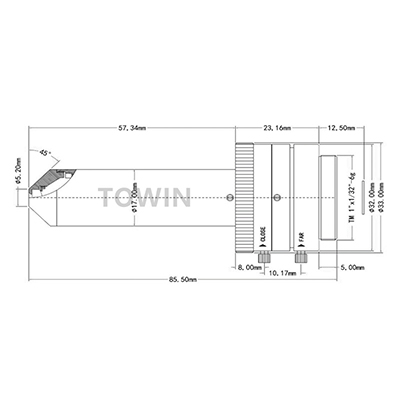
Pinhole lens 4mm HD CCTV CS-mount lens
Why is the conical design the preferred choice for security?
1. Ultimate Concealment for Covert CCTV Surveillance
Security surveillance often demands “undetectable” covert monitoring (e.g., commercial loss prevention, public area security). The narrow profile of conical pinhole lenses—some models as small as 8mm in diameter—allows seamless embedding in ceilings, walls, smoke detectors, or other fixtures. This avoids lens exposure that could lead to tampering or evasion, a core advantage traditional bulky CCTV lenses cannot match.
2. Wide FOV + Compact Structure = Enhanced Coverage Efficiency
The pinhole diameter combined with the conical optical structure delivers a wide field of view within a tiny volume. For example, a conical pinhole lens with a 2.5-2.8mm focal length can cover a 120°-130° area. A single lens suffices for large spaces like retail floors or office lobbies, reducing the number of CCTV cameras required and cutting security system costs.
3. High Installation Flexibility for Diverse CCTV Scenarios
The slim conical structure requires no complex installation space, adapting to various indoor and outdoor security environments (e.g., corridors, parking lots, residential corners). It’s also compatible with most 1/3” and 1/2.7” CMOS/CCD security cameras, making it convenient for both new CCTV system installations and existing system upgrades.
Top 5 Best Conical Pinhole Lenses for CCTV Systems (2026)
We’ve tested and evaluated dozens of conical pinhole lenses from leading brands, focusing on factors like image quality, compatibility, low-light performance, and durability. Below are our top recommendations, tailored to different budgets and surveillance scenarios:
1. Best for Wide-Angle Indoor Surveillance: CCL127042PMP
Key Specifications
| Parameter | Details |
| Focal Length | 4.2mm (ultra-wide) |
| Sensor Compatibility | 1/2.7″ (common for HD CCTV) |
| Resolution | 3MP (highest in this list) |
| Aperture | F2.4 (decent low-light) |
| Horizontal FOV (H.F.O.V.) | 77° (100° diagonal) |
| Mount Type | M12×0.5 (universal for CCTV) |
| Minimum Object Distance (M.O.D.) | 0.1m (close-up details) |
| Special Features | IR-sensitive (works with night vision), conical pinhole design (discreet) |
Best For
- Small indoor spaces requiring broad coverage and sharp details, such as convenience stores, office desks, or retail checkout areas. The 0.1m M.O.D. also makes it ideal for monitoring small objects (e.g., cash registers).
Pros
- 3MP resolution delivers sharper images than 2MP alternatives.
- Ultra-wide FOV covers more area with fewer cameras.
Cons
- F2.4 aperture is less sensitive to low light than F1.6 models (better paired with IR LEDs).
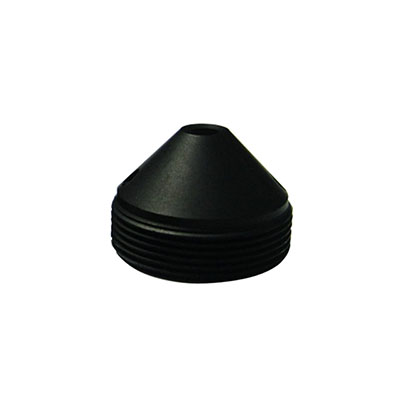
4.2mm 1/3″ HD CCTV M12 mount Pinhole lens
2. Best for Long-Distance & High-Temperature Environments: CCL1230PMP
Key Specifications
| Parameter | Details |
| Focal Length | 30mm (telephoto) |
| Sensor Compatibility | 1/2″ (larger sensor for better light gathering) |
| Resolution | 2MP (reliable HD) |
| Aperture | F1.6 (excellent low-light) |
| H.F.O.V. | 12° (narrow, long-range) |
| Mount Type | M12×0.5 |
| TTL (Total Track Length) | 36.95mm (sturdy build) |
| Special Features | IR-corrected (reduces night vision distortion), high-temperature resistance (suitable for metallurgy/industrial sites) |
Best For
- Long-distance outdoor or industrial surveillance, such as parking lots, warehouse aisles, or high-temperature manufacturing floors. The 30mm telephoto lens captures clear details from 10–20 meters away.
Pros
- F1.6 aperture excels in low light (no need for extra IR lighting in dim areas).
- High-temperature durability for harsh industrial use.
Cons
- Narrow FOV requires precise alignment (not ideal for small spaces).
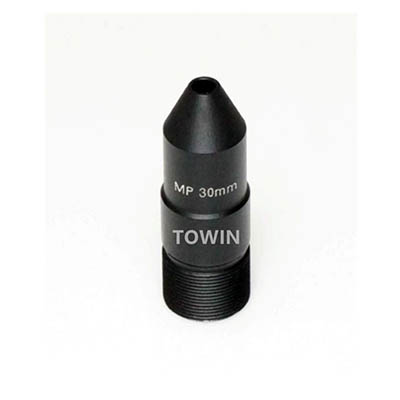
Pinhole-lens-30mm-IR-corrected-CCTV-M12-telecentric-lens
3. Best for Mid-Range Corridor Surveillance: CCL1222PMP
Key Specifications
| Parameter | Details |
| Focal Length | 22mm (mid-telephoto) |
| Sensor Compatibility | 1/2″ |
| Resolution | 2MP |
| Aperture | F1.6 (strong low-light) |
| H.F.O.V. | 15° (balanced mid-range) |
| M.O.D. | 0.2m |
| Special Features | IR-corrected, compact conical design (easy to hide) |
Best For
- Mid-distance linear spaces, such as mall corridors, factory hallways, or school hallways. The 15° FOV strikes a balance between coverage and detail—capturing entire corridors without sacrificing clarity.
Pros
- F1.6 aperture + 1/2″ sensor = superior low-light performance (great for unlit corridors).
- Compact size for discreet installation (e.g., in ceiling panels).
Cons
- Not ideal for ultra-wide or ultra-long-range needs.
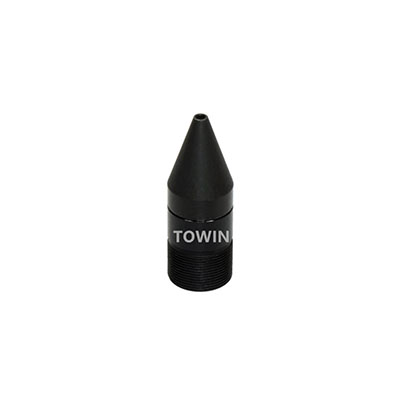
Fixed focus M12 Mount pinhole lens
4. Best for Medium-Size Indoor Areas: CCL1210PMPR
Key Specifications
| Parameter | Details |
| Focal Length | 10mm (mid-wide) |
| Sensor Compatibility | 1/2″ |
| Resolution | 2MP (HD) |
| Aperture | F2.0 (good low-light) |
| H.F.O.V. | 33° (64° diagonal) |
| TTL | 16.8mm (ultra-compact) |
| Special Features | IR-corrected, lightweight (1.2g approx.) |
Best For
- Medium-sized indoor spaces, such as restaurants, classrooms, or small offices. The 33° FOV covers entire rooms without excessive distortion, while the compact design hides easily in fixtures.
Pros
- Ultra-lightweight and small (ideal for hidden installations like ceiling tiles).
- Balanced FOV for medium rooms (no need for multiple cameras).
Cons
- F2.0 aperture is slightly less sensitive than F1.6 (pair with weak IR LEDs for night use).
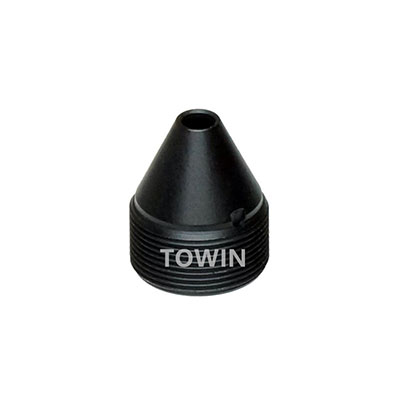
Pinhole-lens-10mm-IR-corrected
5. Best for 1/3″ Sensor CCTV Cameras: CCL1215PMP
Key Specifications
| Parameter | Details |
| Focal Length | 15mm (mid-range) |
| Sensor Compatibility | 1/3″ (common for budget CCTV) |
| Resolution | 2MP |
| Aperture | F1.6 (excellent low-light) |
| H.F.O.V. | 28° (versatile mid-range) |
| TTL | 22.32mm (slim build) |
| Special Features | IR-corrected, compatible with 1/3″ sensors (widely used in entry-level CCTV) |
Best For
- Budget-friendly CCTV setups with 1/3″ sensors, such as residential lobbies, elevators, or small retail backrooms. The 28° FOV is perfect for confined spaces where detail and coverage matter.
Pros
- F1.6 aperture delivers great low-light performance (ideal for dim elevators).
- Designed for 1/3″ sensors (no compatibility issues with entry-level cameras).
Cons
- Not compatible with larger 1/2″ sensors (check camera sensor size before buying).
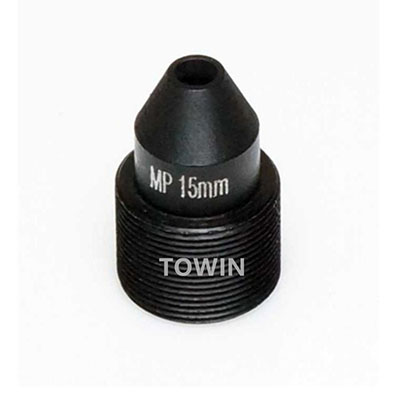
Pinhole 10mm IR corrected CCTV M12 lens
How to Choose the Right Lens for CCTV Scenario?
The core of selecting a conical pinhole lens for CCTV is “matching scenario requirements with product features.” You can make a precise decision based on the following dimensions:
1. Choose by Monitoring Distance
- Close-range monitoring (0.1m-1m): Prioritize the CCL127042PMP (4.2mm focal length + 0.1m ultra-close object distance), suitable for detailed monitoring of counters, desktops, etc.
- Medium-range monitoring (1m-10m): Choose the CCL1215PMP (15mm focal length) or CCL1222PMP (22mm focal length), balancing coverage and clarity.
- Long-range monitoring (over 10m): The CCL1230PMP (30mm telephoto focal length) is the first choice, suitable for fixed-point monitoring of large spaces.
2. Choose Based on Environmental Conditions
- Low-light environments: Prioritize models with an F1.6 aperture (CCL1230PMP, CCL1222PMP, CCL1215PMP) for ample light intake and clearer images;
- High-temperature environments: The CCL1230PMP is the only choice, as its high-temperature metallurgical-compatible design ensures stable operation;
- Confined installation spaces: Choose models with shorter overall lengths (CCL1210PMPR, TTL=16.8mm) for better concealment.
3. Choose Based on Image Quality Needs
- High-definition detail requirements: Choose the CCL127042PMP (3MP resolution) for optimal image quality;
- Regular high-definition needs: The other four 2MP models can all meet these requirements, offering better value for money.
4. Select by Sensor Matching
- For 1/3″ camera sensors: Prioritize CCL1215PMP for better compatibility;
- For 1/2″ or 1/2.7″ sensors: Choose CCL1230PMP, CCL1222PMP, CCL1210PMPR (1/2″), or CCL127042PMP (1/2.7″) for enhanced compatibility.
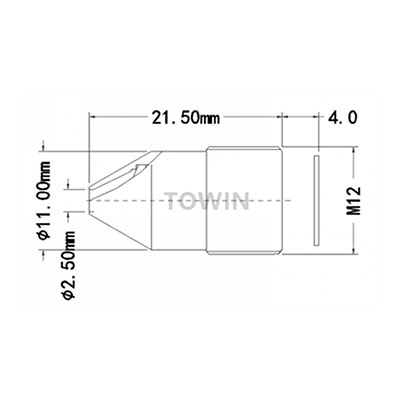
Pinhole lens 16mm IR corrected CCTV M12 mount lens
Key factors in choosing a conical pinhole lens
With so many options available, it’s important to keep these key factors in mind to find the right lens for your needs:
- Focal Length & Field of View (FOV): The focal length determines how wide or narrow your FOV is. For large areas, choose a shorter focal length (2.5-2.8mm) for a wider FOV. For long-distance monitoring, opt for a longer focal length (4-6mm) for a narrower, more focused FOV.
- Compatibility: Ensure the lens is compatible with your CCTV camera’s sensor size (e.g., 1/3”, 1/2.7”). Most lenses specify their compatible sensor sizes, so check your camera’s specs before buying.
- Low-Light Performance: Look for a lens with a wide aperture (lower f-number, e.g., f/2.0 or f/2.2) for better low-light performance. This is critical for 24/7 surveillance, as it ensures clear footage even in dim conditions.
- Concealment Needs: If discretion is key, choose an ultra-compact lens (8-10mm diameter) that can be hidden easily. Larger lenses may offer better performance but are harder to conceal.
- Durability & Environment: For outdoor or harsh environments, look for lenses with durable materials (aluminum alloy) and weather-resistant ratings (IP54 or higher). Indoor lenses can be lighter (plastic housing) but may not withstand outdoor conditions.
- Budget: Set a budget and prioritize features that matter most to you. Budget lenses are great for basic indoor use, while premium options offer better performance, durability, and stealth for commercial or covert needs.
Installation Tips for Conical Pinhole Lenses
1. Installation Location Selection
- Prioritize Concealment: Choose locations that are difficult to detect, such as ceiling gaps, the inside of wall panels, or openings in the equipment casing. The lens aperture should be small (typically 2-5mm), which can be concealed with stickers or decorative items.
- Optimize Viewing Angle: Ensure the lens faces the center of the monitored target, avoiding obstructions (such as greenery or light fixtures). For wide-angle models, avoid pointing the lens edge at strong light sources (such as windows or spotlights) to prevent glare.
- Environmental Adaptability: When installing in high-temperature environments, ensure the lens maintains a safe distance from heat sources, avoiding direct exposure to open flames or hot air currents. When installing in low-light environments, place it as close as possible to auxiliary light sources (such as infrared lights) to improve imaging quality.
2. Installation Operation Points
- Interface Installation: When installing the M12×0.5 interface, rotate clockwise until it fits snugly. Avoid excessive force to prevent damage to the interface. Ensure the lens is parallel to the camera sensor to prevent image tilting.
- Focus Adjustment: For manual focus models, adjust the focus in real-time via the monitoring screen after installation to ensure the target area is sharp (for close-range monitoring, use a small object to assist focusing; for long-range monitoring, ensure the target outline is clear).
- Waterproofing: For outdoor installation (using a waterproof camera), seal the lens mounting hole (e.g., using a waterproof gasket) to prevent rainwater and dust from entering and affecting image quality or damaging the equipment.
3. Debugging and Optimization Techniques
- Light Adjustment: After installation, test the imaging effect at different times (daytime and nighttime). If the image quality is blurry in low-light environments, adjust the angle of the camera’s infrared lights or add auxiliary light sources.
- Blind Spot Inspection: Check each area of the monitoring screen to ensure there are no obstructions or blind spots. For wide-angle lenses, pay attention to edge distortion control to avoid critical areas being located at the edge of the image.
- Stability Testing: After installation, run continuously for 24 hours to check if the image quality is stable and if the lens is loose. In high-temperature environments, additional testing is required to ensure the camera’s performance under prolonged high temperatures.
Fixed focus M12 Mount pinhole lens
FAQs
1. Is there a significant difference in resolution between 3MP and 2MP?
The main difference lies in detail capture: 3MP has a higher pixel density than 2MP. When the image is magnified, details such as facial features and object markings are clearer, making it suitable for scenarios requiring precise tracking. For general surveillance scenarios, 2MP is sufficient and offers better value.
2. How is the concealment of a tapered pinhole camera guaranteed?
The key lies in the installation method: The lens itself has an aperture of only a few millimeters. Combined with concealed installation locations and concealment using stickers or small-hole decorations, it can achieve an effect that is “hard to detect with the naked eye.” It is recommended to choose a model with a shorter overall length (such as the CCL1210PMPR) to further enhance concealment.
3. Which model performs best in low-light conditions?
Prioritize models with a large F1.6 aperture (CCL1230PMP, CCL1222PMP, CCL1215PMP). A large aperture increases light intake, and combined with IR correction, provides significantly better image clarity in low-light conditions compared to models with F2.0 and higher apertures.
4. Is manual focus complicated?
No: After installation, you can adjust it in real time via the monitoring screen. Most models have a clearly designed focus ring with moderate rotational resistance, allowing for precise control of the focus. It is recommended to leave room for adjustment during installation to avoid not being able to reach the focus ring after installation.
4.2mm 1/3″ HD CCTV M12 mount Pinhole lens
Conclusion
With three core advantages—concealment, flexibility, and adaptability—conical pinhole lenses have become an indispensable component for covert CCTV surveillance systems. The five top-rated TOWIN conical pinhole lenses for 2026 cover all key scenarios, from close-range high-definition monitoring to long-distance high-temperature environments, enabling users to select the perfect model based on monitoring distance, environmental conditions, and image quality requirements.
When selecting a camera, it is essential to remember the principle of “scene matching first, core parameters as a safety net,” and during installation, pay close attention to concealment and stability adjustments to ensure the tapered pinhole camera fully realizes its value and creates an “invisible yet efficient” surveillance barrier for the CCTV system.