


How Does Aperture Affect Depth of Field in Industrial Imaging?
09/08/2026
How to Choose the Right Focal Length for Machine Vision
09/15/2026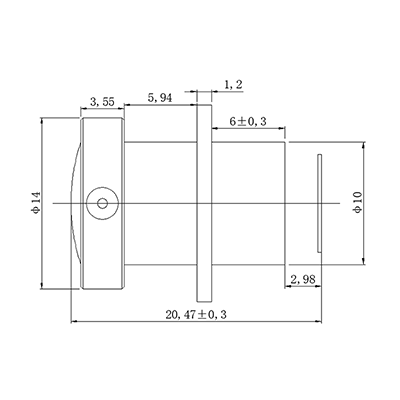
How to Choose the Right Industrial Camera Lens is an important question when building a reliable machine vision or industrial imaging system. A high-resolution camera alone does not guarantee a clear or accurate image. The lens determines how the camera sees the target, including the field of view, image detail, distortion, depth of field, and overall optical performance.
An incorrectly selected lens can result in incomplete object coverage, blurred edges, excessive distortion, insufficient depth of field, or poor image quality even when the camera has a high-resolution sensor. For this reason, industrial lens selection should be based on the complete imaging system rather than on focal length, megapixels, or lens mount alone.
This guide explains how to choose an industrial camera lens step by step. It covers sensor size, field of view, working distance, focal length, resolution, distortion, aperture, depth of field, mount type, and application requirements. It also shows how to connect these parameters to the right industrial lens solution for machine vision, robotics, smart traffic, security, and other imaging applications.
Why Is Choosing the Right Industrial Camera Lens Important?
The lens is the optical interface between the real-world object and the camera sensor. It determines how much of the scene is captured, how large the object appears on the sensor, how accurately its geometry is reproduced, and how much detail can be resolved.
A suitable lens should provide the required coverage, resolution, optical quality, and mechanical compatibility for the application. A mismatch between the camera and lens can create problems that cannot always be corrected through software.
| Lens Selection Problem | Possible Result | What to Check |
|---|---|---|
| Incorrect field of view | Object is cropped or excessive background is captured | FOV, sensor size, focal length, working distance |
| Insufficient resolution | Small defects or features cannot be detected | Sensor resolution and lens resolving capability |
| Excessive distortion | Measurement and geometric accuracy are affected | Lens distortion specification |
| Incorrect image circle | Vignetting or dark corners | Sensor format and lens image circle |
| Insufficient depth of field | Objects at different distances appear out of focus | Aperture, focal length, working distance, object depth |
| Incorrect mount | Lens cannot be mechanically installed correctly | M12, C-Mount, CS-Mount, or other mount |
For a deeper overview of the optical selection process, see the TOWIN Machine Vision Lens Selection Guide.
What Information Do You Need Before Choosing an Industrial Camera Lens?
Before selecting a lens, collect the basic information about the imaging system. This prevents the common mistake of choosing a lens based on only one specification.
- Camera sensor size
- Camera resolution and pixel size
- Required field of view
- Object dimensions
- Working distance
- Required image detail or measurement accuracy
- Required depth of field
- Lighting conditions
- Required aperture
- Lens mount
- Environmental conditions
- Application and inspection requirements
Once these parameters are known, the lens can be selected as part of the complete optical system rather than as an isolated component.
The 8 Most Important Parameters for Industrial Camera Lens Selection
| Parameter | What It Determines | Why It Matters |
|---|---|---|
| Sensor Size | Image format and image circle requirement | Prevents vignetting and ensures full sensor coverage |
| Field of View | Visible object area | Ensures the complete inspection target fits in the image |
| Working Distance | Lens-to-object distance | Affects focal length, magnification, and installation |
| Focal Length | Viewing angle and magnification | Determines the relationship between FOV and working distance |
| Resolution | Fine image detail | Must match the camera’s pixel and resolution requirements |
| Distortion | Geometric accuracy | Critical for measurement and precision inspection |
| Aperture | Light transmission and depth of field | Affects exposure, focus range, and low-light performance |
| Mount | Mechanical interface | Ensures compatibility between camera and lens |
1. Sensor Size
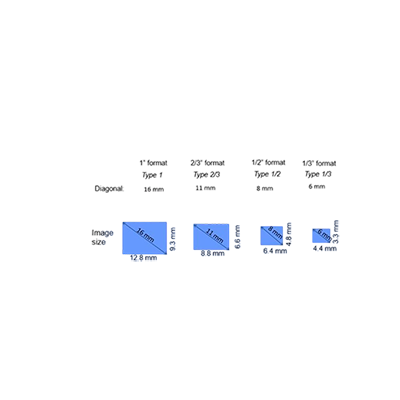
Sensor size is one of the first specifications to check. Common industrial camera sensor formats include 1/3″, 1/2″, 2/3″, 1″, 1.1″, and 4/3″. The lens image circle must adequately cover the camera sensor.
If the image circle is smaller than the sensor, the image may show dark corners or vignetting. A larger sensor can also change the effective field of view for the same focal length.
For a more detailed explanation of sensor formats and optical compatibility, visit the TOWIN Industrial Camera Sensor Guide.
2. Field of View (FOV)
Field of view describes the physical area visible through the camera and lens. Before selecting a focal length, determine how large an area needs to be captured.
For example, if an inspection system needs to capture a 200 mm wide object, the horizontal FOV should provide sufficient coverage for that object while still maintaining the required image detail.
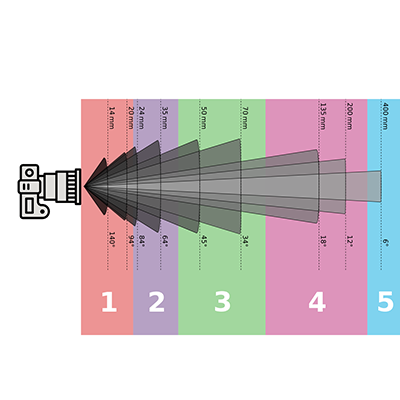
In general, a shorter focal length provides a wider field of view, while a longer focal length provides a narrower field of view and greater image magnification at the same working conditions.
Use the TOWIN FOV Calculator when you need to determine the required viewing area from your imaging parameters.
3. Working Distance
Working distance (WD) is the distance between the lens and the target object. It is a critical mechanical and optical constraint because the available installation space directly affects focal length selection.
For example, a machine vision system may have a fixed working distance because of a conveyor, robot arm, enclosure, or production-line structure. In this situation, the lens must provide the required FOV at the available working distance rather than simply selecting a preferred focal length.
When defining working distance, also consider mechanical clearance, lighting, cables, moving components, protective windows, and future adjustment space.
4. Focal Length
Focal length determines the optical viewing angle and strongly influences the relationship between sensor size, field of view, and working distance.
A short focal length is generally suitable when a wide field of view is required. A longer focal length is generally preferred when a narrower field of view, greater magnification, or longer-distance imaging is required.
However, focal length should not be selected first. A more reliable process is:
Sensor Size + Required FOV + Working Distance → Appropriate Focal Length
If you already know the sensor and imaging geometry, use the TOWIN Focal Length Calculator to help determine a suitable focal length.
5. Resolution
Camera megapixels and lens resolution should be considered together. A high-resolution camera cannot recover optical detail that the lens is unable to resolve.
For machine vision inspection, the lens should provide sufficient resolving capability across the sensor, especially when small defects, edges, printed characters, surface features, or dimensional details must be detected.
For example, a 20MP camera should not automatically be paired with any lens simply because the sensor has 20MP. The optical performance of the lens must also support the required level of detail.
For high-resolution applications, TOWIN provides dedicated options such as 1.1″ 20MP Machine Vision Lenses and 4/3″ 10MP Industrial Lenses.
6. Distortion
Distortion describes how accurately the lens reproduces the geometry of the real object. It is particularly important in dimensional measurement, metrology, alignment, inspection, and applications where straight lines and object dimensions must remain accurate.
For general detection tasks, moderate distortion may be acceptable if the application does not depend on precise geometry. For measurement applications, however, a low-distortion lens can significantly improve image-based dimensional accuracy.
Learn more about the optical effects of distortion in the TOWIN Lens Distortion Guide, or explore Low Distortion Lenses for applications requiring higher geometric accuracy.
7. Aperture and Depth of Field
Aperture controls the amount of light entering the lens and also affects depth of field. A wider aperture can provide more light and support faster exposure, while a smaller aperture generally increases depth of field but reduces the amount of transmitted light.
Depth of field becomes particularly important when the target has significant height variation or when the camera cannot maintain a perfectly constant object distance.
The correct aperture therefore depends on the balance between illumination, exposure time, object movement, image brightness, and required focus range.
For a deeper explanation, see How Does Aperture Affect Depth of Field.
8. Lens Mount
The lens mount determines whether the lens can be mechanically connected to the camera and can also influence the overall optical configuration.
Three common formats in industrial and imaging applications are M12, C-Mount, and CS-Mount.
- M12: Compact and lightweight, commonly used in embedded vision, robotics, AI cameras, and compact imaging devices.
- C-Mount: Widely used in industrial cameras and machine vision systems where flexible optical configurations and high-resolution performance are required.
- CS-Mount: Common in security and camera systems where a compact mechanical configuration is preferred.
Explore TOWIN’s M12 Lenses, C-Mount Lenses, and CS-Mount Lenses according to your camera and application requirements.
How to Choose an Industrial Camera Lens Step by Step
The most reliable lens selection process starts with the application and works toward the final optical specification.
Step 1: Define the Application
First identify what the camera needs to accomplish. Inspection, measurement, robot guidance, traffic monitoring, security, medical imaging, and drone imaging may require very different optical characteristics.
For example, precision measurement may prioritize low distortion and high resolution, while a compact robotic vision system may prioritize FOV, working distance, depth of field, and small mechanical size.
Step 2: Confirm the Camera Sensor
Record the sensor format, resolution, and pixel characteristics. Then make sure the selected lens provides an image circle that covers the sensor.
Sensor size also influences the final field of view, so it should be established before calculating focal length.
Step 3: Determine the Required FOV
Measure the target area that must be visible in the image. Include an appropriate margin so the object is not unnecessarily cropped and positioning variations can be accommodated.
FOV should be determined from the actual inspection requirement rather than selected from the lens focal length alone.
Step 4: Measure Working Distance
Determine the available distance between the lens and the target. In industrial systems, this may be constrained by machinery, conveyors, robots, safety enclosures, or lighting equipment.
Step 5: Calculate Focal Length
With sensor size, FOV, and working distance defined, calculate the focal length required to achieve the desired image coverage.
This approach is more reliable than selecting a focal length first and trying to adapt the rest of the system around it.
Step 6: Match Resolution
Check whether the lens can provide enough optical detail for the camera sensor and inspection task. Consider the smallest feature or defect that must be detected.
Step 7: Check Distortion
Determine whether the application requires low distortion. Measurement, dimensional inspection, alignment, and metrology applications normally require greater attention to geometric accuracy than simple object detection.
Step 8: Select Aperture and Depth of Field
Evaluate available lighting, exposure time, object movement, and object depth. Select an aperture that balances light transmission with the required depth of field.
Step 9: Select the Mount
Confirm that the optical and mechanical configuration is compatible with the camera. Select M12, C-Mount, CS-Mount, or another appropriate interface.
Step 10: Check Environmental Conditions
Industrial imaging systems may operate under vibration, temperature changes, dust, moisture, outdoor lighting, or other demanding conditions. Lens selection should therefore consider mechanical robustness, temperature range, sealing requirements, IR performance, and other environmental factors where applicable.
Industrial Camera Lens Selection Parameter Comparison
| Your Main Requirement | Parameters to Prioritize | Typical Lens Direction |
|---|---|---|
| Large inspection area | FOV, sensor size, focal length | Wide-angle or shorter focal length lens |
| Small defect detection | Resolution, focal length, sensor pixel size | High-resolution industrial or machine vision lens |
| Precision measurement | Distortion, resolution, stability | Low-distortion lens |
| Large object depth variation | Depth of field, aperture, working distance | Lens optimized for greater DOF |
| Low-light imaging | Aperture, sensor sensitivity, transmission | Low-light-sensitive or large-aperture lens |
| Compact embedded vision | Size, weight, mount, FOV | M12 or miniature lens |
| Factory automation | Resolution, distortion, working distance | C-Mount industrial or FA lens |
| Traffic monitoring | Focal length, aperture, resolution, low-light performance | Traffic or ITS lens |
How to Choose a Lens Based on Your Application
Machine Vision and Factory Inspection
Machine vision applications typically require stable image quality, sufficient resolution, appropriate FOV, controlled distortion, and reliable mechanical performance. PCB inspection, surface inspection, quality control, dimensional measurement, and defect detection all require different combinations of these parameters.
Explore TOWIN’s Machine Vision Lens Solutions for industrial inspection applications.
Robotics Vision
Robotic systems often need a combination of wide coverage, stable focus, suitable working distance, and sufficient depth of field. Compact M12 lenses can be useful when camera size and system integration are important.
See TOWIN’s Robotics Vision Solutions for robot guidance and imaging applications.
Precision Measurement
When the camera is used to measure dimensions, detect edges, inspect tolerances, or perform alignment, distortion becomes a major selection factor. High resolution alone is not enough if the optical geometry is inaccurate.
For these applications, consider Low Distortion Lenses together with an appropriately matched sensor, FOV, working distance, and resolution.
Smart Traffic and ANPR
Traffic monitoring and license plate recognition often require longer working distances, sufficient focal length, high resolution, low-light capability, and stable optical performance.
TOWIN provides dedicated F1.4 Traffic Monitoring Lenses and F1.2 ITS Lenses for demanding traffic imaging applications.
Learn more about the optical requirements through TOWIN’s Smart Traffic Lens Solutions.
ADAS Imaging
ADAS cameras may require wide-angle coverage, controlled distortion, compact optical packaging, high resolution, and stable performance across changing environmental conditions.
Explore the TOWIN ADAS Lens Solutions for automotive and advanced driver assistance imaging.
Drone Imaging
Drone imaging systems typically need compact optics, low weight, suitable FOV, high resolution, and controlled distortion. Mapping and inspection applications may place additional emphasis on geometric accuracy.
See Drone Imaging Lens Solutions for aerial imaging requirements.
Smart Security
Security systems may require fixed focal length, varifocal, low-light, IR-corrected, or wide-angle optics depending on the monitoring scene and camera architecture.
Explore TOWIN’s Smart Security Lens Solutions for surveillance and intelligent camera applications.
M12 vs C-Mount vs CS-Mount: Which Lens Should You Choose?
| Mount | Main Characteristics | Typical Applications |
|---|---|---|
| M12 | Compact, lightweight, flexible for embedded systems | Embedded vision, robotics, AI cameras, compact devices |
| C-Mount | Flexible industrial interface with broad lens options | Machine vision, factory automation, traffic monitoring |
| CS-Mount | Compact camera and security configuration | CCTV, security, IP cameras, surveillance |
The mount should be selected after considering the optical and mechanical requirements. Choosing a mount first without checking sensor size, image circle, FOV, and resolution can lead to unnecessary limitations.
For compact systems, explore TOWIN M12 Lenses, For factory automation and machine vision, see C-Mount Lenses, For security imaging, explore CS-Mount Lenses.
Fixed Focal vs Varifocal vs Zoom Lenses
The required imaging flexibility should also be considered during lens selection.
| Lens Type | Advantage | Typical Use |
|---|---|---|
| Fixed Focal | Stable optical configuration and predictable imaging performance | Machine vision, inspection, fixed-view cameras |
| Varifocal | Allows focal length adjustment within a defined range | Security and surveillance systems |
| Zoom | Provides a wider range of viewing configurations | Applications requiring variable magnification or framing |
For highly controlled industrial inspection, fixed focal length lenses are often preferred because the optical configuration remains consistent. For surveillance applications where scene conditions vary, varifocal or zoom configurations may provide greater flexibility.
How to Match an Industrial Lens With a Camera
A reliable camera-lens combination should be evaluated as one imaging system:
Camera Sensor → Image Circle → FOV → Working Distance → Focal Length → Resolution → Distortion → Aperture → Mount
The camera sensor establishes the image format and pixel requirements. FOV and working distance define the required optical geometry. Focal length then determines how the lens achieves the desired coverage. Resolution, distortion, aperture, and mount complete the optical and mechanical requirements.
This is why simply purchasing a high-megapixel camera and adding a high-megapixel lens does not automatically produce a high-performance machine vision system.
Common Industrial Camera Lens Selection Mistakes
1. Choosing a Lens Only by Megapixels
A high-MP camera requires an appropriate optical system. Camera resolution should always be considered together with lens resolving capability, sensor size, pixel size, and application requirements.
2. Choosing Focal Length Before Defining FOV
Focal length should be calculated from the required FOV, sensor size, and working distance rather than selected independently.
3. Ignoring Working Distance
A lens that provides the correct FOV at one working distance may not provide the same coverage at another distance. Always define the actual mechanical installation distance.
4. Ignoring Distortion
High distortion can be especially problematic when images are used for dimensional measurement, alignment, or metrology. Select low-distortion optics when geometric accuracy matters.
5. Forgetting Image Circle Compatibility
The lens image circle should cover the camera sensor. If it does not, the resulting image may suffer from vignetting or incomplete sensor coverage.
6. Ignoring Depth of Field
If objects are positioned at different distances from the camera, a lens with insufficient depth of field may produce inconsistent image sharpness.
7. Selecting the Mount Too Early
M12, C-Mount, and CS-Mount are mechanical choices, but they should not replace the optical selection process. Determine the imaging requirements first and then confirm the appropriate mount.
8. Choosing Only by Price
The lowest-cost lens may create additional engineering work if it produces poor edge resolution, excessive distortion, inadequate coverage, or unstable imaging. The better approach is to evaluate the complete system cost and required performance.
TOWIN Industrial Camera Lens Selection Recommendations
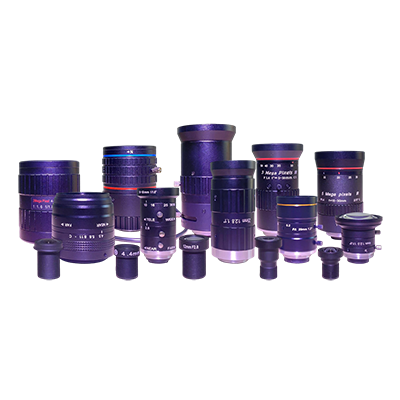
TOWIN’s product range covers multiple optical formats and application requirements, allowing engineers to select lenses according to sensor size, focal length, resolution, mount, distortion, and application.
| Requirement | TOWIN Lens Direction |
|---|---|
| Compact embedded imaging | M12 Lenses |
| Factory automation | C-Mount Lenses |
| Security imaging | CS-Mount Lenses |
| Precision measurement | Low Distortion Lenses |
| Wide-area imaging | Wide Angle Lenses |
| High-resolution machine vision | 20MP Machine Vision Lenses |
| Traffic monitoring | F1.4 Traffic Monitoring Lenses |
| ITS applications | F1.2 ITS Lenses |
When a standard lens does not meet the requirements of a specific camera or imaging system, engineers can also evaluate customized optical configurations based on sensor, FOV, focal length, resolution, mechanical dimensions, and environmental requirements.
Industrial Camera Lens Selection Checklist
Before finalizing a lens, confirm the following:
- ✓ What is the imaging application?
- ✓ What is the camera sensor size?
- ✓ What is the camera resolution and pixel size?
- ✓ What field of view is required?
- ✓ What is the available working distance?
- ✓ What focal length is required?
- ✓ What is the smallest feature that must be detected?
- ✓ Does the lens resolution match the camera?
- ✓ Is low distortion required?
- ✓ How much depth of field is required?
- ✓ What aperture is appropriate?
- ✓ Is the image circle large enough for the sensor?
- ✓ Which mount is required?
- ✓ Will the lens operate under the required temperature and environmental conditions?
- ✓ Is a standard lens sufficient, or is a customized optical solution required?
If these questions can be answered before ordering the lens, the risk of selecting an unsuitable optical configuration is significantly reduced.
Frequently Asked Questions
How do I choose the correct industrial camera lens?
Start with the application, sensor size, required FOV, working distance, resolution, distortion, aperture, depth of field, and mount. These parameters should be evaluated together rather than selecting a lens based on focal length or megapixels alone.
How do I calculate the focal length for a machine vision lens?
Focal length is determined primarily by sensor size, required field of view, and working distance. Once these parameters are known, use the Focal Length Calculator to estimate a suitable focal length.
How do I match a lens to my camera sensor?
Check that the lens image circle fully covers the sensor format and that the lens provides sufficient resolution for the sensor’s pixel size and application requirements. The focal length should then be selected according to the required FOV and working distance.
What lens is best for high-resolution machine vision?
A high-resolution machine vision lens should provide sufficient resolving power across the sensor and maintain suitable edge performance. The lens should also be matched to the sensor format, focal length, FOV, and application requirements.
What lens is best for precision measurement?
Precision measurement generally benefits from a high-resolution, low-distortion lens with stable optical performance. The correct lens should also provide appropriate FOV, working distance, and image coverage for the measurement system.
Should I choose an M12, C-Mount, or CS-Mount lens?
M12 lenses are often suitable for compact embedded vision systems, robotics, and AI cameras. C-Mount lenses are widely used in industrial machine vision and factory automation, while CS-Mount lenses are common in security and surveillance systems. The final choice depends on sensor size, optical performance, mechanical space, and application requirements.
How important is distortion when selecting an industrial lens?
Distortion is especially important for measurement, metrology, alignment, and other applications where geometric accuracy matters. For these applications, a low-distortion lens can help maintain more accurate dimensional information in the captured image.
Can TOWIN customize an industrial camera lens?
Yes. When standard optics do not meet a project’s requirements, TOWIN can evaluate customized industrial lens solutions based on parameters such as sensor format, focal length, FOV, resolution, distortion, mount, mechanical dimensions, and application conditions. Contact TOWIN to discuss your optical requirements.
Conclusion
How to Choose the Right Industrial Camera Lens should never be reduced to selecting a focal length or matching a camera’s megapixel rating. A reliable lens selection begins with the application and then connects sensor size, FOV, working distance, focal length, resolution, distortion, aperture, depth of field, mount, and environmental requirements.
The most effective process is to define the inspection task first, determine the required field of view and working distance, calculate the appropriate focal length, match the lens resolution to the camera, evaluate distortion and depth of field, and finally confirm mechanical and environmental compatibility.
By following this process, engineers can build an imaging system that provides better coverage, sharper image detail, more reliable measurements, and more consistent machine vision performance. Whether the requirement is compact M12 imaging, high-resolution C-Mount inspection, CS-Mount security, low-distortion measurement, or specialized traffic and robotics imaging, the correct optical configuration should always be selected according to the complete system.
If you are still evaluating How to Choose the Right Industrial Camera Lens for your camera, application, or optical system, review TOWIN’s Lens Selection Guide, use the FOV Calculator or Focal Length Calculator, and contact TOWIN for further lens selection or customized optical requirements.