


What Lenses Are Used for ANPR Systems?
08/04/2026
What Is Focal Length in an Industrial Lens?
08/12/2026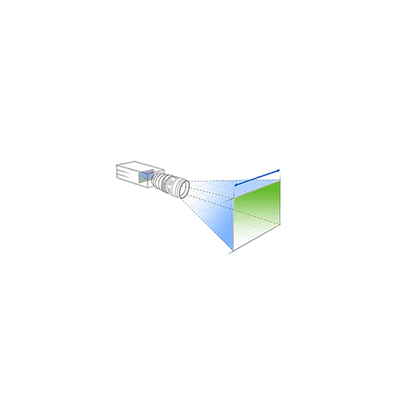
What is field of view in machine vision? Field of view (FOV) is the physical area that a camera and lens system can capture at a specific working distance. In machine vision, FOV determines whether the complete inspection target fits within the image and directly influences lens selection, image coverage, pixel density, and measurement performance.
Understanding FOV is one of the first steps in designing a reliable machine vision imaging system. The required field of view depends mainly on sensor size, focal length, and working distance, while resolution and lens distortion also need to be considered for demanding inspection applications.
In this guide, we explain what FOV means, how machine vision FOV is calculated, how sensor size and focal length affect it, and how to select a suitable industrial lens based on your required field of view.
What Is Field of View in Machine Vision?
Field of view, commonly abbreviated as FOV, refers to the physical area visible to a camera and lens system at a defined working distance. In machine vision, FOV describes how much of an object, inspection area, or scene can be captured in a single image.
FOV is normally expressed using the horizontal and vertical dimensions of the object space, such as 100 mm × 75 mm. It can also be described as an angular field of view, such as 60° horizontally or 45° vertically.
For industrial imaging, object-space FOV is particularly useful because engineers need to know whether the complete target will fit inside the camera image and whether enough pixels are available to detect the required details.
Simple Definition
Machine vision FOV is the physical area that a camera can see and inspect through a lens at a specific working distance.
An overly‑narrow field‑of‑view risks cutting portions of the target out of the captured frame. Conversely, an excessively wide FOV spreads limited pixels over an extended scene area and lowers the pixel density for inspection tasks.
If you are new to industrial optics, start with our industrial lens basics to understand focal length, aperture, sensor format, resolution, and other fundamental lens parameters.
Why Is FOV Important in Machine Vision?
FOV is not simply a camera specification. It is a key design parameter that connects the camera, lens, working distance, target size, and required image resolution.
1. FOV Determines Object Coverage
The first purpose of FOV is to ensure that the complete inspection target fits within the image. For example, if a machine vision system must inspect a 200 mm-wide component, the horizontal FOV needs to cover the required inspection width with an appropriate margin.
2. FOV Affects Pixel Density
A camera sensor has a fixed number of pixels. When the same pixels are spread over a larger FOV, fewer pixels are available for each millimeter of the target.
| FOV | Coverage | Pixel Density | Typical Effect |
|---|---|---|---|
| Smaller FOV | Smaller inspection area | Higher pixels/mm | Better for fine details |
| Larger FOV | Larger inspection area | Lower pixels/mm | Better for large targets |
3. FOV Influences Measurement Performance
In dimensional inspection, the selected FOV must provide enough spatial resolution to distinguish the features being measured. A very wide FOV may capture the entire component but provide insufficient pixels for small defects or dimensional features.
4. FOV Is a Key Lens Selection Parameter
Before selecting a machine vision lens, engineers normally determine the required inspection area, working distance, sensor format, and resolution. The lens focal length can then be selected to achieve the required FOV.
For a complete lens selection process, see the machine vision lens selection guide.
What Parameters Affect Machine Vision FOV?
Three parameters have the most direct influence on machine vision FOV: sensor size, focal length, and working distance. Resolution and lens design also affect the practical performance of the imaging system.
1. Sensor Size
Sensor size affects the amount of the image circle captured by the camera. When focal length and working distance remain constant, a larger sensor generally captures a wider field of view than a smaller sensor.
| Sensor Size | General FOV Effect | Key Consideration |
|---|---|---|
| Smaller sensor | Narrower coverage | Compact camera systems |
| Larger sensor | Wider coverage | Requires adequate image circle |
Sensor size also determines whether a lens can properly cover the entire sensor without vignetting. For a deeper explanation, see our sensor size and lens selection guide.
2. Focal Length
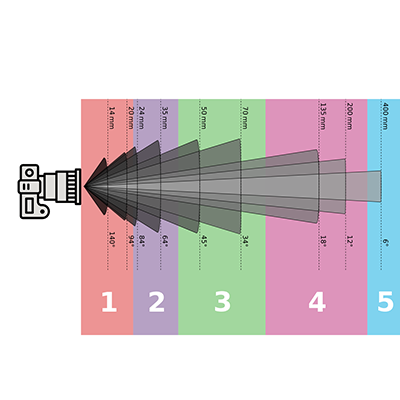
Focal length is one of the most important lens parameters affecting FOV. With the same sensor and working distance, a shorter focal length generally provides a wider FOV, while a longer focal length provides a narrower FOV.
| Focal Length | Typical FOV | Typical Application |
|---|---|---|
| Short focal length | Wide | Large-area inspection and embedded vision |
| Medium focal length | Moderate | General machine vision |
| Long focal length | Narrow | Detailed or long-distance inspection |
3. Working Distance
Working distance (WD) is the distance between the lens and the object being inspected. Changing the working distance changes the amount of the object that can be captured.
For a given optical configuration, increasing the working distance generally increases the physical area captured by the system, while reducing the working distance generally decreases the coverage area.
4. Resolution
Resolution does not directly determine the geometric FOV, but it strongly affects how much detail can be resolved within that FOV. A high-resolution camera combined with an excessively large FOV may still provide insufficient pixels per millimeter for a small inspection feature.
How Is Field of View Calculated?
FOV can be calculated using the relationship between sensor size, focal length, and working distance. For angular field of view, a commonly used approximation is:
Angular FOV = 2 × arctan(Sensor Size ÷ (2 × Focal Length))
In this equation, sensor size refers to the relevant sensor dimension, such as sensor width for horizontal FOV or sensor height for vertical FOV. Focal length is the optical focal length of the lens.
For machine vision applications, however, engineers are often more interested in object-space FOV: the actual physical width and height visible at the inspection distance.
Because real lenses have specific optical designs, distortion characteristics, and sensor compatibility requirements, theoretical calculations should be treated as an estimate. The actual lens datasheet and optical test results should be used for final system verification.
Machine Vision FOV Calculation Example
Consider a machine vision system using a sensor with a 6.4 mm horizontal sensor dimension, an 8 mm focal length lens, and a working distance of 500 mm.
The angular horizontal FOV can be estimated using:
FOV = 2 × arctan(6.4 ÷ (2 × 8))
This produces an estimated horizontal angular FOV of approximately 43.6°. The actual object-space coverage depends on the optical configuration and the relationship between the lens, sensor, and working distance.
For practical industrial lens selection, it is more convenient to use a dedicated FOV Calculator to evaluate sensor size, focal length, working distance, and coverage together.
FOV vs. Focal Length vs. Sensor Size
These three parameters are closely related, but they are not the same thing. Understanding their differences helps engineers avoid common lens selection errors.
| Parameter | What It Means | Increase in Parameter | Typical Effect on FOV |
|---|---|---|---|
| Sensor Size | Physical dimensions of the image sensor | Sensor becomes larger | Generally wider FOV |
| Focal Length | Optical distance that determines magnification characteristics | Focal length becomes longer | Narrower FOV |
| Working Distance | Distance between lens and target | Working distance increases | Generally wider object coverage |
| Resolution | Number of pixels available for imaging | Resolution increases | Does not directly change FOV |
The key point is that FOV should not be selected by looking at focal length alone. Sensor format, working distance, required coverage, resolution, and lens performance must be evaluated together.
How to Choose a Machine Vision Lens Based on FOV
Once the required FOV has been defined, the next step is to select a lens that can provide the required coverage while maintaining adequate resolution, distortion performance, and sensor compatibility.
Step 1: Define the Inspection Area
Measure the width and height of the object or area that needs to be inspected. Include a reasonable margin if the application requires object movement or positioning tolerance.
Step 2: Determine the Working Distance
Identify the available distance between the lens and the target. Mechanical constraints, lighting equipment, conveyor systems, and robotic movement can all affect the practical working distance.
Step 3: Confirm the Sensor Size
Check the camera sensor format and active sensor dimensions. The selected lens must provide an image circle large enough to cover the sensor.
Step 4: Calculate the Required FOV
Compare the required inspection area with the available sensor and optical configuration. TOWIN’s machine vision FOV Calculator can help estimate the relationship between sensor size, focal length, working distance, and field of view.
Step 5: Select the Appropriate Focal Length
A shorter focal length is generally used when a wider FOV is required. A longer focal length is typically selected when a narrower FOV and higher magnification are needed.
Step 6: Verify Resolution and Distortion
FOV alone does not guarantee good image quality. Check the lens resolution, MTF performance, distortion, relative illumination, aperture, and compatibility with the selected sensor.
For measurement and precision inspection, review the lens distortion guide to understand how optical distortion can affect image geometry and measurement accuracy.
Which Machine Vision Lens Is Suitable for Different FOV Requirements?
Different lens categories can be suitable for different FOV and application requirements. The correct choice depends on the combination of coverage, sensor size, resolution, distortion, working distance, and mechanical constraints.
| Requirement | Potential Lens Type | Typical Application |
|---|---|---|
| Wide FOV and compact size | M12 Lens | Embedded vision, robotics, AI cameras |
| Moderate FOV and high image quality | FA / C-Mount Lens | Machine vision and inspection |
| Wide coverage with controlled distortion | Low Distortion Lens | Measurement and precision inspection |
| High precision and geometric stability | Telecentric Lens | Metrology, dimensional measurement, PCB inspection |
TOWIN’s Knowledge Center provides additional guidance on industrial lens selection based on sensor size, working distance, distortion requirements, and application conditions.
How Does Distortion Affect Field of View?
The theoretical FOV and the practical image coverage of a lens are related but should not be treated as identical. Optical distortion changes the geometric relationship between the object and its image, particularly toward the edges of the image.
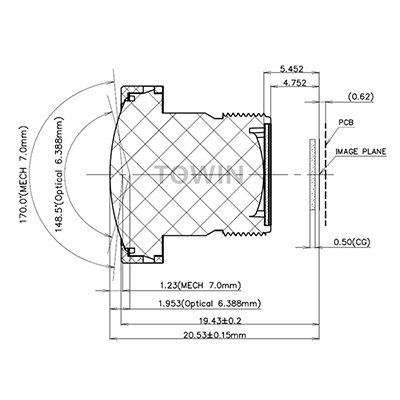
This is especially important for wide-angle machine vision lenses. A lens may provide a large FOV, but excessive barrel or pincushion distortion can reduce geometric accuracy and affect measurement or image analysis.
| Application | FOV Priority | Distortion Consideration |
|---|---|---|
| General inspection | Complete object coverage | Moderate control may be sufficient |
| Barcode / OCR | Complete code coverage | Image geometry and edge quality matter |
| Dimensional measurement | Controlled inspection area | Low distortion is important |
| Metrology | Precisely defined FOV | Very low distortion may be required |
For precision applications, explore TOWIN’s industrial lens distortion guide for more information about barrel distortion, pincushion distortion, calibration, and low-distortion imaging.
FOV Considerations for Different Machine Vision Applications
There is no single ideal FOV for every machine vision application. The required field of view depends on the target size, inspection distance, required detail, camera resolution, and application environment.
| Application | Typical FOV Consideration | Important Lens Requirement |
|---|---|---|
| PCB Inspection | Match FOV to board or inspection zone | High resolution and low distortion |
| Barcode Reading | Cover the complete code and surrounding area | Resolution and image clarity |
| Robotic Picking | Wide enough to locate the target | Wide FOV and compact design |
| Dimensional Measurement | Precisely controlled inspection area | Low distortion and stable magnification |
| Conveyor Inspection | Match FOV to conveyor width | Resolution and uniform image quality |
| AI Vision | Balance scene coverage and object detail | Resolution, FOV, and image quality |
For application-specific requirements, explore TOWIN’s machine vision lens solutions for industrial inspection, quality control, barcode reading, and automation applications.
Common Machine Vision FOV Problems
1. FOV Is Too Small
When the selected FOV is smaller than the target, part of the object may be cropped from the image. This can prevent complete inspection and create inconsistent results when the object moves.
2. FOV Is Too Large
A large FOV can capture a bigger area, but the available pixels are spread over more physical space. This may reduce pixels per millimeter and make small defects more difficult to detect.
3. The Sensor and Lens Are Not Properly Matched
A lens designed for a smaller sensor may not provide sufficient image circle coverage for a larger sensor. This can cause vignetting or reduced image quality at the edges.
4. Working Distance Is Incorrect
Even if the focal length is correct, an unsuitable working distance can produce the wrong object-space coverage. Mechanical installation requirements should therefore be considered before final lens selection.
5. Distortion Is Ignored
A wide FOV can be useful for coverage, but excessive distortion may compromise measurement accuracy or image analysis. For precision applications, FOV and distortion should always be evaluated together.
Calculate Your Machine Vision FOV
If you already know your sensor size, focal length, and working distance, you can estimate the required field of view using TOWIN’s online tool.
The FOV Calculator is designed to help engineers evaluate field of view, working distance, sensor coverage, and focal length when planning an industrial imaging system.
After calculating the required FOV, continue with the Lens Selection Guide to evaluate sensor compatibility, focal length, distortion, resolution, and other lens specifications.
Frequently Asked Questions
Q1: What is field of view in machine vision?
Field of view (FOV) is the physical area captured by a camera and lens system at a specific working distance. In machine vision, the correct FOV ensures that the inspection target fits within the image while providing sufficient pixel density for the required inspection task.
Q2: What factors affect field of view in machine vision?
The primary factors are sensor size, focal length, and working distance. Resolution, lens design, and distortion also affect the practical imaging performance of a machine vision system.
Q3: How do I calculate FOV for a machine vision camera?
FOV can be estimated from sensor size and focal length for angular calculations, while object-space coverage also depends on working distance. For practical lens selection, use a dedicated FOV Calculator to evaluate the relevant parameters together.
Q4: Does focal length affect FOV?
Yes. With the same sensor and working distance, a shorter focal length generally produces a wider FOV, while a longer focal length produces a narrower FOV and higher magnification.
Q5: Does sensor size affect machine vision FOV?
Yes. With the same focal length, a larger sensor generally captures a wider field of view. However, the lens must have an image circle large enough to cover the selected sensor.
Q6: How do I choose a lens based on FOV?
First determine the inspection area and working distance, then confirm the sensor size and calculate the required FOV. After that, select a lens with a suitable focal length and verify resolution, distortion, image circle, aperture, and mechanical compatibility.
Q7: What is a good field of view for machine vision?
There is no universal ideal FOV for machine vision. The appropriate FOV depends on the target size, required inspection detail, working distance, sensor resolution, and lens characteristics. The goal is to cover the required area without sacrificing the pixel density needed for inspection.
For a deeper discussion, see What Is a Good Field of View for Machine Vision?.
Conclusion
Understanding What is field of view in machine vision is essential for selecting the right camera and industrial lens. FOV defines the physical area captured by the imaging system and directly affects object coverage, pixel density, inspection performance, and lens selection.
The required FOV is primarily determined by sensor size, focal length, and working distance. However, a complete machine vision design should also consider resolution, image circle, distortion, aperture, working conditions, and the specific inspection requirements.
The most effective workflow is to define the inspection area, determine the working distance, confirm the sensor size, calculate the required FOV, and then select a lens that provides the required coverage and optical performance.
If you need to determine What is field of view in machine vision for your specific camera and lens configuration, start with the TOWIN FOV Calculator, then use the Machine Vision Lens Selection Guide to identify a suitable optical solution.