


What Is Image Circle and Why It Matters for Industrial Lens Selection
07/04/2026
How Does Resolution Influence Lens Choice?
07/06/2026
Low Distortion Lenses are essential for industrial vision systems that require highly accurate dimensional measurement, defect inspection, and object positioning. Unlike conventional lenses, they minimize geometric distortion so that captured images closely represent the real-world object. This makes them an ideal choice for machine vision, automated inspection, robotics, semiconductor manufacturing, and precision metrology.
Whether you are designing a new vision system or upgrading an existing inspection line, selecting the correct low distortion lens requires understanding several optical parameters, including sensor size, focal length, field of view (FOV), working distance, and imaging resolution. If you’re new to industrial optics, we recommend first reading our Lens Selection Guide, which explains the complete workflow for choosing an industrial lens.
This guide explains how Low Distortion Lenses work, why they are critical for precision measurement, and how to select the best lens for your application while avoiding common design mistakes.
Why Low Distortion Lenses Matter in Precision Measurement
In industrial measurement applications, image accuracy is just as important as image clarity. Even a small amount of lens distortion can cause measurement deviations that affect product quality, manufacturing efficiency, and automated decision-making.
When a standard lens introduces barrel or pincushion distortion, straight edges become curved, causing image processing software to calculate incorrect dimensions. Although software calibration can compensate for some distortion, optical correction is always the preferred solution because it preserves the highest measurement accuracy.
For this reason, Low Distortion Lenses are widely used in applications that require precise geometry rather than simply producing visually pleasing images.
Typical Applications
- PCB and electronic component inspection
- Semiconductor wafer measurement
- LCD and display panel inspection
- Automated optical inspection (AOI)
- Robot positioning and guidance
- Industrial metrology systems
- Precision assembly verification
- Glass and solar panel inspection
Before selecting a measurement lens, engineers should evaluate the entire imaging system instead of focusing only on distortion. Parameters such as sensor size, focal length, working distance, and image resolution all influence final imaging performance. Our comprehensive Lens Selection Guide explains how these parameters work together during the lens selection process.
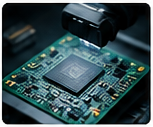
Why Engineers Choose Low Distortion Lenses
- ✔ Higher dimensional measurement accuracy
- ✔ More reliable edge detection
- ✔ Reduced calibration complexity
- ✔ Improved AI inspection consistency
- ✔ Better geometric fidelity across the entire image
- ✔ Higher production yield in automated inspection
What Are Low Distortion Lenses?
Low Distortion Lenses are industrial imaging lenses specifically engineered to minimize geometric deformation across the image. Their optical design ensures that straight lines remain straight and object dimensions remain consistent from the center of the image to the edges.
Compared with consumer camera lenses, industrial low distortion lenses typically use optimized optical structures, precision glass elements, advanced coatings, and tighter manufacturing tolerances to maintain image accuracy throughout the entire field of view.
These lenses are commonly paired with machine vision cameras for inspection, measurement, robotics, and quality control applications where accurate image geometry is critical.
Typical Distortion Performance
| Lens Type | Typical Distortion | Recommended Applications |
|---|---|---|
| Consumer Camera Lens | 3–10% | Photography & Video |
| Standard Industrial Lens | 1–3% | General Vision Systems |
| Low Distortion Lens | <1% | Machine Vision Inspection |
| High Precision Measurement Lens | <0.5% | Industrial Metrology |
Although software correction can reduce visible distortion, excessive optical distortion often decreases effective resolution near the image edges. Therefore, choosing a lens with inherently low distortion usually produces better inspection accuracy and faster image processing.
To understand how distortion influences optical performance and image quality, you can also read our detailed Distortion Guide.
How Distortion Affects Measurement Accuracy
One of the primary reasons engineers select Low Distortion Lenses is to eliminate measurement errors caused by geometric deformation. Even if an object appears visually acceptable, small distortions can significantly influence dimensional analysis when measurements are performed in pixels.
For example, a circular object may appear slightly elliptical, while a perfectly straight production line may become curved near the image edges. As distortion increases, the relationship between pixel coordinates and real-world dimensions becomes increasingly inaccurate.
Common Types of Distortion
- Barrel Distortion — Straight lines curve outward, making objects appear inflated.
- Pincushion Distortion — Straight lines bend inward toward the image center.
- Mustache Distortion — A complex combination of barrel and pincushion distortion.
Measurement Impact Comparison
| Distortion Level | Measurement Accuracy | Recommended Use |
|---|---|---|
| Above 5% | Poor | Photography |
| 2–3% | Moderate | General Monitoring |
| Below 1% | Excellent | Machine Vision Inspection |
| Below 0.5% | Very High | Precision Measurement |
In applications such as PCB inspection, semiconductor manufacturing, coordinate measurement, and robotic guidance, distortion directly affects positioning accuracy and repeatability. Selecting an appropriate low distortion lens can significantly reduce calibration workload while improving long-term measurement consistency.
Besides distortion, engineers should also evaluate sensor size and field of view when building a measurement system. Our Sensor Guide explains how sensor dimensions influence image coverage, while the interactive FOV Calculator helps determine the required focal length for your application.
Low Distortion Lens vs Standard Lens
Choosing between a Low Distortion Lens and a standard industrial lens depends on your application’s accuracy requirements. While standard lenses are suitable for general monitoring and imaging, they often introduce noticeable geometric distortion that can reduce measurement accuracy. For machine vision systems performing dimensional inspection or automated metrology, a low distortion lens provides significantly better image fidelity.
The difference becomes especially important when inspecting products with tight manufacturing tolerances. Even a distortion of only 2–3% can create measurable errors near the edges of the image, affecting automated inspection results.
| Feature | Low Distortion Lens | Standard Industrial Lens |
|---|---|---|
| Typical Distortion | <1% | 2–5% |
| Geometric Accuracy | Excellent | Moderate |
| Edge Accuracy | Very High | May Decrease |
| Calibration Requirement | Minimal | Usually Required |
| Inspection Reliability | Excellent | Average |
| Typical Applications | Precision Measurement, AOI, Robotics | General Surveillance, Monitoring |
| Cost | Higher | Lower |
Although standard industrial lenses are often more economical, they may increase system calibration time and software correction requirements. In contrast, Low Distortion Lenses provide better optical performance directly from the hardware, reducing long-term maintenance and improving production consistency.
Low Distortion Lens vs Telecentric Lens
Many engineers compare Low Distortion Lenses with telecentric lenses because both are used in industrial inspection systems. However, they solve different imaging challenges.
A low distortion lens minimizes geometric distortion while maintaining a conventional optical design. A telecentric lens, on the other hand, eliminates perspective error by keeping magnification nearly constant throughout the depth of field.
| Comparison | Low Distortion Lens | Telecentric Lens |
|---|---|---|
| Primary Purpose | Reduce geometric distortion | Eliminate perspective error |
| Measurement Accuracy | High | Extremely High |
| Perspective Control | Normal | Excellent |
| Working Distance Flexibility | High | Limited |
| Physical Size | Compact | Larger |
| System Cost | Moderate | Higher |
| Typical Applications | AOI, Robotics, Machine Vision | Precision Metrology, Gauge Measurement |
Which Lens Should You Choose?
- Choose a Low Distortion Lens when you need accurate geometry, compact size, faster integration, and lower system cost.
- Choose a Telecentric Lens when your application requires micron-level measurement accuracy and perspective errors cannot be tolerated.
For most factory automation, PCB inspection, robotic guidance, and AI vision systems, a Low Distortion Lens provides the best balance between imaging accuracy, cost, and installation flexibility.
Key Parameters to Consider When Selecting Low Distortion Lenses
Selecting the right Low Distortion Lenses involves much more than comparing distortion values. Engineers should evaluate the complete optical system to ensure optimal image quality and reliable inspection performance.
1. Sensor Size
The lens image circle must completely cover the camera sensor. An undersized image circle may cause vignetting and reduced image quality near the edges.
Learn more in our Sensor Guide.
2. Field of View (FOV)
Field of view determines how much of the target object appears in the captured image. A wider field of view generally requires a shorter focal length, while longer focal lengths provide higher magnification over smaller areas.
Use our interactive FOV Calculator to calculate the required focal length before selecting your lens.
3. Resolution
Lens resolution should match or exceed the camera sensor resolution. High-resolution cameras require lenses capable of delivering sufficient Modulation Transfer Function (MTF) performance.
4. Working Distance
Working distance influences focal length selection, magnification, installation space, and illumination design. Always verify the available mechanical space before finalizing the lens.
5. Distortion Specification
Different industrial applications have different distortion requirements.
| Application | Recommended Distortion |
|---|---|
| General Machine Vision | <2% |
| AOI Inspection | <1% |
| Robot Guidance | <1% |
| Precision Measurement | <0.5% |
| Industrial Metrology | <0.3% |
6. Optical Design Quality
A high-quality optical design improves sharpness, contrast, relative illumination, chromatic correction, and overall measurement consistency.
To better understand how industrial lenses are engineered, read our Optical Design Guide.
How to Choose Low Distortion Lenses
The most effective way to select Low Distortion Lenses is to follow a structured engineering workflow instead of comparing specifications individually.
Step 1 — Define the Inspection Task
- Target size
- Measurement tolerance
- Inspection speed
- Lighting conditions
- Environmental requirements
Step 2 — Select the Camera Sensor
Choose an appropriate sensor size and resolution according to the required inspection accuracy.
Step 3 — Calculate the Field of View
Determine the required imaging area using the FOV Calculator.
Step 4 — Determine the Working Distance
Measure the available installation distance and mechanical constraints.
Step 5 — Select the Appropriate Focal Length
Choose a focal length that provides the required magnification while maintaining adequate depth of field.
Step 6 — Compare Lens Performance
Evaluate the following specifications before making your final decision:
- ✔ Distortion
- ✔ Resolution (MTF)
- ✔ Image Circle
- ✔ Relative Illumination
- ✔ Aperture
- ✔ Working Distance
- ✔ Mechanical Size
Professional Recommendation
Rather than selecting a lens solely by focal length, evaluate the complete imaging system—including sensor size, field of view, working distance, distortion, and resolution. This approach ensures the highest imaging accuracy and minimizes redesign during system integration.
If you would like a complete walkthrough of the industrial lens selection process, including sensor matching, focal length calculation, and application-based recommendations, visit our comprehensive Lens Selection Guide.
Typical Applications of Low Distortion Lenses
Low Distortion Lenses are widely used in industrial vision systems where dimensional accuracy, repeatability, and geometric consistency are essential. Compared with conventional imaging lenses, they significantly reduce optical distortion, making them ideal for applications that require reliable measurements rather than simply capturing clear images.
PCB Inspection
Inspect solder joints, component placement, and circuit traces with high geometric accuracy while minimizing measurement deviation.
Semiconductor Inspection
Measure wafers, chips, and microelectronic components with extremely low distortion for micron-level inspection.
Robot Guidance
Improve robot positioning accuracy by providing consistent imaging across the entire field of view.
Industrial Metrology
Support dimensional measurement, coordinate verification, and automated quality control with stable optical performance.
LCD & Display Inspection
Detect pixel defects, alignment errors, and panel deformation while maintaining precise geometric accuracy.
Precision Assembly
Verify component position and assembly tolerances in automated production lines.
Many of these applications are also discussed in our Machine Vision Solutions page, where you can explore complete industrial imaging systems and recommended optical configurations.
Recommended Low Distortion Lens Categories
Different inspection tasks require different lens designs. The following categories provide a practical starting point when selecting Low Distortion Lenses.
| Lens Category | Recommended Applications | Main Advantages |
|---|---|---|
| M12 Low Distortion Lens | Embedded Vision, AI Cameras, Compact Robotics | Compact size, lightweight, cost-effective |
| FA Lens | Industrial Inspection, AOI, Machine Vision | High resolution, excellent sharpness |
| C Mount Lens | High-resolution industrial cameras | Supports larger sensors and flexible focal lengths |
| Telecentric Lens | Precision Metrology | Highest dimensional measurement accuracy |
Selecting the appropriate lens category depends on sensor size, field of view, working distance, and required measurement accuracy. If you’re unsure where to start, our Lens Selection Guide provides a complete step-by-step workflow.
Common Mistakes When Selecting Low Distortion Lenses
Choosing the wrong lens can significantly reduce inspection accuracy and increase system integration costs. Avoid these common mistakes when evaluating Low Distortion Lenses.
| Common Mistake | Potential Result | Recommended Solution |
|---|---|---|
| Selecting focal length before calculating FOV | Incorrect imaging area | Use the FOV Calculator first |
| Ignoring sensor size | Image vignetting | Verify compatibility using the Sensor Guide |
| Choosing lenses based only on price | Poor measurement accuracy | Prioritize optical performance |
| Ignoring distortion specifications | Measurement errors | Select distortion below application requirements |
| Ignoring optical resolution | Loss of image detail | Match lens MTF to camera resolution |
| Ignoring working distance | Installation problems | Verify mechanical constraints before purchasing |
Frequently Asked Questions
1. What are Low Distortion Lenses?
Low Distortion Lenses are industrial lenses designed to minimize geometric image distortion, making them ideal for precision measurement, machine vision inspection, and automated quality control.
2. What level of distortion is acceptable for machine vision?
General industrial inspection typically requires distortion below 2%, while precision measurement systems often require distortion below 1%. High-end metrology applications may require less than 0.5%.
3. Can software completely correct lens distortion?
Software calibration can compensate for some distortion, but optical correction provides better measurement accuracy and preserves image resolution, especially near the image edges.
4. Are Low Distortion Lenses better than telecentric lenses?
Not necessarily. Telecentric lenses provide the highest dimensional accuracy, while Low Distortion Lenses offer an excellent balance of performance, flexibility, and cost for most industrial applications.
5. Does sensor size affect lens selection?
Yes. Larger sensors require larger image circles and different focal length combinations. See our Sensor Guide for more information.
6. Which industries commonly use Low Distortion Lenses?
Machine vision, semiconductor manufacturing, robotics, precision metrology, medical imaging, automated optical inspection (AOI), and intelligent manufacturing all benefit from low distortion optical systems.
7. What parameters should I compare before buying a lens?
Compare distortion, focal length, image circle, working distance, sensor compatibility, aperture, MTF performance, and mechanical dimensions.
8. How do I choose the right Low Distortion Lens?
Follow a structured engineering workflow by considering sensor size, field of view, working distance, resolution, and application requirements. Our Lens Selection Guide walks through every step in detail.
Conclusion
Low Distortion Lenses play a critical role in modern industrial imaging by delivering accurate geometry, consistent measurement results, and reliable inspection performance. Whether you are developing an automated inspection system, integrating a robotic vision solution, or building a high-precision metrology platform, selecting the correct lens is just as important as choosing the camera itself.
Instead of evaluating distortion alone, engineers should consider the complete optical system—including sensor size, field of view, working distance, optical resolution, and application requirements. Following a structured selection process helps reduce integration time while improving long-term system performance.
If you’re planning a new machine vision project, start with our Lens Selection Guide, use the FOV Calculator to determine the required imaging area, review the Sensor Guide for sensor compatibility, and explore our Machine Vision Solutions to find the most suitable industrial imaging solution.
Need Help Choosing the Right Low Distortion Lens?
Towin’s optical engineering team can help you select the optimal industrial lens based on your sensor, field of view, working distance, and measurement accuracy requirements.
- ✔ Lens Selection Consultation
- ✔ Sensor & Lens Matching
- ✔ FOV Analysis
- ✔ Custom Optical Design
- ✔ OEM & ODM Manufacturing Support
Contact Our Engineers to discuss your project and receive professional lens recommendations tailored to your application.