


Telecentric Lens vs Standard Lens: Which One Is Right for Machine Vision?
06/25/2026
What Causes Lens Distortion?
06/25/2026C-Mount and CS-Mount are two of the most widely used lens interfaces in industrial imaging systems. Although they share the same thread specification, they differ in flange focal distance, compatibility, and typical applications. Understanding these differences helps engineers select the right optical solution for machine vision, robotics, medical imaging, and smart security systems.
Choosing the correct lens mount improves image quality, simplifies system integration, and reduces compatibility issues during camera deployment.
If you are new to industrial optics, start with our Lens Basics to understand focal length, sensor size, aperture, distortion, and industrial lens fundamentals.
What Is a C-Mount Lens?
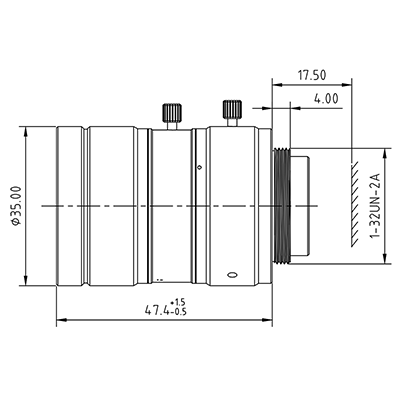
A C-Mount lens uses a standardized 1″-32 UN thread and has a flange focal distance of 17.526 mm. It has been widely adopted in industrial cameras, machine vision systems, microscopy, and scientific imaging due to its stability and compatibility with larger image sensors.
| Specification | C-Mount |
|---|---|
| Thread | 1″-32 UN |
| Flange Focal Distance | 17.526 mm |
| Typical Sensors | 1/2″ to 1″ and above |
| Typical Applications | Machine Vision, Medical Imaging, Industrial Inspection |
What Is a CS-Mount Lens?
A CS-Mount lens shares the same thread specification as a C-Mount lens but uses a shorter flange focal distance of 12.5 mm. This compact design makes it popular for embedded vision, AI cameras, surveillance systems, and lightweight imaging devices.
| Specification | CS-Mount |
|---|---|
| Thread | 1″-32 UN |
| Flange Focal Distance | 12.5 mm |
| Typical Sensors | 1/3″ to 1/2″ |
| Typical Applications | Security Cameras, Embedded AI Vision |
C-Mount and CS-Mount: Key Differences
Although the thread size is identical, C-Mount and CS-Mount lenses are designed for different optical distances and applications.
| Parameter | C-Mount | CS-Mount |
|---|---|---|
| Thread Standard | 1″-32 UN | 1″-32 UN |
| Flange Distance | 17.526 mm | 12.5 mm |
| Physical Size | Larger | More Compact |
| Typical Sensor Support | Medium to Large Sensors | Small to Medium Sensors |
| Main Applications | Machine Vision & Industrial Inspection | Security & Embedded Vision |
Are C-Mount and CS-Mount Compatible?
C-Mount Lens on a CS-Mount Camera
In most cases, a C-Mount lens can be installed on a CS-Mount camera by adding a 5 mm adapter ring, compensating for the difference in flange focal distance.
CS-Mount Lens on a C-Mount Camera
A CS-Mount lens generally cannot achieve proper focus on a C-Mount camera because the lens sits too far away from the sensor.
| Lens | Camera | Compatibility |
|---|---|---|
| C-Mount | C-Mount | ✔ Fully Compatible |
| CS-Mount | CS-Mount | ✔ Fully Compatible |
| C-Mount | CS-Mount | ✔ Requires 5 mm Adapter |
| CS-Mount | C-Mount | ✖ Not Recommended |
Industrial Applications
Machine Vision
C-Mount lenses are commonly selected for machine vision systems requiring high resolution, large sensors, and precise dimensional inspection.
Explore our Machine Vision Solutions.
Robotics Vision
Compact CS-Mount and embedded vision systems provide lightweight solutions for autonomous navigation and robotics perception.
Learn more about Robotics Vision Solutions.
Smart Security
CS-Mount lenses are widely used in surveillance cameras because of their compact size and wide-angle imaging capabilities.
See our Smart Security Solutions.
Medical Imaging
High-quality C-Mount optics provide excellent stability and image consistency for microscopy and medical diagnostic equipment.
Visit our Medical Imaging Solutions.
When Should You Consider an M12 Lens Instead?
While C-Mount and CS-Mount lenses remain industry standards, many modern embedded vision systems benefit from compact M12 lenses.
- Smaller and lighter design
- Optimized for AI cameras
- Suitable for robotics and drones
- Supports embedded vision systems
- Cost-effective for OEM applications
For compact imaging projects, explore our Lens Selection Guide to compare different industrial lens options.
How to Choose Between C-Mount and CS-Mount
| Application | Recommended Mount |
|---|---|
| Machine Vision Inspection | C-Mount |
| Medical Imaging | C-Mount |
| Security Monitoring | CS-Mount |
| Embedded AI Camera | CS-Mount or M12 |
| Robotics Vision | M12 or CS-Mount |
Mount selection should also consider sensor size, image circle, focal length, and working distance.
Read our Sensor Guide to learn how sensor dimensions influence lens compatibility.
Common Lens Mount Selection Mistakes
- Ignoring flange focal distance
- Selecting a mount before defining the application
- Choosing an incompatible sensor size
- Ignoring image circle requirements
- Using the wrong adapter
To understand image quality limitations, visit our Distortion Guide and Optical Design Guide.
Frequently Asked Questions
Q: What is the main difference between C-Mount and CS-Mount?
A: The primary difference is flange focal distance. C-Mount uses 17.526 mm, while CS-Mount uses 12.5 mm.
Q: Can I use a C-Mount lens on a CS-Mount camera?
A: Yes. A 5 mm adapter ring is typically required.
Q: Can I use a CS-Mount lens on a C-Mount camera?
A: No. In most cases, proper focus cannot be achieved.
Q: Which mount is better for machine vision?
A: C-Mount is generally preferred for high-resolution industrial inspection systems.
Q: Should I choose M12 instead?
A: If your project requires compact size, low weight, embedded AI vision, or robotics applications, M12 lenses may provide a more suitable solution.
Related Resources
- Lens Basics
- Lens Selection Guide
- Sensor Guide
- Optical Design Guide
- Distortion Guide
- Field of View Calculator
Conclusion
Understanding the differences between C-Mount and CS-Mount is essential for selecting the right industrial imaging solution. Although they share the same thread standard, their flange focal distances, camera compatibility, and application scenarios differ significantly.
By considering sensor size, optical performance, working distance, and future scalability, engineers can select the most appropriate lens mount for machine vision, robotics, medical imaging, or smart security systems. For a deeper understanding of industrial optics, continue exploring our Lens Basics Knowledge Center, where you’ll find comprehensive guides on lens selection, sensor compatibility, optical design, and imaging performance.