


M12 Lens for 1/1.7 Sensor: Selection Guide for High-Resolution Imaging Systems
06/11/2026
What Is a TOF Lens? A Complete Guide to Time-of-Flight Imaging Technology
06/11/2026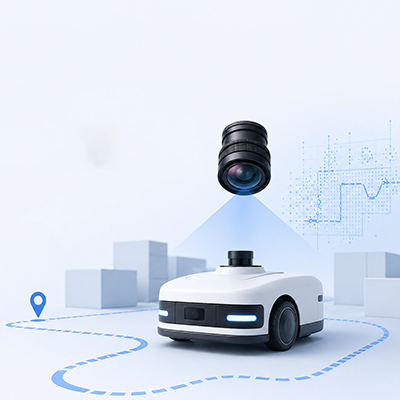
SLAM navigation has become a core technology for autonomous mobile robots (AMRs), automated guided vehicles (AGVs), delivery robots, service robots, and drones. While advanced algorithms and image sensors receive significant attention, the optical lens is equally important for navigation performance.
The right lens helps robots capture more environmental features, improve localization accuracy, and generate reliable maps. In contrast, a poorly selected lens can introduce distortion, reduce feature detection, and negatively affect positioning accuracy.
In this guide, we explain how to choose the best lens for SLAM systems, compare critical optical parameters, and provide practical recommendations for robotics vision applications.
Why Lens Selection Matters in SLAM Navigation
SLAM (Simultaneous Localization and Mapping) enables robots to build maps while simultaneously determining their location within an environment. Modern visual SLAM systems rely heavily on camera images to detect, track, and match visual features.
The optical lens serves as the first stage of the imaging pipeline. Every image used for localization passes through the lens before reaching the image sensor.
Lens performance directly affects:
- Feature detection quality
- Localization accuracy
- Map consistency
- Obstacle recognition
- Navigation reliability
For robotics developers, selecting the correct lens is just as important as selecting the camera sensor or SLAM algorithm.
Key Lens Parameters for SLAM Navigation
1. Field of View (FOV)
Field of View (FOV) determines how much of the surrounding environment the camera can capture in a single frame.
A wider FOV allows robots to observe more landmarks and environmental features, which can improve localization robustness.
| Application | Recommended HFOV |
|---|---|
| Indoor AMR | 90°–120° |
| Warehouse Robot | 80°–110° |
| Service Robot | 100°–130° |
| Drone Navigation | 120°–180° |
Before selecting a lens, it is helpful to calculate the required field of view using a Field of View Calculator.
2. Lens Distortion
Distortion is one of the most important factors affecting visual localization.
Barrel distortion, pincushion distortion, and mustache distortion can alter the geometry of captured images. Excessive distortion reduces the accuracy of feature matching and camera calibration.
For high-precision robotics systems, distortion should ideally remain below 5%, while advanced SLAM applications often target below 2%.
To learn more about image geometry errors, see our Lens Distortion Guide.
3. Focal Length
F.l. determines image magnification and viewing angle.
| Focal Length | Typical Robotics Application |
|---|---|
| 1.8mm | Ultra-wide SLAM coverage |
| 2.1mm | Indoor robot navigation |
| 2.8mm | General-purpose robotics vision |
| 4mm | Long corridor navigation |
| 6mm | Long-range feature detection |
Most mobile robots use focal lengths between 2.1mm and 4mm to balance coverage and image quality.
4. Sensor Compatibility
A lens must be matched correctly to the camera sensor size.
Common robotics camera sensors include:
- 1/4″
- 1/3″
- 1/2.8″
- 1/2″
- 2/3″
An incorrect sensor-lens combination may cause vignetting or reduced image coverage.
For detailed sensor comparisons, visit our Image Sensor Size Guide.
5. Low-Light Performance
Many robots operate continuously in warehouses, factories, parking facilities, and outdoor environments where lighting conditions vary significantly.
Lenses with larger apertures allow more light to reach the sensor, improving image quality and navigation stability under challenging conditions.
Wide-Angle vs Fisheye Lens for SLAM Navigation
Many robotics engineers compare wide-angle lenses and fisheye lenses when designing visual SLAM systems.
| Feature | Wide-Angle Lens | Fisheye Lens |
|---|---|---|
| Distortion | Low | High |
| Coverage | High | Very High |
| Calibration Complexity | Easy | Difficult |
| Localization Accuracy | High | Medium |
| Recommended for SLAM | Yes | Specific Cases |
For most SLAM navigation applications, low-distortion wide-angle lenses provide the best balance between environmental coverage and localization accuracy.
Recommended Lens Specifications for Different Robotics Applications
| Application | Focal Length | HFOV | Distortion |
|---|---|---|---|
| AMR | 2.1mm | 120° | <5% |
| AGV | 2.8mm | 100° | <3% |
| Service Robot | 2.1mm | 120° | <5% |
| Drone | 1.8mm | 140° | <8% |
| Delivery Robot | 2.8mm | 100° | <3% |
Related Robotics Vision Solution
Lens performance directly impacts robot perception, localization accuracy, environmental awareness, and autonomous decision-making.
To learn how optical design supports autonomous systems, explore our Robotics Vision Solution page.
How to Choose the Right Lens for Your SLAM Camera
When selecting a lens, follow this process:
- Define the robot application.
- Select the image sensor size.
- Calculate the required field of view.
- Determine installation space constraints.
- Evaluate distortion requirements.
- Consider lighting conditions.
- Validate performance through testing and calibration.
Compact robots frequently utilize M12 lenses due to their lightweight design, compact dimensions, and cost efficiency.
For a broader overview of optical selection criteria, see our Lens Selection Guide.
Can M12 Lenses Be Used for SLAM Navigation?
Yes. Modern M12 lenses are widely used in robotics vision systems because they offer compact form factors, wide viewing angles, and excellent compatibility with embedded camera modules.
Many AMRs, AGVs, service robots, and autonomous delivery systems use M12 lenses for visual positioning and environmental perception.
When properly selected, high-quality M12 lenses can provide the low distortion and wide coverage required for reliable SLAM performance.
Frequently Asked Questions
What focal length is best for robot navigation?
Most indoor robots achieve excellent results using focal lengths between 2.1mm and 4mm, depending on the required field of view.
Does lens distortion affect SLAM accuracy?
Yes. Distortion influences feature matching, camera calibration, and localization precision. Lower distortion generally improves navigation performance.
Is a fisheye lens suitable for SLAM?
Fisheye lenses can provide maximum coverage but often require additional calibration and image correction. Wide-angle lenses are generally preferred.
What sensor size is commonly used in robotics vision?
1/3″, 1/2.8″, and 1/2″ sensors are among the most common choices in robotics applications.
Are low-distortion lenses necessary for autonomous robots?
Yes. Low-distortion lenses help improve feature consistency and localization accuracy.
What type of lens is used in stereo vision systems?
Stereo vision cameras typically use matched low-distortion lenses with identical focal lengths and optical characteristics.
Can machine vision lenses be used in robotics?
Yes. Many robotics platforms utilize specialized Machine Vision Lenses to achieve higher imaging performance.
Conclusion
Choosing the best lens for SLAM navigation requires balancing field of view, distortion, focal length, sensor compatibility, and environmental conditions.
For most robotics applications, low-distortion wide-angle M12 lenses provide an ideal combination of navigation accuracy, environmental awareness, and compact integration. By understanding these optical requirements and matching the lens to the robot’s operational needs, engineers can significantly improve the performance and reliability of their SLAM navigation systems.