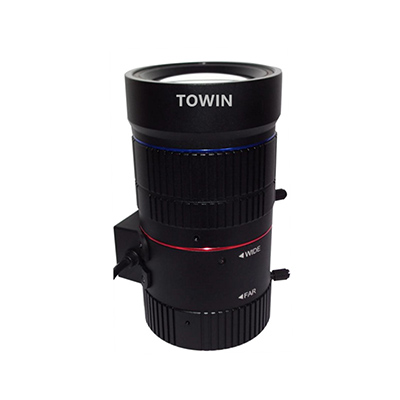
M12 S-mount 6mm CCTV lens
03/08/2026
Low distortion wide angle 4.2mm M8 mount lens
03/09/2026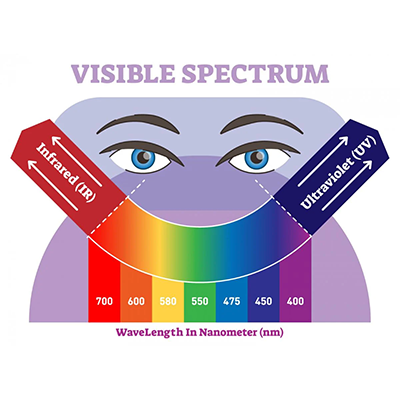
Table of Contents
Key Takeaways
- UV lenses are engineered for ultraviolet light (10–400 nm) and use UV-transmissive materials to avoid light absorption, critical for fluorescence, forensic, and industrial inspection applications.
- IR lenses optimize for infrared light (700 nm–1 mm) (near, mid, far IR) with low thermal dispersion materials, ideal for night vision, thermal imaging, and remote sensing.
- Core material differences: UV lenses rely on fused silica/quartz; IR lenses use germanium (Ge), silicon (Si), or chalcogenide glass.
- TOWIN’s UV/IR-corrected optical lenses integrate multi-coating technology for high transmittance and day/night performance, compatible with M12/S-mount, C-mount, and CS-mount camera systems.
- Lens selection hinges on spectral range, sensor type/size, application environment, and mount compatibility (M12, C, CS).
Introduction
The visible light spectrum (400–700 nm) is just a small fraction of the electromagnetic spectrum, and many industrial, security, scientific, and automotive applications demand imaging capabilities beyond what the human eye can see. UV vs. IR Lenses(Ultraviolet (UV) and infrared (IR) lenses) are specialized optical components designed to capture and manipulate light in these invisible wavelengths, solving unique challenges that standard visible-light lenses cannot address.
As a professional optical lens manufacturer and supplier in China, TOWIN Lens designs and produces high-precision UV and IR-corrected lenses for global customers, with customizable mount options (M12/S-mount, C-mount, CS-mount) and multi-coating technology for optimal transmittance in non-visible spectra. This guide breaks down the design, performance, applications, and selection of UV and IR lenses to help you choose the right optical solution for your project.
How UV vs. IR Lenses Interact with Light
Standard optical lenses are optimized for visible light, using materials like crown glass that absorb most UV and IR radiation—making them useless for non-visible imaging. UV vs. IR Lenses are re-engineered to transmit, focus, and minimize distortion of their target wavelengths, with two core design principles:
- Maximize transmittance: Use materials that do not absorb UV/IR light and apply specialized coatings to reduce reflection loss.
- Minimize chromatic aberration: Correct for wavelength-specific refraction differences that blur non-visible images.
- Thermal stability (IR focus): IR light is often linked to heat; IR lenses use materials that resist thermal expansion and dispersion to maintain focus.
Unlike visible-light lenses, UV and IR lenses also avoid optical coatings that block non-visible wavelengths, and their mechanical design aligns with the compact camera mounts (M12, C, CS) used in industrial, security, and automotive systems— a specialty of TOWIN’s lens manufacturing.
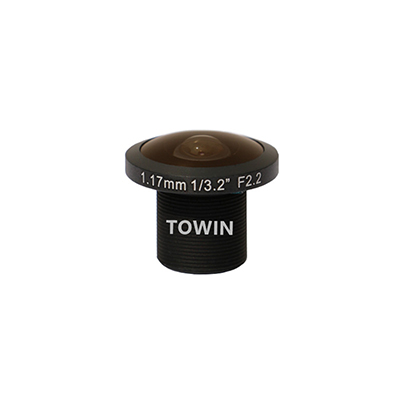
IR corrected 1.17mm M12 Fisheye CCTV lens
UV Lenses: Design, Materials & Core Performance
UV lenses are tailored for the ultraviolet spectrum, split into UVC (10–280 nm), UVB (280–315 nm), and UVA (315–400 nm) (the most commonly used for imaging). TOWIN’s UV lenses focus on UVA/UVB for industrial and commercial applications, with design and performance optimized for real-world usability.
Core Design Features
- UV-transmissive optical paths: No opaque materials for UV light in lens barrels or glass elements.
- Anti-reflective (AR) coating for UV: Reduces reflection at UV wavelengths to boost transmittance and image clarity.
- Compact mount compatibility: M12/S-mount (board/miniature) and C-mount options for PCB cameras and machine vision systems.
Key Materials for UV Lenses
UV light is easily absorbed by standard glass, so UV lenses use high-purity, UV-transmissive materials:
- Fused silica/quartz: The gold standard—high transmittance for UVA/UVB, low thermal expansion, and chemical resistance.
- Sapphire: Ideal for harsh industrial environments (scratch/impact resistance) with good UVA transmittance.
- Special UV-grade glass: Cost-effective alternative for low-power UVA applications.
Core Performance Metrics
- UV transmittance: ≥90% for target UV wavelengths (critical for low-light UV imaging).
- Low distortion: <1% distortion to ensure accurate imaging for inspection and forensics.
- Mount precision: Threaded M12X0.5 (S-mount) or C-mount flanges for direct integration with TOWIN’s compatible camera boards.
- Chemical/thermal resistance: For use in industrial inspection (e.g., high-temperature manufacturing lines).
IR Lenses: Structure, Optical Characteristics & Performance Metrics
Infrared lenses cover the near-IR (NIR: 700–1400 nm), mid-IR (MIR: 1400–3000 nm), and far-IR (FIR: 3000 nm–1 mm) spectra, with NIR being the most widely used for security, automotive, and machine vision (the focus of TOWIN’s IR lens production). IR lenses (especially NIR) are often labeled IR-corrected—a key feature of TOWIN’s CS-mount and M12-mount lenses for day/night security cameras.
Core Structural Features
- IR-transmissive element stacking: Multiple glass/semiconductor elements to correct for IR refraction and aberration.
- Multi-coating technology: TOWIN’s signature IR correction coating for seamless day (visible) and night (NIR) imaging.
- Iris control: Manual/DC auto/P-Iris options for CS-mount IR lenses, adjusting light intake for variable lighting conditions.
Key Optical Characteristics
- High NIR transmittance: Optimized for 850 nm/940 nm (the most common NIR wavelengths for night vision).
- Day/night compatibility: No image shift when switching between visible and NIR light (critical for security cameras).
- Low thermal noise: For MIR/FIR thermal imaging, minimizes image blur from heat-induced refraction.
Core Performance Metrics
- Flange focal distance accuracy: 12.526 mm (CS-mount) and 17.526 mm (C-mount) for precise camera alignment—TOWIN’s strict manufacturing standard.
- Megapixel resolution: High-resolution IR lenses (5MP+) for clear NIR imaging in IP/network security cameras.
- Low light sensitivity: For NIR night vision, captures clear images with minimal IR illumination.
- Environmental sealing: Dust/water resistance for outdoor applications (traffic monitoring, automotive).
Spectral Range & Core Specifications: UV vs. IR Lenses (Comparison Table)
A side-by-side breakdown of UV and IR lens key attributes—including TOWIN’s standard manufacturing specifications:
| Attribute | UV Lenses | IR Lenses |
| Target Spectrum | UVA (315–400 nm) / UVB (280–315 nm) | NIR (700–1400 nm, 850/940 nm focus); MIR optional |
| Core Materials | Fused silica, quartz, UV-grade glass | IR-corrected optical glass, silicon (Si), germanium (Ge) (MIR/FIR) |
| Key Coating | UV anti-reflective (AR) coating | Multi-coating for IR correction + visible light transmittance |
| Mount Options | M12/S-mount (M12X0.5), C-mount | M12/S-mount, C-mount, CS-mount (Fixed/Vari-Focal) |
| Primary Resolution | 2MP–5MP (industrial inspection) | 5MP+ (security/IP cameras); 2MP–8MP (machine vision) |
| Focal Distance | Fixed focal (12mm–35mm) | Fixed/Vari-Focal (4mm–35mm); P-Iris available |
| Transmittance | ≥90% (target UV wavelength) | ≥85% (850/940 nm NIR); ≥90% (visible light) |
Imaging Quality Factors: Resolution, Contrast & Sensitivity
For both UV and IR lenses, imaging quality is determined by three non-negotiable factors—TOWIN’s lenses are manufactured to strict tolerances to optimize all three for non-visible spectra:
Resolution
- Defined by megapixel (MP) capability and lens sharpness at target wavelengths.
- TOWIN’s 5MP UV lenses deliver high resolution for micro-inspection (e.g., PCB defect detection); 5MP+ IR lenses ensure clear night vision for security cameras.
- Critical for machine vision (MV/FA) and intelligent traffic systems (ITS)—core applications for TOWIN’s C-mount industrial/traffic lenses.
Contrast
- Driven by coating technology and low light transmittance; poor contrast leads to washed-out UV/IR images.
- TOWIN’s AR coatings for UV and IR correction coatings eliminate reflection glare, boosting contrast in high-glare environments (e.g., industrial metal inspection, outdoor traffic monitoring).
Sensitivity
- UV sensitivity: Requires high transmittance to capture weak UV light (e.g., fluorescence imaging).
- IR sensitivity: NIR lenses need low light sensitivity to work with small IR LEDs (night vision); TOWIN’s low-light sensitive M12 IR lenses are ideal for compact security cameras.
- TOWIN’s lenses are paired with CCD/CMOS sensor compatibility in mind, ensuring maximum sensitivity with standard imaging sensors.
Practical Applications of UV & IR Lenses
TOWIN’s UV and IR-corrected lenses are designed for the most common industrial, commercial, and automotive applications—with mount and performance tailored to each use case. Below are the key applications, paired with TOWIN’s recommended lens mounts:
UV Lens Applications
- Industrial inspection: PCB defect detection, semiconductor wafer inspection, and coating thickness analysis (M12/S-mount for compact PCB cameras; C-mount for machine vision).
- Forensic science: Fingerprint detection (UV fluorescence) and document authentication (UVA lenses).
- Environmental monitoring: Water quality analysis (UV absorption) and air pollution detection.
- Medical imaging: Skin condition analysis (UVB) and fluorescence microscopy (UVA).
IR Lens Applications
- Security & surveillance: Day/night IP/network cameras, CCTV systems (CS-mount with P-Iris/DC auto iris; M12-mount for mini cameras)—TOWIN’s best-selling IR lens application.
- Machine vision (MV/FA): Industrial automation and robotic guidance (C-mount industrial lenses with NIR correction).
- Intelligent Traffic Systems (ITS): Traffic monitoring and license plate recognition (C-mount traffic/ITS lenses with IR low light sensitivity).
- Automotive: Night vision assist and driver monitoring (compact M12/S-mount IR lenses).
- Agriculture: Crop health analysis (NIR imaging for chlorophyll detection).
How to Select UV & IR Lenses: TOWIN’s Expert Guide
Selecting the right UV or IR lens depends on 4 critical factors—TOWIN’s team of optical engineers can customize lenses to your exact specifications, but these core steps will guide your initial selection:
1: Define Your Target Spectral Range
- Choose UV lenses if you need to image 315–400 nm (UVA) or 280–315 nm (UVB); confirm if UVC (germicidal) is required (specialized materials).
- Choose IR lenses if you need night vision (850/940 nm NIR) or thermal imaging (MIR/FIR); TOWIN’s standard IR lenses are NIR-optimized for day/night use.
2: Match the Lens Mount to Your Camera
TOWIN’s UV/IR lenses support the three most common camera mounts—always confirm camera mount type first:
- M12/S-mount (M12X0.5): Miniature/board lenses for compact PCB, security, and automotive cameras (TOWIN’s “board lens” specialty).
- CS-mount (12.526 mm flange): CCTV/IP/network security cameras (fixed/vari-focal, manual/auto/P-Iris).
- C-mount (17.526 mm flange): Industrial machine vision (MV/FA), ITS/traffic, and 3D cameras (TOWIN’s industrial/ITS lens line).
3: Align Lens Performance with Your Application
- Resolution: 5MP+ for security/IP cameras; 2MP–8MP for industrial machine vision.
- Focal length: Wide-angle (4mm–8mm) for surveillance; fixed focal (12mm–35mm) for inspection/monitoring.
- Environmental resistance: Dust/water sealing for outdoor/industrial use (TOWIN’s custom option).
- Iris control: P-Iris/DC auto iris for variable lighting (CS-mount IR lenses); manual iris for fixed-environment industrial use.
4: Confirm Sensor Compatibility
- UV/IR lenses must match your camera’s CCD/CMOS sensor size (1/2″, 2/3″, 3/4″—TOWIN’s lenses support all standard sizes, e.g., 1/2″ 5MP F2 IR lenses).
- TOWIN provides sensor size specifications for all lenses (e.g., CCL121625MPRF 1/2″ 5MP F2) for easy matching.
5: Consider Customization Needs
TOWIN offers custom lens design and manufacturing for unique applications:
- Custom spectral range optimization (specific UV/IR wavelengths).
- Custom mount or focal length.
- Special coatings (enhanced UV/IR transmittance, scratch resistance).
- Bulk production with fast shipping (TOWIN’s FAST service promise).

M12 CCTV lens 3-Megapixel IR corrected
UV vs. IR Lenses: Quick Selection Flowchart
Follow this simple flowchart to narrow down your TOWIN UV/IR lens selection—start with your core application:
1. What is your primary application?
- For UV fluorescence/inspection/forensics → UV Lenses → Go to 2a
- For night vision/security/ITS/automotive → IR Lenses → Go to 2b
- 2a. UV Lens Next Step: Confirm camera mount (M12/S-mount → compact PCB cameras; C-mount → machine vision) → Select target UV range (UVA/UVB) → TOWIN UV lens series
- 2b. IR Lens Next Step: Confirm camera mount (M12 → mini cameras; CS-mount → security; C-mount → industrial/ITS) → Choose fixed/vari-focal + iris type → TOWIN IR-corrected lens series
2. Final Check: Match lens sensor size (1/2″, 2/3″) to camera sensor → Confirm resolution (5MP+/2MP–8MP)
3. Custom? Yes → Contact TOWIN for custom design; No → Select TOWIN standard UV/IR lens → Fast shipping/selection
FAQs
Q1: Can TOWIN’s IR lenses be used for both day and night imaging?
Yes—all TOWIN IR lenses use multi-coating IR correction technology that transmits both visible and NIR light, with no image shift between day and night modes. This is a core feature of our CS-mount security lenses.
Q2: What mount options are available for TOWIN’s UV lenses?
TOWIN’s UV lenses are available in M12/S-mount (M12X0.5) (miniature/board cameras) and C-mount (industrial machine vision cameras). Custom mounts are available on request.
Q3: Do TOWIN’s UV/IR lenses support high-megapixel sensors?
Yes—we offer 5MP+ UV/IR lenses for high-resolution imaging, with 1/2″ 5MP F2 IR lenses (e.g., M300617513730) as a popular standard option. We also manufacture 8MP lenses for industrial machine vision.
Q4: Can I get a custom UV/IR lens designed for my unique application?
Absolutely—TOWIN is a full-service optical lens supplier, offering custom design and manufacturing for UV/IR lenses (spectral range, mount, focal length, coatings). Our engineering team will work with you to create a tailored solution.
Q5: How fast can TOWIN ship UV/IR lenses?
TOWIN prides itself on FAST selection and shipping—standard UV/IR lenses are in stock and shipped within a short lead time; custom lenses have a fast manufacturing turnaround (contact us for exact timelines).
Conclusion
UV vs. IR Lenses unlock imaging capabilities far beyond the visible spectrum, powering critical applications in industrial inspection, security, automotive, and scientific research. The key to successful non-visible imaging is choosing a lens optimized for your target wavelength, camera mount, and application—something TOWIN Lens excels at as a professional Chinese optical lens manufacturer.
With a full range of M12/S-mount, C-mount, and CS-mount UV and IR-corrected lenses, multi-coating technology, high megapixel resolution, and custom design capabilities, TOWIN is your one-stop supplier for all non-visible optical lens needs. Our core values—PROFESSIONAL, ALL, EASY, FAST—ensure you get the right lens, quickly and with expert support.
Get Your TOWIN UV/IR Lens Solution Today
Contact TOWIN Now: info@towin-elec.com
TOWIN Lens – Your Trusted Partner for Optical Lenses Beyond the Visible Spectrum