



Low distortion wide angle 4.2mm M12 mount lens
03/04/2026
3.6mm M12 S-mount wide angle HD board lens
03/05/2026
Table of Contents
Introduction
In the industrial imaging industry, the debate of C-Mount vs. CS-Mount is one of the most common topics for engineers and system integrators. While these two lens mounts look identical at first glance, that tiny 5mm gap is the difference between a crystal-clear image and a system that fails to focus.
In this comprehensive guide, we will analyze the technical specifications of C-Mount vs. CS-Mount, explain the physics behind the “5mm difference,” and provide a clear compatibility roadmap for your machine vision projects.
Quick Summary: C-Mount vs. CS-Mount at a Glance
Before diving into the technical details, here is the essential takeaway for the C-Mount vs. CS-Mount standard:
- C-Mount: Flange focal distance of 17.526 mm.
- CS-Mount: Flange focal distance of 12.526 mm.
The Key Rule: You can use a C-Mount lens on a CS-Mount camera (with an adapter), but you cannot use a CS-Mount lens on a C-Mount camera.
What is the Difference Between C-Mount vs. CS-Mount?
Both C-Mount and CS-Mount are threaded lens mounts with a 1-inch (25.4 mm) diameter and 32 threads per inch (TPI). Because the physical thread is the same, many users mistakenly believe they are cross-compatible without accessories.
The real difference lies in the Flange Focal Distance (FFD)—the distance from the lens mounting flange to the image sensor.
Technical Comparison Table: C-Mount vs. CS-Mount
| Specification | C-Mount Standards | CS-Mount Standards |
| Flange Focal Distance | 17.526 mm (0.69 inches) | 12.526 mm (0.493 inches) |
| Thread Specification | 1″ – 32 UN 2A | 1″ – 32 UN 2A |
| Physical Length | Longer barrel design | Shorter, compact design |
| Typical Application | High-end FA Lenses | Compact CCTV/Industrial Cameras |
The “5mm Difference” Explained
Why does 5mm matter so much in the C-Mount vs. CS-Mount comparison?
If the lens is positioned even a fraction of a millimeter too far or too close to the sensor, the light rays will not converge correctly.
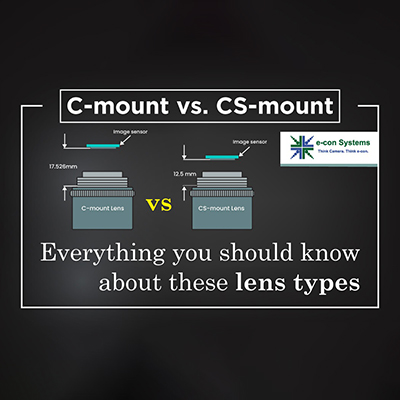
- In a C-Mount system, the lens is designed to sit 17.526mm away from the sensor.
- In a CS-Mount system, the camera body is shorter, placing the mount only 12.526mm away from the sensor.
This 5mm difference allows CS-Mount cameras to be smaller and use more cost-effective optics, but it creates a challenge for lens interchangeability.
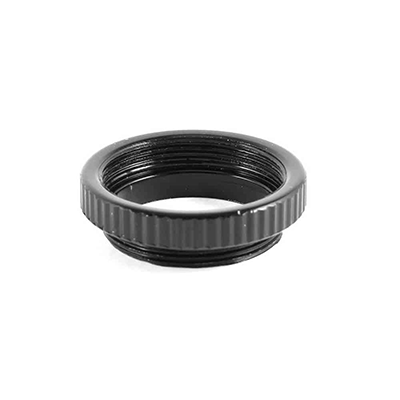
5mm Adapter Ring
As shown above, the C-mount has a longer distance (17.526mm), while the CS-mount is shorter (12.526mm). This exactly 5.0mm difference is what defines their compatibility rules.
Compatibility Guide: C-Mount vs. CS-Mount Adapters
When integrating a vision system, you must follow these two scenarios for C-Mount vs. CS-Mount compatibility:
Scenario A: Using a C-Mount Lens on a CS-Mount Camera
This is the most common setup. Because the C-Mount lens expects a 17.526mm distance but the CS-mount camera only provides 12.526mm, you have a 5mm deficit.
- Solution: Simply add a 5mm C-CS adapter ring.
- Result: The lens will function perfectly and achieve infinity focus.
Scenario B: Using a CS-Mount Lens on a C-Mount Camera
This setup is not possible. Since the C-mount camera body is already 17.526mm long, the CS-mount lens (which needs to be at 12.526mm) is physically too far from the sensor.
- Result: The image will be blurry, and you cannot focus the lens. There is no adapter that can “shorten” the camera’s fixed mechanical distance.
Which One Should You Choose?
When deciding between C-Mount vs. CS-Mount for your next project, consider these factors:
- Lens Availability: C-Mount is the legacy standard. There is a much wider variety of high-performance, specialized, and large-format C-Mount lenses available on the market.
- Space Constraints: If you are designing a compact medical device or a small inspection robot, CS-Mount cameras offer a smaller footprint.
- Future-Proofing: Most modern industrial cameras are CS-mount but include a 5mm adapter in the box, giving you the flexibility to use both types of lenses.
C-Mount vs. CS-Mount
FAQs
Q: Can I identify a C-Mount vs. CS-Mount camera just by looking?
A: It is difficult because the threads are identical. However, if the sensor looks very close to the edge of the mount, it is likely a CS-mount. Checking the camera’s datasheet is the only 100% reliable method.
Q: Does Towin provide adapters for C-Mount vs. CS-Mount conversion?
A: Yes, we provide high-precision 5mm spacer rings and a wide range of C-mount industrial lenses designed for precision machine vision.
Q: Why is my image blurry even when I turn the focus ring to the limit?
A: You are likely using a C-mount lens on a CS-mount camera without a 5mm adapter. Without the adapter, the lens sits too close to the sensor, preventing it from reaching focus.
Q: Does adding a 5mm adapter ring affect image quality?
A: No. Since there are no glass elements in a standard 5mm spacer, it does not degrade the optical quality. It simply restores the correct mechanical distance.
Q: How can I tell if my camera is C-mount or CS-mount?
A: Most modern compact industrial cameras are CS-mount by default but often ship with a 5mm ring pre-installed. If the distance from the mount edge to the sensor looks very shallow (about 12.5mm), it’s a CS-mount.
Conclusion: Which One Should You Choose?
When building your vision system:
- Choose C-Mount if you need high-end, specialized optics or large-format lenses, as the variety of C-mount lenses on the market is vast.
- Choose CS-Mount if space-saving and cost are your primary concerns, especially for standard factory automation tasks.
At Towin, we provide a wide range of high-precision C-mount lenses and [optical accessories] tailored for your specific industrial needs.
Still unsure about your lens-to-camera compatibility?
[Contact our engineering team today] for a free technical consultation to ensure your vision system performs at its peak.