


Customized Lens Search: Filter by Mount, Sensor, and EFL
04/14/2026
Top 7 Global M12 Lens Manufacturers in 2026
04/16/2026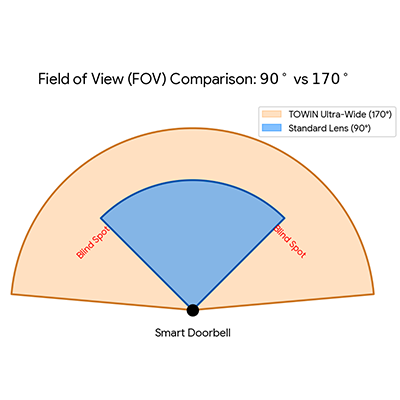
Table of Contents
Key Takeaways
- Smart doorbells require Wide angle lens between 120°–166° to capture visitors, packages and side entrances without blind spots.
- Ideal specs: 1.6mm–2.8mm focal length, F1.6–F2.4 aperture, low distortion, IR correction, M12 mount.
- Overly wide angles cause heavy distortion; 150°–160° offers the best balance for most doorbells.
- TOWIN provides high-quality M12 wide-angle lenses for 2MP–5MP doorbell cameras with stable day-night imaging.
- Always match lens format, sensor size and mount type to avoid blurriness, vignetting or assembly issues.
Introduction
In the era of smart home security, the video doorbell is the first line of defense. However, the effectiveness of a doorbell depends entirely on its “eyes” — the lens.
For manufacturers and hardware engineers, selecting the right wide angle lens for smart doorbells is not just about capturing a wider image. It is about ensuring every part of the porch — from the package on the ground to a visitor’s face — is sharp, clear and usable.
At TOWIN, we specialize in precision optical lens design and manufacturing, helping smart hardware brands achieve the ideal balance between viewing angle, image quality and reliability.
FOV Comparison: Which Angle Works Best for Your Doorbell?
Field of View (FOV) is the most critical parameter for a doorbell lens. Performance varies based on housing structure, installation environment and sensor size (such as 1/2.7″, 1/3″).
FOV & Application Scenario Comparison
| FOV Range | Suitable Scene | Advantage | Disadvantage |
|---|---|---|---|
| 120°–140° | Villa, open porch | Low distortion, natural face | Narrower coverage, possible blind spots |
| 150°–160° | Most apartments & doors | Balanced view & low distortion | Best overall performance |
| 160°–166° | Narrow corridor, mini doorbell | Maximum coverage | Slight edge distortion |
| 170°+ | Panoramic use | Ultra-wide view | Obvious fisheye effect |
Core Parameters of Wide-Angle Doorbell Lens
Viewing Angle
- Typical working range: 120°–166°
- Apartments & narrow corridors: 150°–166°
- Villas & open areas: 120°–140°
- Angles over 170° often cause heavy barrel distortion and edge blur
Focal Length
- Shorter focal length = wider viewing angle
- Recommended range: 1.6mm – 2.8mm
- 1.6mm–2.0mm: ultra-wide for compact battery doorbells
- 2.4mm–2.8mm: balanced wide view with less distortion
Distortion Control
- Recommended TV distortion: < 3%
- High distortion deforms faces and reduces recognition accuracy
- TOWIN uses optimized optical structures to minimize distortion
Aperture (F-number)
- Ideal range for doorbells: F1.6 – F2.4
- Larger aperture (lower F-number) improves low-light performance
- Supports clearer IR night vision with 850nm / 940nm LEDs
IR & Day-Night Performance
- IR-corrected optical design
- Compatible with IR cut filters
- No focus shift or color cast between day and night
- Stable imaging under 850nm and 940nm infrared lighting
Mount Type
- M12 (S-mount):industry standard for doorbell PCBA
- Small size, easy assembly, high stability
- CS-mount only used in larger specialized doorbell systems
Resolution & Sensor Compatibility
- Supports 2MP, 3MP, 5MP sensors
- Matches 1/2.9″, 1/3″, 1/4″ sensors widely used in doorbells
- Ensures sharp center and edge images without vignetting
Parameter Comparison: Standard vs. TOWIN Wide angle lens
Standard Lens vs. TOWIN Wide-Angle Lens
| Parameter | Standard General Lens | TOWIN Wide angle lens | Application Demand |
|---|---|---|---|
| FOV | < 110° | 120°–166° | Full porch coverage |
| Distortion | High, obvious warping | < 3% low distortion | Clear facial recognition |
| Aperture | F2.6 or higher | F1.6–F2.4 | Strong night vision |
| IR Correction | Basic or none | Professional IR matching | 24-hour stable imaging |
| Mount | Mixed types | M12 (S-mount) | Compact assembly |
| Resolution | Up to 2MP | 2MP–5MP | High-definition video |
| Structure | Universal | Doorbell-optimized | Fits slim doorbell housing |
How to Select the Best Wide Angle Lens
Follow this step-by-step guide to avoid R&D and mass-production errors.
1. Confirm Installation Environment
- Narrow indoor corridor → use 150°+ ultra-wide lens
- Open villa entrance → medium wide angle to control distortion
- Consider weather resistance and operating temperature range
2. Match Sensor Parameters
- Confirm sensor size: 1/2.9″, 1/3″, etc.
- Confirm resolution: 2MP / 3MP / 5MP
- Avoid format mismatch that causes dark corners or blurring
3. Confirm Mount & Mechanical Size
- Almost all smart doorbells use M12 mount
- Confirm back focal length (BFL) for PCB positioning
- Ensure outer diameter fits the doorbell shell
4. Prioritize Low-Light & IR Performance
- Choose F1.6–F2.4 for better night vision
- Use IR-corrected lenses for 850nm/940nm LEDs
- Verify day-night switching stability
5. Test Image Quality & Distortion
- Test facial recognition at 0.5m–2m
- Check edge clarity and deformation
- Ensure no color shift or focus drift
TOWIN Lens Solutions for Smart Doorbells
TOWIN focuses on high-performance optical lenses for smart security and smart home devices.
Our strengths for doorbell applications:
- Professional M12 wide-angle lenses designed for doorbells
- Low-distortion optics for better AI human detection
- Excellent IR day-night compatibility
- Stable quality for mass production
- Customizable parameters: angle, aperture, focal length, BFL
- Small MOQ for sampling and prototyping
- Full technical support for lens-sensor matching
We provide reliable lens solutions for manufacturers of video doorbells, intercoms and access control systems.
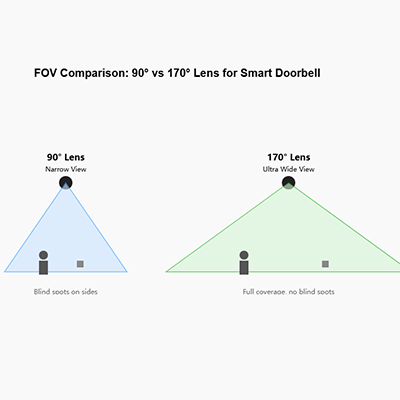
wide angle doorbell lens comparison
FAQs
Q: How to eliminate the fisheye effect in ultra-wide lenses?
A: Optical design reduces distortion; most doorbells also use SoC software dewarping to provide a natural, flat view.
Q: Is M12 mount the best for smart doorbells?
A: Yes. M12 (S-mount) is the most compact, stable and cost-effective standard for doorbell PCB assembly.
Q: Can wide-angle lenses cause facial distortion?
A: Low-quality lenses do. TOWIN lenses control distortion below 3% for natural faces and reliable recognition.
Q: Does TOWIN support custom doorbell lenses?
A: Yes. We customize focal length, FOV, aperture, IR design and mechanical structure to match your project.
Conclusion
The right wide angle lens directly defines the performance of a smart doorbell. Viewing angle, distortion, aperture, IR compatibility and mount type are the five most important factors.
A high-quality, doorbell-optimized wide-angle lens improves product competitiveness, user experience and overall reliability.
If you’re developing or upgrading a smart doorbell and need professional lens support, contact TOWIN for datasheets, samples or customized solutions.
📧 : info@towin-elec.com