


What are the common applications of short-focus lenses?
07/02/2025
CCTV camera lens options
07/03/2025
A macro lens is a specialized optical lens designed to capture small objects and fine details at close focusing distances. By providing higher magnification than a standard imaging lens, it allows cameras to record intricate features that may not be clearly visible in conventional images. Macro lenses are used in close-up photography, industrial inspection, electronic component imaging, and laboratory applications. In industrial machine vision, selecting the right macro lens requires careful consideration of magnification, working distance, resolution, depth of field, and sensor compatibility.
Understanding how a macro lens works and which optical parameters affect image quality is essential when building a reliable close-up imaging system.
What Is a Macro Lens?
A macro lens is an optical lens designed to focus on objects at relatively short distances and reproduce small subjects with a high level of detail. Unlike standard lenses primarily used for general scene imaging, a macro lens is optimized for close-up imaging and higher magnification.
One important characteristic of macro imaging is the magnification ratio, also known as the reproduction ratio. It describes the relationship between the actual size of an object and the size of its image projected onto the camera sensor.
For example, a 1:1 magnification ratio means that a 10 mm object produces an image measuring 10 mm on the sensor plane. A 2:1 magnification ratio means the projected image is twice the object’s actual size.
Not every lens used for close-up imaging needs to provide 1:1 magnification. The required magnification depends on the object dimensions, sensor size, field of view, and level of detail that the imaging system needs to capture.
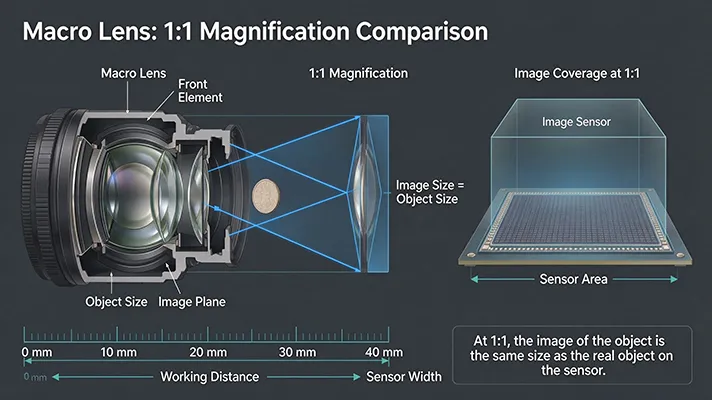
Macro lens for close-up imaging
In industrial applications, macro imaging is particularly useful when a camera needs to inspect small components, identify surface defects, or capture fine structural details. The lens must provide sufficient optical resolution and maintain image quality at the required working distance.
How Does a Macro Lens Work?
A macro lens works by focusing light reflected or transmitted from a nearby object onto the camera’s image sensor. Its optical design enables the camera to maintain focus at close distances while reproducing small subjects at relatively high magnification.
When an object is positioned in front of the lens, light passes through the optical elements and forms an image on the sensor. The magnification depends on the optical configuration, object distance, image distance, and focusing arrangement.
Several optical factors determine the performance of a macro imaging system:
- Object distance: The distance between the object and the optical system affects focusing and image magnification.
- Focal length: Influences the field of view and imaging geometry at a given setup.
- Optical design: Determines how well the lens controls aberrations and maintains image quality at close distances.
- Magnification: Determines how large the object appears on the image sensor.
- Sensor characteristics: Sensor dimensions and pixel size affect the captured field of view and visible detail.
In industrial imaging, the macro lens must work together with the camera sensor, illumination system, and mechanical installation. A suitable combination helps produce clear and repeatable images for automated inspection.
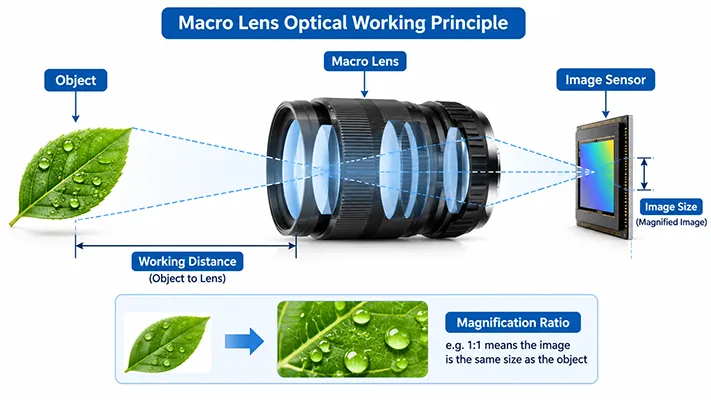
How a macro lens works
Key Optical Parameters of a Macro Lens
Choosing a suitable macro lens requires more than checking its focal length or magnification. Several optical parameters work together to determine whether a lens can meet the requirements of a close-up imaging application.
1. Magnification Ratio
Magnification ratio describes how large an object’s image appears on the sensor compared with its actual physical size.
For example, a 1:1 ratio reproduces an object at its actual size on the sensor plane, while a 0.5:1 ratio produces an image half the object’s actual size.
In industrial inspection, the required magnification should be determined by the object dimensions, camera sensor size, and the smallest feature that needs to be detected.
2. Working Distance
Working distance refers to the physical distance between the front of the lens and the object being imaged. It is an important consideration when designing close-up imaging systems.
A shorter working distance may be suitable for compact inspection equipment, but it can create installation difficulties or interfere with lighting and object movement. A longer working distance may provide more room for mechanical integration and illumination.
For automated inspection, the working distance should be considered together with magnification, field of view, and the available installation space.
3. Focal Length
Focal length is an important optical parameter that influences the field of view and imaging configuration. Different focal lengths can be used to achieve different viewing angles and object coverage.
However, focal length alone does not determine whether a lens is suitable for macro imaging. Minimum focusing distance, optical design, magnification capability, and sensor compatibility must also be evaluated.
4. Depth of Field
Depth of field (DOF) describes the range of object distances that appear acceptably sharp in an image. In close-up imaging, depth of field can become very shallow, particularly at high magnification.
This is important when inspecting objects with uneven surfaces, different heights, or complex three-dimensional structures. Aperture, magnification, and optical configuration all influence the available depth of field.
5. Optical Resolution
Optical resolution determines the lens’s ability to reproduce fine details and distinguish closely spaced features. A high-resolution lens is important when inspecting small defects, component markings, edges, and surface structures.
The lens resolution should be compatible with the camera sensor’s pixel size and resolution. A high-megapixel camera alone cannot guarantee detailed images if the lens cannot resolve the required features.
6. Sensor Size Compatibility
The lens image circle must adequately cover the camera sensor. If the image circle is too small, dark corners or vignetting may appear in the captured image.
Sensor size also affects the field of view and the relationship between magnification and object coverage. Therefore, lens selection should always consider the camera’s sensor format and imaging requirements.
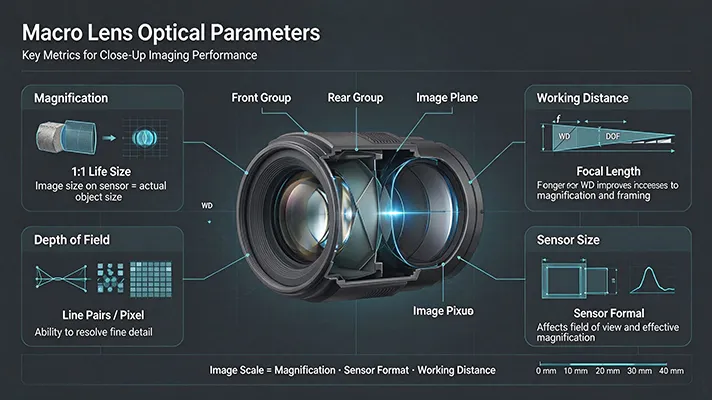
Key optical parameters of a macro lens
What Is a Macro Lens Used For?
A macro lens is used whenever a camera needs to capture small objects or fine details that require close-up imaging. Its applications range from photography to precision inspection and scientific imaging.
1. Macro Photography
Macro photography uses close-focusing optical systems to capture detailed images of small subjects, such as insects, flowers, textures, and miniature objects. The magnification capability allows photographers to reveal details that are difficult to observe with the naked eye.
2. Electronic Component Inspection
In electronics manufacturing, macro imaging can help inspect small components, PCB features, connectors, solder joints, and other fine structures.
Industrial cameras equipped with suitable close-up lenses can capture detailed images for automated inspection, component positioning, and defect identification.
3. Precision Part Inspection
Manufacturing processes often require the inspection of small mechanical components, machined surfaces, precision parts, and product edges.
Close-up imaging helps machine vision systems capture surface details and identify visual defects. The appropriate lens should provide sufficient resolution, suitable working distance, and controlled distortion for the inspection task.
4. Laboratory and Medical Imaging
Macro imaging is also used in laboratory equipment, sample observation, medical device inspection, and scientific imaging. These applications often require clear visualization of small structures and consistent image quality.
The optical system should be selected according to the sample size, required magnification, illumination conditions, and sensor specifications.
Macro Lenses in Industrial Machine Vision
In industrial machine vision, macro imaging is used to capture small objects and fine details for automated inspection, measurement, and recognition. Unlike conventional photography, industrial imaging systems usually operate under controlled conditions and require consistent image quality.
A suitable lens helps the camera capture the necessary visual information for image processing and automated analysis.
Close-Up Imaging for Small Components
Electronic components, miniature mechanical parts, and precision products may contain features that require high magnification and sufficient optical resolution. The lens must provide an appropriate field of view while capturing the details needed by the inspection system.
Image Quality for Automated Inspection
Consistent image quality is important for reliable machine vision results. Optical resolution, distortion, illumination, and focus stability can all affect the performance of an automated inspection system.
For measurement applications, low distortion can help maintain accurate image geometry. For detailed defect inspection, sufficient optical resolution and appropriate magnification are essential.
Lens Mount and Camera Integration
Industrial imaging systems use different lens mounting standards depending on camera design and application requirements. Common configurations include M12/S-Mount, C-Mount, and CS-Mount.
These mounting types describe the mechanical interface rather than the magnification capability of a lens. An M12 or C-Mount lens is not automatically a macro lens. Its close-up imaging suitability must be verified through its optical specifications, minimum focusing distance, and actual performance.
Explore TOWIN’s industrial lens and machine vision solutions to understand different optical configurations for industrial imaging applications.
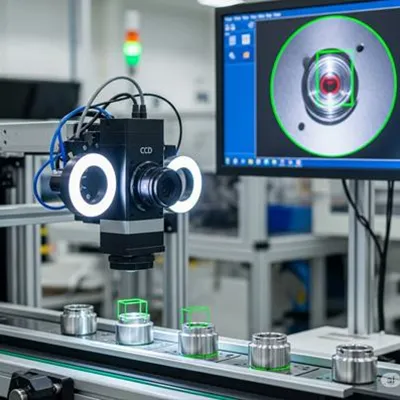
Industrial machine vision inspection system
How to Choose a Macro Lens for Industrial Imaging
Selecting a macro lens for industrial imaging requires matching the optical characteristics of the lens with the camera, inspection object, and application environment.
1. Determine the Object Size and Required Field of View
Start by measuring the dimensions of the object or inspection area. The required field of view determines how much of the object needs to be captured in a single image.
Smaller fields of view generally require higher magnification for a given sensor size. The required magnification should be calculated based on the object dimensions and sensor format.
2. Confirm the Working Distance
Determine the available distance between the camera lens and the object. Consider mechanical limitations, lighting installation, object movement, and equipment layout before selecting the optical configuration.
3. Match Lens Resolution to the Camera Sensor
The optical resolution should be sufficient to reproduce the smallest features that the inspection system needs to identify. Consider sensor pixel size, camera resolution, and the required measurement or detection accuracy.
4. Select the Appropriate Lens Mount
Choose a compatible mounting configuration based on the industrial camera and mechanical installation requirements.
- M12/S-Mount: Commonly used in compact cameras, embedded vision systems, and miniature imaging modules.
- C-Mount: Widely used in industrial cameras, machine vision, factory automation, and inspection systems.
- CS-Mount: Commonly used in CCTV, network cameras, and selected industrial imaging configurations.
Explore the relevant M12/S-Mount lenses, C-Mount lenses, and CS-Mount lenses from TOWIN. Actual close-up imaging performance should be confirmed using the specifications of each lens model.
5. Evaluate Optical Performance in the Actual Setup
Before finalizing a lens, evaluate image sharpness, distortion, illumination, focusing performance, and coverage under the actual operating conditions.
For applications with demanding optical requirements, a customized lens configuration may also be considered based on sensor size, field of view, working distance, focal length, and mechanical constraints.
For additional guidance, read our industrial camera lens selection guide.
TOWIN Industrial Lens Solutions for Close-Up Imaging
TOWIN specializes in industrial optical lenses for machine vision, AI imaging, robotics, and other industrial camera applications. Our product portfolio includes M12/S-Mount, C-Mount, CS-Mount, and customized optical lens solutions.
Different close-up imaging applications require different optical configurations. Important factors include magnification, minimum focusing distance, working distance, resolution, sensor compatibility, and distortion requirements.
Rather than selecting a lens based on its mount type alone, engineers should evaluate the actual optical specifications against the imaging task.
TOWIN can discuss lens requirements based on your camera sensor, object dimensions, field of view, working distance, and application conditions.
Visit our industrial optical lens product range to explore available lens configurations, or contact our team to discuss your imaging requirements.
Looking for the Right Lens for Close-Up Imaging?
Share your camera sensor size, object dimensions, required field of view, and working distance. TOWIN can help evaluate suitable industrial lens configurations for your imaging application.
Frequently Asked Questions About Macro Lenses
Q1. What is a macro lens used for?
A: A macro lens is used to capture small objects and fine details at close focusing distances. Common applications include macro photography, electronic component inspection, precision part inspection, laboratory imaging, and industrial machine vision.
Q2. What does a macro lens do?
A: A macro lens focuses on nearby objects and reproduces them at relatively high magnification. It helps cameras capture fine details that may be difficult to see with standard imaging lenses.
Q3. What is the magnification ratio of a macro lens?
A: The magnification ratio describes the relationship between the image size on the sensor and the actual object size. A 1:1 ratio means the image is reproduced at actual size on the sensor plane, while a 2:1 ratio means the image is twice the object’s actual size.
Q4. What is the difference between a macro lens and a standard lens?
A: A macro lens is designed to support close focusing and higher magnification for capturing small details. A standard lens is generally optimized for broader imaging distances and fields of view, although some standard lenses can also provide close-up imaging capabilities.
Q5. Can a macro lens be used for industrial inspection?
A: Yes. Macro imaging can be used in industrial inspection to capture small components, PCB features, surface defects, and precision mechanical parts. The lens must provide suitable magnification, working distance, optical resolution, and compatibility with the camera sensor.
Q6. How do I choose the right macro lens for machine vision?
A: Consider the object size, required field of view, magnification, working distance, sensor format, pixel size, and optical resolution. You should also evaluate distortion, illumination, and mechanical mounting requirements.
Q7. Are M12 and C-Mount lenses suitable for macro imaging?
A: M12 and C-Mount lenses can be considered for certain close-up imaging applications, but their mount types alone do not determine macro capability. Minimum focusing distance, magnification, optical design, and actual image performance must be checked for each lens model.
Q8. What is the most important parameter when selecting a macro lens?
A: There is no single parameter that determines macro lens suitability. Magnification and field of view establish object coverage, while working distance, optical resolution, depth of field, and sensor compatibility determine whether the lens can meet the actual imaging requirements.