


M12 wide angle 3.6mm CCTV lens with IR corrected
04/07/2026
4K Low Distortion Lens for Drone Camera
04/08/2026
Table of Contents
- Introduction
- Lens Type & Scene Adaptability
- Focal Length & Monitoring Distance
- Aperture & Light Sensitivity
- Optical Performance & Image Quality
- Mount Type & Compatibility
- Distortion Correction & Image Fidelity
- Build Quality & Durability
- Installation & Practical Features
- Recommended TOWIN Surveillance Camera Lenses
- FAQs
- Conclusion
Key Takeaways
- Focal length directly determines field of view and monitoring distance; short for wide coverage, long for distant identification.
- Aperture (f‑number) controls light intake; lower f‑number = better low‑light performance.
- Resolution & sensor matching ensure sharp, clear images without dark corners or blurry edges.
- Mount compatibility (C/CS) and IR correction are essential for stable installation and reliable night vision.
- Build quality & weather resistance extend service life in outdoor & harsh environments.
Introduction
Surveillance camera lenses are the core of any security system. A well‑chosen lens delivers clear footage day and night, covers the right area, and identifies critical details like faces or license plates. This guide breaks down the most important features to help you select the ideal lens for home, business, or industrial surveillance.
Lens Type & Scene Adaptability
Choose the right lens type based on your coverage needs and installation scenario.
- Stable imaging, simple structure, cost‑effective
- Ideal for fixed areas: hallways, entrances, small rooms
- No adjustment after installation
- Adjustable focal length (e.g., 2.8–12mm)
- Balance wide view and long‑distance detail
- Great for sites needing flexible coverage
- Ultra‑wide field of view (up to 180°/360°)
- Minimize blind spots in lobbies, parking lots
- Note: requires distortion correction
Zoom Lenses (Motorized)
- Remote zoom & focus control
- Suits PTZ cameras, perimeter monitoring
- High flexibility for dynamic security needs
Surveillance Camera Lenses: Focal Length & Monitoring Distance
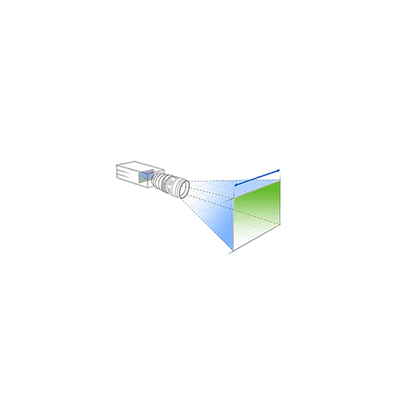
The viewing angle and observable distance are most strongly influenced by the focal length.
| Focal Length | Typical Horizontal Angle | Best For |
|---|---|---|
| 2.8mm | ~110° | Elevators, small rooms, tight corridors |
| 3.6mm | ~90° | Shops, offices, home rooms |
| 6mm | ~55° | Store entrances, cash registers |
| 8–12mm | ~30–40° | Face recognition 10–30m away |
| 16–25mm | ~15–20° | License plates, long‑range perimeter |
| 25mm+ | <15° | Extreme long distance, border monitoring |
Focal length rules:
- Shorter = wider view, less detail at distance
- Longer = narrower view, clearer distant details
- Always match focal length to sensor size to avoid vignetting
Surveillance Camera Lenses: Aperture & Light Sensitivity
Aperture controls how much light enters the lens—critical for night and low‑light performance.
- Smaller f‑number = larger aperture = more light
- f/1.0, f/1.2: excellent for starlight‑level night vision
- f/1.4–f/2.0: general indoor/outdoor use
- f/2.8+: bright environments to avoid overexposure
Auto Iris vs Manual Iris
- Auto Iris: adjusts automatically to lighting changes; ideal outdoors
- Manual Iris: fixed setting; cost‑effective for stable indoor light
- DC auto iris: widely compatible with professional CCTV cameras
Optical Performance & Image Quality
Resolution & Megapixel Compatibility
- Match lens resolution to camera sensor: 3MP, 5MP, 8MP, 12MP
- High‑res lenses deliver sharp center and edge details
- Avoid mismatching: low‑res lens + high‑res camera = blurry results
Low‑Light & IR Capability
- IR‑corrected lenses reduce shift & distortion at night
- IR pass coating ensures clear night imaging
- Supports true day/night switching without focus shift
Dynamic Range & Backlight Performance
- Handles high‑contrast scenes (windows, skylights)
- Preserves details in bright and dark areas
- Reduces washout and blackout
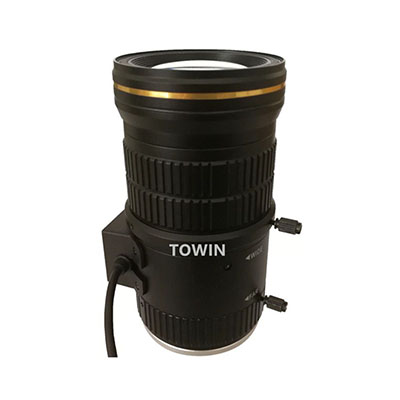
IR-corrected-ITS-traffic-C-mount-CCTV-lens
Surveillance Camera Lenses: Mount Type & Compatibility
C Mount vs CS Mount
- C mount: standard thread, longer flange distance
- CS mount: shorter flange, widely used in modern IP cameras
- Most CS cameras can use C mount with a 5mm adapter
- Always verify before purchasing to avoid fitting issues
Sensor Size Matching
- Common formats: 1/3″, 1/2.7″, 1/2″, 2/3″
- Lens image circle must cover the sensor
- Mismatch causes dark corners or reduced resolution
Distortion Correction & Image Fidelity
Low Distortion Design
- Barrel distortion: bulging edges (common in wide-angle)
- TOWIN low-distortion lenses control distortion <–1.5% to –2.9%
- Critical for measurement, ANPR, and face capture
Center-to-Edge Uniformity
- Balanced sharpness across the entire sensor
- No soft corners even at maximum aperture
- Supports high megapixel imaging
Optical vs. Digital Correction
- Premium optical correction reduces reliance on camera software
- Preserves resolution, contrast, and latency-free performance
Build Quality & Durability
Glass vs Plastic Optics
- Glass lenses: better light transmission, anti‑aging, stable imaging
- Plastic lenses: lightweight, lower cost, suitable for basic use
Environmental Protection
- Waterproof & dustproof ratings (IP65, IP66, IP67)
- Resistance to high/low temperatures
- Vibration and impact resistance for vehicles & factories
Distortion Control
- Barrel & pincushion distortion correction
- Sharpness balance between center and edges
- Aspherical lenses for minimal distortion
Installation & Practical Features
- Easy focus & iris adjustment
- Stable locking mechanism to prevent shifting
- Compatibility with standard camera housings
- Support for remote control (motorized models)
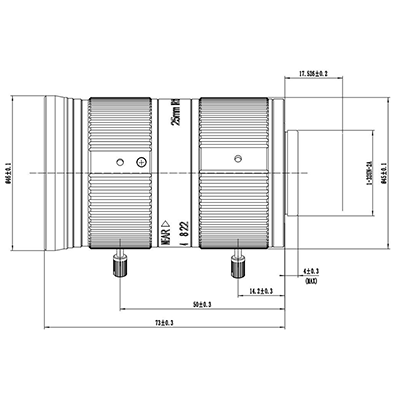
C-Mount 1/1.2″ 25mm low-distortion lens
Recommended TOWIN Surveillance Camera Lenses
1: C157511715A8
- 15–75mm F1.5 DC auto iris
- 1/1.7″ 8MP, IR corrected, C-mount
- ITS traffic, long-range road monitoring
- Manual zoom/focus, 26°–6° HFOV
- 25mm F1.4 fixed focal
- 1/1.2″ 8MP, low distortion <–1.5%
- IR corrected, manual iris/focus
- Indoor/outdoor clear imaging
- 35mm F1.4, 12MP high resolution
- 1.1″ sensor, low distortion
- IR corrected, long M.O.D. 3m
- Ideal for high-detail recognition
- 3.6–10mm varifocal, F1.5~F2.8
- 1/1.8″ 3MP, IR corrected
- Motorized zoom/focus, Φ14 mount
- Compact, versatile for multiple scenarios
FAQs
Q: How do I choose the right focal length?
A: Measure your target distance and desired coverage; use a lens calculator for precision. Short for wide, long for far.
Q: Is a bigger aperture always better?
A: Larger apertures improve low light but reduce depth of field. Choose based on your lighting conditions.
Q: Can I use any lens with my camera?
A: No—match mount type (C/CS) and sensor size; otherwise, images will be flawed.
Q: Do I need an IR lens?
A: Yes for 24/7 surveillance; IR lenses prevent focus shift between day and night.
Conclusion
Selecting a Surveillance Camera Lenses means balancing focal length, aperture, resolution, compatibility, and durability. Prioritize features that match your scene, lighting, and distance requirements. With the right lens, your security system will capture clear, reliable footage when you need it most.
📧: info@towin-elec.com