


Hidden pinhole camera lens
03/11/2026
The Impact of IR-Corrected Lenses on 24/7 Day/Night Surveillance
03/13/2026
Table of Contents
Key Takeaways
- LPR/ANPR Core Requirement: High-resolution ITS lenses deliver sharp, distortion-free imagery across varying lighting and distances, directly improving OCR accuracy and reducing false reads.
- Key Lens Parameters: Critical specs include focal length (E.F.L.), horizontal field of view (H.F.O.V.), resolution, F-number, and iris type—all tailored to traffic speed, lane width, and installation height.
- System Integration: Matching lens mount, sensor size, and resolution to your camera hardware ensures seamless deployment and maximizes ROI for traffic monitoring.
- Towin Advantage: Our interactive lens selection tool lets you filter by MOUNT, Sensor, E.F.L., and more to find the optimal ITS lens for your LPR/ANPR use case.
Introduction
License Plate Recognition (LPR) and Automatic Number Plate Recognition (ANPR) are the backbone of modern intelligent transportation systems (ITS), powering toll collection, traffic law enforcement, parking management, and vehicle tracking. At the heart of every reliable LPR/ANPR system lies a high-performance lens, specifically High-resolution ITS lenses: the optical component that determines how clearly a camera can capture license plate details under real-world conditions—from bright sunlight to nighttime low light, from fast-moving highway vehicles to slow urban traffic.
Without a purpose-built ITS lens, even the most advanced camera sensor and AI algorithm will struggle to deliver consistent, accurate results. Blurry edges, motion blur, chromatic aberration, or insufficient light transmission can lead to missed reads, misclassified characters, and costly system errors.
In this guide, we’ll break down the critical lens requirements for LPR/ANPR, explain how high-resolution ITS lenses solve common challenges, and show you how to select the right optics for your deployment—including how Towin’s specialized High-resolution ITS lenses and interactive selection tool simplify the process.
Core Lens Requirements for LPR/ANPR Systems
To ensure reliable license plate recognition, your lens must meet non-negotiable performance criteria tailored to traffic environments:
1. High Resolution & Pixel Density
- Captures fine character details (even on small or distant license plates)
- Matches sensor resolution (e.g., 2MP, 5MP, 8MP) to avoid under-sampling or wasted pixels
- Delivers sharp edge-to-edge clarity to prevent character distortion at frame corners
2. Wide Dynamic Range (WDR) Compatibility
- Works seamlessly with WDR cameras to handle high-contrast scenes (e.g., sun glare vs. shaded license plates)
- Minimizes lens flare and ghosting to preserve detail in bright/dark regions
3. Consistent Performance Across Lighting Conditions
- Fixed or P-iris designs maintain optimal aperture settings for day/night operation
- Low F-number (e.g., F1.2–F2.8) maximizes light gathering for nighttime LPR without motion blur
- IR-corrected optics preserve focus and clarity across visible and near-infrared spectra
4. Stable Mechanical Design
- Ruggedized construction resists vibration from traffic and environmental stress
- Locked focus/iris mechanisms prevent drift over time, eliminating the need for frequent recalibration
- Weather-sealed options (IP65/IP67) for outdoor deployments
5. Optimized Field of View (FOV)
- Matches lane width, camera mounting height, and target distance to cover the required number of lanes
- Balances coverage width and plate magnification to avoid overly wide (too small plates) or overly narrow (limited coverage) setups
Advantages of High-Resolution ITS Lenses for LPR/ANPR
High-resolution ITS lenses are purpose-engineered to address the unique demands of traffic monitoring, offering clear advantages over generic security or consumer lenses:
| Benefit | Impact on LPR/ANPR Performance |
| Sub-pixel Sharpness | Reduces OCR error rates by 20–30% compared to standard lenses, especially for small or fast-moving plates |
| Minimal Distortion | Eliminates barrel/pincushion distortion that warps character shapes at frame edges, improving read accuracy |
| Consistent MTF Across Sensor | Ensures uniform clarity across the entire image, so plates in the center and corners of the frame are equally readable |
| Low Light Performance | Enables reliable nighttime recognition without sacrificing shutter speed, reducing motion blur from fast vehicles |
| Long-Term Stability | Locked mechanisms and durable materials maintain calibration for years, lowering maintenance costs |
Additional key advantages:
- Compatibility with 4K/8MP sensors future-proofs your system for higher-resolution LPR algorithms
- Customizable focal lengths and FOVs adapt to diverse deployment scenarios (highway, urban, parking)
- Reduced need for post-processing, as raw image data is already optimized for OCR
Lens Selection for LPR/ANPR Use Cases
The right lens depends entirely on your specific deployment environment. Below is a breakdown of how to match key parameters to common LPR/ANPR scenarios:
1: Define Your Deployment Parameters
- Mounting Height: Distance from camera to road surface (e.g., 6m for highway, 3m for parking)
- Target Distance: Range from camera to license plate (e.g., 10–50m for highways, 2–10m for parking)
- Lane Coverage: Number of lanes to monitor (1–4 lanes typical)
- Vehicle Speed: Highway (80–120km/h) vs. urban/parking (0–30km/h)
- Lighting Conditions: Day-only, 24/7, or IR-enhanced nighttime
2: Match Key Lens Parameters
| Parameter | How to Choose for LPR/ANPR |
| E.F.L. (Effective Focal Length) | Calculate to balance plate size and coverage: longer focal lengths for distant plates, shorter for wide lane coverage |
| H.F.O.V. (Horizontal Field of View) | Select to cover your target number of lanes without shrinking plate size below OCR thresholds (typically 4°–245°) |
| Resolution | Match to your camera sensor (e.g., VGA, 1080p, 4K) to ensure the lens can resolve the required pixel density per character |
| F-Number | Lower F-numbers (F1.2–F2.8) for 24/7 operation; higher F-numbers (F8–F22) for bright daylight to increase depth of field |
| Iris Type | P-iris for consistent exposure; DC-iris for manual control; fixed iris for simplified deployments |
| Mount Type | Match your camera’s mount (C/CS-mount, S-mount, etc.) for physical compatibility |
3: Prioritize Use Case-Specific Features
- Highway LPR: Prioritize long E.F.L., low motion blur, and high resolution to capture plates at 50–100m
- Urban/Intersection LPR: Prioritize wide H.F.O.V. and WDR compatibility to cover multiple lanes and handle variable lighting
- Parking LPR: Prioritize short E.F.L., low light performance, and compact size for close-range, low-speed recognition
Towin High-Resolution ITS Lenses: Purpose-Built for LPR/ANPR
Towin’s ITS lens portfolio is engineered from the ground up to meet the rigorous demands of LPR/ANPR systems, with models optimized for every traffic scenario. Our flagship F1.2 ITS Lens(Model: C252312M5) exemplifies this focus:
- Ultra-fast F1.2 aperture: Maximizes light gathering for 24/7 operation, delivering clear nighttime plates without motion blur
- High-resolution design: Supports up to 8MP sensors for sharp, detailed imagery
- P-iris control: Maintains consistent exposure and depth of field across changing light conditions
- Ruggedized construction: Locked focus/iris, vibration-resistant design, and IP67 weather sealing for outdoor deployments
- Wide range of E.F.L. options: From 4mm (wide coverage) to 50mm (long-range recognition) to fit any LPR/ANPR setup
Towin Interactive Lens Selection Tool
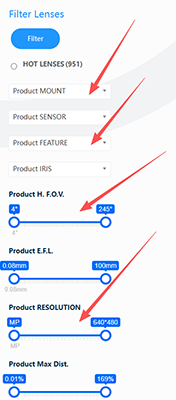
To simplify your lens selection process, Towin’s product page features an intuitive interactive filtering tool that lets you narrow down options based on your exact requirements:
- Filter by Mount: Match your camera’s physical mount (C/CS, S-mount, etc.)
- Filter by Sensor: Select your sensor size (1/2.8″, 1/1.8″, etc.) to ensure compatibility
- Filter by Feature: Prioritize attributes like IR correction, P-iris, or weather sealing
- Filter by Iris Type: Choose between P-iris, DC-iris, or fixed iris designs
- Adjust H.F.O.V.: Slide to select your desired horizontal field of view (4°–245°)
- Adjust E.F.L.: Fine-tune focal length (0.08mm–100mm) to match your target distance
- Filter by Resolution: Match your camera’s resolution (VGA to 4K+)
- Adjust Max Dist.: Set your maximum target recognition distance
- Adjust FNo.: Select your preferred aperture range (F2.8–F22)
This tool eliminates guesswork, ensuring you select the optimal lens for your LPR/ANPR system without overspending or compromising on performance. Whether you’re deploying a single camera or a large-scale ITS network, Towin’s selection tool streamlines the process and guarantees compatibility.
Lens Selection Tool
Optimization Strategies: Lens & System Integration
Even the best ITS lens will underperform if not integrated properly with your LPR/ANPR system. Follow these strategies to maximize accuracy and reliability:
1. Calibrate Focus & Exposure
- Use a test license plate at your target distance to lock focus and iris settings
- Align the lens axis perpendicular to the road to minimize perspective distortion
- Test under both bright sunlight and low-light conditions to validate exposure consistency
2. Match Lens & Sensor Resolution
- Avoid under-sampling: Ensure the lens resolution matches or exceeds your camera sensor’s pixel count
- For 4K sensors, use a lens rated for 8MP+ to preserve edge-to-edge sharpness
- For lower-resolution sensors (e.g., 1080p), a 5MP-rated lens will deliver sufficient performance at a lower cost
3. Optimize Camera Placement
- Mount the camera at a height and angle that keeps license plates centered in the frame
- Avoid direct sunlight or headlight glare into the lens (use sunshades or hoods if necessary)
- Ensure the lens’s H.F.O.V. fully covers your target lanes without unnecessary extra width
4. Maintain Long-Term Performance
- Schedule regular inspections to check for lens drift, dirt, or damage
- Use lens hoods and protective covers to shield against weather and debris
- Update your OCR algorithm to leverage the high-resolution imagery from your ITS lens
FAQs
1. How do I calculate the right E.F.L. for my LPR/ANPR setup?
Use the formula E.F.L. (mm) = (Sensor Width (mm) × Target Distance (m)) / License Plate Width (m) to estimate focal length, or use Towin’s interactive tool to auto-calculate based on your deployment inputs.
2. What F-number is best for 24/7 LPR/ANPR?
F1.2–F2.0 is ideal for 24/7 use, maximizing light for clear nighttime plates without motion blur. F2.8–F4 suits mixed lighting, while F8–F22 is only for bright daylight deployments.
3. Can I use a variable focal length (zoom) lens for LPR/ANPR?
Zoom lenses are not ideal—they cause mechanical drift, focus shift, and reduced resolution at extreme lengths. Fixed focal length ITS lenses are more stable, compact, and cost-effective for permanent deployments.
4. What is the minimum pixel density required for reliable LPR/ANPR?
Most OCR algorithms need 10–15 pixels per character (~20 pixels/mm of plate width). Calculate this with your sensor resolution and E.F.L., or verify via Towin’s lens selection tool.
Conclusion
High-resolution ITS lenses are not just a component—they are the foundation of a reliable LPR/ANPR system. By prioritizing sharpness, low-light performance, and long-term stability, you can drastically reduce recognition errors, lower maintenance costs, and future-proof your traffic monitoring infrastructure.
Towin’s specialized ITS lenses and interactive selection tool make it easy to find the perfect optics for your deployment, whether you’re building a small parking lot system or a nationwide highway network. With purpose-built designs and intuitive filtering, Towin empowers you to maximize the accuracy and efficiency of your LPR/ANPR investment.
Explore Towin’s F1.2 ITS Lens for LPR/ANPR →
Call to Action (CTA):“Ready to test you parameters? Try our Advanced Lens Finder to see lenses with your desired.