


What Is Depth of Field in Industrial Imaging?
09/01/2026
How Does Aperture Affect Depth of Field is an important question when selecting an industrial lens for machine vision, inspection, robotics, and automated imaging. Aperture controls how much light enters the lens, but it also changes the usable focus range of the imaging system. In general, a larger aperture with a smaller F-number produces a shallower depth of field, while a smaller aperture with a larger F-number generally increases depth of field.
For industrial imaging, however, aperture should never be considered by itself. Engineers must balance depth of field with brightness, exposure time, optical resolution, diffraction, working distance, focal length, sensor size, and application requirements. This guide explains the relationship between aperture and depth of field and shows how to select an appropriate aperture for different machine vision applications.
If you are new to industrial optics, start with the Lens Basics section to understand the fundamental relationships between focal length, sensor size, field of view, aperture, resolution, distortion, and lens selection.
What Is Aperture in an Industrial Lens?
Aperture is the opening inside a lens that controls the amount of light reaching the camera sensor. In industrial lenses, aperture is commonly expressed using an F-number, such as F1.4, F2.0, F2.8, F4, F5.6, F8, or higher.
The relationship between F-number and physical aperture is important:
- Smaller F-number: larger physical aperture and more light transmission.
- Larger F-number: smaller physical aperture and less light transmission.
For example, an F1.4 lens setting has a much larger opening than an F8 setting. Therefore, F1.4 generally allows more light to reach the sensor, while F8 reduces the amount of transmitted light.
Aperture affects more than image brightness. It also influences depth of field, optical aberrations, sharpness, exposure time, and the overall imaging performance of an industrial camera system.
What Is Depth of Field?
Depth of field (DOF) is the range of object distances around the focus plane where the image remains acceptably sharp according to the requirements of the imaging system.
Only one specific object plane is technically in exact focus. However, areas in front of and behind that plane may still appear sufficiently sharp to be useful. This acceptable range is known as depth of field.
In machine vision, depth of field is particularly important because inspection targets are not always perfectly flat or positioned at exactly the same distance from the lens.
| Term | Meaning |
|---|---|
| Focus Plane | The exact object distance where the lens is focused. |
| Near DOF | The acceptable sharpness range closer to the lens. |
| Far DOF | The acceptable sharpness range farther from the lens. |
| Total DOF | The complete acceptable focus range around the focus plane. |
For a more detailed explanation, see TOWIN’s guide to Depth of Field in Industrial Imaging.
How Does Aperture Affect Depth of Field?
How Does Aperture Affect Depth of Field can be summarized by one fundamental relationship: a larger aperture generally produces a shallower depth of field, while a smaller aperture generally produces a deeper depth of field.
The key is the F-number. A smaller F-number represents a larger aperture opening, while a larger F-number represents a smaller aperture opening.
| Aperture | Physical Opening | Light Transmission | Typical Depth of Field |
|---|---|---|---|
| F1.4 | Very Large | Very High | Very Shallow |
| F2.8 | Large | High | Shallow to Moderate |
| F4 | Medium-Large | Moderate-High | Moderate |
| F5.6 | Medium | Moderate | Moderate to Deep |
| F8 | Smaller | Lower | Deep |
| F11+ | Small | Low | Very Deep |
These values should be treated as general optical relationships rather than universal application standards. Actual depth of field depends on focal length, working distance, magnification, sensor characteristics, acceptable image sharpness, and optical design.
What Happens With a Large Aperture?
A large aperture corresponds to a small F-number such as F1.4, F2, or F2.8. Because the opening is larger, more light reaches the sensor.
The main advantages include:
- Higher light transmission.
- Shorter exposure times.
- Better performance in low-light environments.
- Greater flexibility for high-speed imaging.
However, the trade-off is a shallower depth of field. If the inspected object contains significant height variation, areas outside the focus plane may become blurred.
This can be a problem for applications such as dimensional inspection, PCB inspection, surface inspection, and robotic vision where multiple areas of an object may need to remain sufficiently sharp.
What Happens With a Small Aperture?
A small aperture corresponds to a larger F-number, such as F5.6, F8, or F11. Less light reaches the sensor, but the acceptable focus range generally becomes larger.
This can be useful when:
- The inspection target has different object heights.
- The working distance varies during production.
- The entire object needs to remain acceptably sharp.
- Measurement or inspection requires stable image features.
The disadvantage is reduced light transmission. If the aperture is reduced significantly, the system may require stronger illumination, a longer exposure time, or a camera with higher sensitivity.
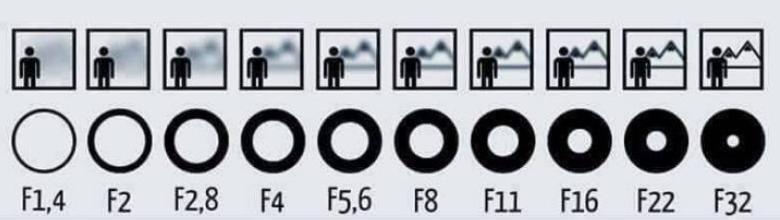
Aperture Depth of field
Why Does a Smaller Aperture Increase Depth of Field?
When the aperture becomes smaller, the range of light rays entering the optical system is restricted. This reduces the size of the blur produced by objects that are slightly in front of or behind the focus plane.
As a result, more object positions can fall within the acceptable sharpness criterion used by the imaging system.
This is why stopping down an industrial lens from F2.8 to F5.6 or F8 can often increase the usable focus range.
However, stopping down should not continue indefinitely. Extremely small apertures can introduce diffraction, which can reduce fine-detail resolution and contrast. Therefore, the goal is not to use the smallest possible aperture, but to find an aperture that provides an appropriate balance between DOF, brightness, and optical resolution.
Aperture vs F-Number: What Is the Difference?
A common source of confusion is the relationship between aperture size and F-number.
The important point is that the numerical F-number works in the opposite direction from the physical aperture size.
| F-Number | Physical Aperture | Light | Depth of Field |
|---|---|---|---|
| F1.4 | Very Large | Very High | Very Shallow |
| F2.8 | Large | High | Shallow |
| F4 | Medium | Moderate-High | Moderate |
| F5.6 | Smaller | Moderate | Deeper |
| F8 | Small | Lower | Deep |
Therefore, saying that an industrial lens has a “smaller aperture” can actually mean using a larger F-number.
Understanding this relationship is essential when comparing machine vision lenses and configuring the aperture during system integration.
Aperture vs Depth of Field: Key Parameter Comparison
The following comparison provides a practical overview of how aperture changes can affect an industrial imaging system.
| Parameter | Larger Aperture | Smaller Aperture |
|---|---|---|
| F-number | Smaller | Larger |
| Light Transmission | Higher | Lower |
| Exposure Requirement | Lower exposure time possible | May require more light or longer exposure |
| Depth of Field | Generally shallower | Generally deeper |
| Focus Tolerance | Lower | Higher |
| Low-Light Performance | Better | More demanding |
| Diffraction Risk | Lower | Higher at very small apertures |
| Optical Aberrations | May be more noticeable | Often reduced at moderate apertures |
How Aperture Affects Machine Vision Image Quality
Aperture influences several aspects of machine vision image quality simultaneously. The correct setting therefore depends on the application rather than on brightness alone.
1. Aperture and Image Brightness
A larger aperture allows more light to reach the sensor. This can be valuable in low-light environments or when a short exposure time is required.
For high-speed inspection, a larger aperture may allow the camera to use a faster shutter speed, helping reduce motion blur.
2. Aperture and Depth of Field
A smaller aperture generally increases depth of field. This is useful when an inspection target contains multiple depth levels or when object positioning cannot be controlled precisely.
For industrial inspection, adequate DOF can be more important than achieving the brightest possible image.
3. Aperture and Optical Sharpness
Very large apertures can make certain optical aberrations more noticeable, including spherical aberration, coma, and chromatic aberration. As the lens is stopped down, these aberrations may decrease and image uniformity can improve.
However, extremely small apertures can introduce diffraction and reduce fine-detail contrast.
For this reason, many optical systems have an aperture range where overall MTF and image quality are optimized rather than simply maximizing or minimizing the aperture.
For a deeper explanation of optical performance, see the Optical Design Guide.
4. Aperture and Motion Blur
Because a larger aperture provides more light, it can support shorter exposure times. This can be beneficial for moving objects, robotic systems, conveyor inspection, and high-speed manufacturing.
However, the resulting shallower depth of field must be evaluated at the same time.
Does a Larger Aperture Always Produce Better Images?
No. A larger aperture improves light transmission, but it does not automatically produce better industrial images.
A large aperture may provide a brighter image while reducing depth of field and increasing the visibility of optical aberrations. For an inspection system, a brighter image is not necessarily a more accurate image.
For example, an F1.4 setting may be useful for a low-light camera, but an inspection system may obtain more consistent focus and image uniformity at a moderate aperture.
The ideal setting depends on the balance between:
- Available illumination.
- Required depth of field.
- Camera sensitivity.
- Exposure time.
- Object movement.
- Required resolution.
- Working distance.
- Optical aberration control.
For a related discussion, read Does a Larger Aperture Always Improve Image Quality?.
Can a Small Aperture Reduce Image Resolution?
Yes. Although reducing the aperture generally increases depth of field, using an excessively small aperture can increase diffraction.
Diffraction occurs because light behaves as a wave when passing through a finite aperture. As the aperture becomes very small, the resulting diffraction pattern can spread fine image details and reduce contrast at high spatial frequencies.
This creates an important industrial imaging trade-off:
| Aperture Strategy | Main Benefit | Potential Limitation |
|---|---|---|
| Very Large Aperture | High light transmission | Shallow DOF and more aberrations |
| Moderate Aperture | Balanced optical performance | May require controlled lighting |
| Very Small Aperture | High DOF | Diffraction and lower light transmission |
This is why aperture selection should be treated as an optical optimization problem rather than simply choosing the largest or smallest available opening.
What Other Factors Affect Depth of Field?
Aperture is important, but it is only one part of the depth-of-field equation. Industrial imaging systems must consider several optical parameters together.
| Factor | Main Function | Relationship With DOF |
|---|---|---|
| Aperture / F-number | Controls light and optical opening | Smaller aperture generally increases DOF |
| Focal Length | Controls magnification and FOV | Longer focal lengths generally reduce DOF under comparable conditions |
| Working Distance | Defines lens-to-object distance | Changes magnification and focus tolerance |
| Sensor Size | Defines image format and FOV relationship | Influences lens configuration and magnification |
| Magnification | Defines object-to-image scale | Higher magnification generally reduces DOF |
| Circle of Confusion | Defines acceptable blur | Determines what is considered acceptably sharp |
Understanding these relationships is essential when moving from basic optical theory to actual industrial lens selection.
How Does Focal Length Interact With Aperture and Depth of Field?
Focal length and aperture should be evaluated together because both influence the final depth-of-field performance.
A longer focal length generally provides a narrower field of view and higher magnification. Under comparable imaging conditions, this can reduce the available depth of field.
For example, a long focal length may be required when a camera must inspect a small component from a relatively long working distance. In this situation, engineers need to determine whether the selected aperture can provide sufficient DOF.
Use the Focal Length Calculator when determining an appropriate focal length for a specific imaging configuration.
How Does Sensor Size Affect Aperture and Depth of Field?
Sensor size does not simply determine depth of field by itself. Instead, it interacts with field of view, focal length, image circle, magnification, and lens selection.
Different sensor formats may require different focal lengths to achieve the same field of view. This changes the optical configuration and can therefore affect the resulting depth of field.
Before choosing an industrial lens, verify:
- Camera sensor size.
- Lens image circle.
- Required field of view.
- Working distance.
- Focal length.
- Required resolution.
- Aperture range.
For more information, visit the TOWIN Sensor Guide.
How Does Working Distance Affect Depth of Field?
Working distance is the distance between the lens and the inspected object. In industrial imaging, it affects magnification, field of view, installation space, lighting configuration, and focus tolerance.
A longer working distance can provide additional installation flexibility and may help achieve a more practical focus range, depending on the lens and imaging geometry.
Working distance should therefore be evaluated together with sensor size, focal length, aperture, and required FOV.
Use the FOV Calculator to estimate the relationship between sensor size, focal length, working distance, and field coverage.
How to Choose the Right Aperture for Machine Vision
There is no single aperture setting that is ideal for every machine vision application. The correct F-number depends on the imaging environment and the performance target.
Machine Vision Inspection
Automated inspection often requires sufficient depth of field to accommodate object height variation and maintain clear edges.
A moderate or smaller aperture may be appropriate when lighting is sufficiently controlled. The goal is to achieve stable image quality rather than maximum brightness.
Explore TOWIN’s Machine Vision Solutions for industrial inspection and automation applications.
Robotics Vision
Robotic systems may need to balance DOF with movement. If objects or cameras are moving quickly, a larger aperture can help achieve shorter exposure times, but the resulting reduction in DOF must be considered.
Explore Robotics Vision Solutions for more information about optical requirements in robotic imaging.
Low-Light Imaging
Low-light systems often benefit from larger apertures because additional light can reach the sensor without requiring excessive gain or long exposure times.
However, if the target contains significant depth variation, the system may require additional illumination to allow a smaller aperture and achieve greater DOF.
High-Speed Inspection
High-speed inspection systems must minimize exposure time to reduce motion blur. A larger aperture can provide additional light for faster exposure, but the reduced DOF must be balanced against inspection requirements.
Precision Measurement
Precision measurement applications generally prioritize consistent geometry, sharp edges, and stable image quality. Aperture should therefore be optimized together with lens resolution, distortion, MTF, working distance, and lighting.
For applications where geometric accuracy is critical, also review TOWIN’s Distortion Guide.
Application-Based Aperture Comparison
| Application | Typical Aperture Strategy | Main Priority |
|---|---|---|
| Machine Vision Inspection | Moderate to smaller aperture | DOF and image stability |
| Robotics Vision | Moderate aperture | DOF and motion performance |
| Low-Light Imaging | Larger aperture | Light transmission |
| High-Speed Inspection | Larger to moderate aperture | Exposure time and motion control |
| Precision Measurement | Optimized moderate aperture | Sharpness and dimensional accuracy |
| Surface Inspection | Moderate to smaller aperture | DOF and surface detail |
These are general starting points rather than fixed specifications. The optimal aperture should always be verified using the actual camera, lens, illumination, working distance, target geometry, and inspection requirements.
How to Increase Depth of Field Using Aperture
If an industrial imaging system does not provide enough usable focus range, reducing the aperture is one of the first optical adjustments to consider.
1. Increase the F-number
Moving from a large aperture such as F2.8 toward F5.6 or F8 generally increases depth of field.
2. Improve Illumination
Because a smaller aperture reduces light transmission, additional industrial lighting can compensate for the lower exposure level.
3. Optimize Working Distance
Adjusting the lens-to-object distance can influence magnification, field coverage, and focus tolerance.
4. Select the Correct Focal Length
Focal length should be selected based on sensor size, field of view, working distance, and object dimensions rather than chosen independently.
5. Verify Optical Resolution
Increasing DOF is not useful if diffraction or insufficient lens resolution prevents the system from resolving the required features.
How to Select an Industrial Lens Based on Aperture
Aperture should be considered during the complete lens-selection process rather than after the lens has already been selected.
- Define the application: determine whether the system is used for inspection, measurement, robotics, security, traffic, or another imaging task.
- Identify the sensor: confirm sensor size, resolution, and pixel requirements.
- Define the field of view: determine the exact object area that must be captured.
- Determine working distance: identify the available mechanical installation space.
- Calculate focal length: select a focal length that provides the required FOV and magnification.
- Determine required DOF: evaluate the height variation and focus tolerance of the target.
- Select aperture: balance DOF, brightness, exposure time, and optical resolution.
- Check optical performance: evaluate resolution, MTF, distortion, image circle, and illumination.
- Validate the complete system: test the selected lens with the actual camera, lighting, target, and working distance.
This workflow is consistent with the broader approach in TOWIN’s Machine Vision Lens Selection Guide.
Aperture and Other Industrial Lens Parameters
Aperture should not be used as the only lens-selection criterion. Industrial imaging performance results from the interaction of multiple optical parameters.
| Lens Parameter | Primary Purpose | Why It Matters |
|---|---|---|
| Aperture | Controls light transmission | Influences brightness and DOF |
| Focal Length | Controls FOV and magnification | Influences object coverage and DOF |
| Sensor Compatibility | Matches lens image circle to camera | Prevents image cropping and supports full sensor utilization |
| Resolution | Defines fine-detail imaging capability | Important for inspection and measurement |
| Distortion | Controls geometric accuracy | Critical for measurement and positioning |
| MTF | Describes contrast transfer | Indicates optical detail performance |
These parameters should be evaluated together rather than selecting a lens based on aperture alone.
Which Industrial Lens Types May Require Careful Aperture Selection?
Different industrial lens categories have different imaging priorities. Aperture therefore becomes part of the overall optical design rather than an isolated specification.
M12 Lenses
M12 lenses are widely used in compact machine vision, embedded cameras, robotics, AI vision, and smart devices. Compact systems may require careful optimization between aperture, sensor size, resolution, and physical size.
Explore TOWIN’s M12 Lenses and the dedicated M12 Lens Solution page.
C-Mount Lenses
C-mount industrial lenses are commonly used in machine vision, factory automation, inspection, and measurement systems. Their optical configurations provide flexibility for applications requiring specific focal lengths, sensor formats, resolution, and aperture characteristics.
See the available C-Mount Lenses for industrial imaging applications.
Low-Distortion Lenses
When aperture, resolution, and DOF are optimized for inspection, geometric accuracy must also be considered. Low-distortion optics are especially important when the system measures dimensions, positions, or shapes.
Explore TOWIN’s Low Distortion Lenses for applications requiring improved geometric accuracy.
Frequently Asked Questions
Q1: How Does Aperture Affect Depth of Field?
A larger aperture with a smaller F-number generally produces a shallower depth of field, while a smaller aperture with a larger F-number generally increases depth of field. However, actual DOF also depends on focal length, working distance, magnification, sensor size, and acceptable image sharpness.
Q2: Does a Smaller Aperture Increase Depth of Field?
Yes. Reducing the physical aperture opening, which means increasing the F-number, generally increases the usable depth of field. The trade-off is lower light transmission, so stronger illumination or longer exposure may be required.
Q3: Does a Larger Aperture Reduce Depth of Field?
Yes. A larger physical aperture, represented by a smaller F-number, generally produces a shallower depth of field. This can be useful in low-light or high-speed imaging but may reduce focus tolerance.
Q4: What F-number Is Best for Machine Vision?
There is no universal best F-number for machine vision. A moderate aperture is often a useful starting point because it can balance light transmission, DOF, sharpness, and aberration control, but the final setting should be determined by the actual application and lighting conditions.
Q5: Does Aperture Affect Image Brightness?
Yes. A larger aperture allows more light to reach the camera sensor, while a smaller aperture reduces light transmission. Aperture therefore directly affects exposure and can influence shutter speed and camera gain requirements.
Q6: Can a Small Aperture Reduce Image Resolution?
Yes. Although a smaller aperture generally increases depth of field, an excessively small aperture can introduce diffraction, reducing fine-detail contrast and effective optical resolution.
Related Industrial Lens Resources
Continue exploring TOWIN’s industrial optics resources to build a complete understanding of lens selection:
- Lens Basics for Machine Vision & Industrial Cameras
- Optical Design Guide
- Industrial Camera Sensor Guide
- Lens Distortion Guide
- Machine Vision Lens Selection Guide
- FOV Calculator
- Focal Length Calculator
- What Is Depth of Field in Industrial Imaging?
- Does a Larger Aperture Always Improve Image Quality?
Conclusion
Aperture is one of the most important optical parameters influencing depth of field in industrial imaging. How Does Aperture Affect Depth of Field ultimately comes down to the relationship between physical aperture size and F-number: a larger aperture generally increases light transmission while reducing depth of field, whereas a smaller aperture generally increases depth of field while reducing the amount of light reaching the sensor.
For machine vision and industrial cameras, however, the best aperture is not necessarily the largest or smallest available. Engineers need to balance depth of field with brightness, exposure time, focal length, working distance, sensor size, resolution, MTF, distortion, and diffraction.
The most reliable approach is to select the complete optical system according to the application. Define the required field of view, working distance, sensor, resolution, and depth of field first, then optimize aperture and lighting around those requirements.
By understanding How Does Aperture Affect Depth of Field, engineers can make better industrial lens decisions and build machine vision systems with more stable focus, reliable image quality, and consistent inspection performance.
For additional industrial lens information, explore the TOWIN Lens Basics Knowledge Center or browse the complete Industrial Lens Products.