


MTF Explained for Machine Vision Lenses: Understanding Optical Performance and Image Quality
06/28/2026
Pixel Size vs Resolution: Understanding the Trade-Off for Machine Vision
06/30/2026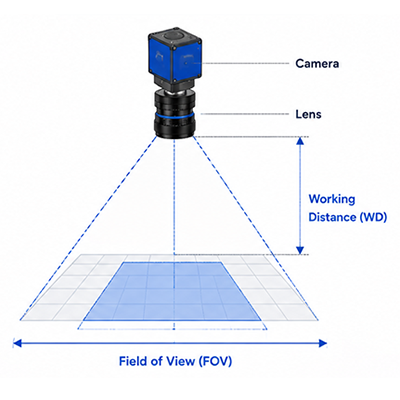
Field of view for machine vision is one of the most important factors when designing an industrial imaging system. Selecting the correct field of view (FOV) determines whether the camera can capture the complete inspection area while maintaining sufficient image resolution for accurate detection, measurement, and quality control.
There is no universal “best” field of view for every application. The ideal FOV depends on the object size, camera sensor, focal length, working distance, and inspection requirements. A field of view that is too small may crop important features, while one that is too large reduces pixel density and measurement accuracy.
This guide explains how to determine the optimal field of view for machine vision, compares different application scenarios, and provides practical lens selection advice. You can also use our FOV Calculator to estimate the required viewing area before selecting an industrial lens.
What Determines a Good Field of View?
A good field of view is one that captures the entire inspection target while providing enough image resolution for reliable analysis. Instead of choosing a focal length first, engineers should begin by defining the required inspection area and then determine the appropriate lens configuration.
The following factors have the greatest influence on field of view:
| Factor | Influence on Field of View |
|---|---|
| Object Size | The inspection area should fully contain the target with a reasonable safety margin. |
| Sensor Size | Larger sensors capture a wider viewing area using the same focal length. |
| Focal Length | Shorter focal lengths provide wider FOV, while longer focal lengths increase magnification. |
| Working Distance | Increasing the camera distance enlarges the field of view. |
| Camera Resolution | The larger the FOV becomes, the fewer pixels are available per millimeter. |
| Inspection Accuracy | High-precision inspection generally requires a smaller field of view. |
Understanding these parameters allows engineers to optimize both imaging quality and lens selection. If you are unfamiliar with how these optical parameters interact, our Optical Design Guide explains the principles behind industrial imaging systems.
How Much Field of View Do You Really Need?
The goal is not to maximize the field of view—it is to choose the right amount of coverage for your inspection task. A properly sized FOV balances image coverage and measurement accuracy.
| Field of View | Result |
|---|---|
| Too Small | The inspection target cannot fit entirely inside the image, resulting in incomplete inspection. |
| Too Large | Image resolution decreases because each object occupies fewer pixels. |
| Properly Sized | Captures the full object while maintaining sufficient detail for reliable detection and measurement. |
As a general guideline, engineers should allow approximately 5–15% additional viewing area around the inspection target. This provides installation tolerance while ensuring that the object remains completely visible during operation.
Before selecting a lens, you can estimate the required viewing area using our Interactive FOV Calculator, which instantly calculates the visible inspection area based on sensor size, focal length, and working distance.
Recommended Field of View for Common Machine Vision Applications
Different industrial applications require different field of view ranges. The values below are general recommendations and should be adjusted according to the specific object size, camera resolution, and inspection requirements.
| Application | Typical Field of View | Primary Goal |
|---|---|---|
| Machine Vision Inspection | 50–300 mm | High-precision inspection |
| Robot Guidance | 300–1000 mm | Positioning and navigation |
| Smart Traffic | Several meters | Vehicle monitoring |
| Medical Imaging | Application dependent | Diagnostic imaging |
| Barcode Reading | 100–600 mm | Code recognition |
| AOI Inspection | 50–200 mm | Defect detection |
These values should be considered starting points rather than fixed requirements. Always verify the final field of view using the actual sensor size, focal length, and installation distance before selecting an industrial lens.
Factors That Affect Field of View
Three optical parameters determine the final field of view for machine vision. Understanding how they work together helps engineers select the correct lens and camera combination.
Sensor Size
A larger image sensor captures a wider viewing area with the same focal length. Selecting the appropriate sensor size is essential for achieving sufficient coverage without sacrificing image quality. Learn more in our Sensor Guide.
Lens Focal Length
Focal length directly controls the viewing angle. Wide-angle lenses provide larger fields of view, while telephoto lenses produce narrower viewing areas with greater magnification. Selecting the correct focal length is one of the most important steps in industrial lens selection.
Working Distance
Increasing the distance between the camera and the inspection object naturally increases the field of view. However, longer working distances may also reduce image resolution, making it necessary to balance coverage and inspection accuracy.
These three parameters should always be evaluated together rather than individually. Our Lens Selection Guide provides a step-by-step approach for matching sensor size, focal length, and working distance.
How to Choose the Right Lens Based on Your Required Field of View
Once the required field of view has been determined, the next step is selecting a lens that delivers the desired image coverage while maintaining sufficient image quality. A well-matched lens improves inspection accuracy, minimizes distortion, and reduces system redesign.
| If You Need… | Recommended Choice |
|---|---|
| Capture a larger inspection area | Choose a shorter focal length lens. |
| Inspect small details | Select a longer focal length lens for greater magnification. |
| Use a larger image sensor | Select a lens with a larger image circle. |
| Install the camera close to the object | Use a low-distortion wide-angle lens. |
| Perform precision measurement | Consider a low-distortion or telecentric lens. |
Choosing the correct lens involves more than focal length alone. Sensor compatibility, distortion performance, working distance, and image resolution all influence final imaging quality. Our Lens Selection Guide provides a complete workflow for selecting industrial lenses.
Calculate Your Field of View with Our FOV Calculator
Instead of calculating field of view manually every time, you can use our Interactive FOV Calculator to estimate the visible inspection area within seconds.
Simply enter three parameters:
- Sensor Size
- Lens Focal Length
- Working Distance
The calculator instantly estimates the horizontal field of view, allowing engineers to compare different lens configurations before purchasing hardware. It is an efficient tool for machine vision design, robotics, smart traffic, barcode reading, and industrial inspection projects.
Common Mistakes When Choosing Field of View
Selecting an inappropriate field of view can reduce inspection accuracy and increase system costs. Avoid these common mistakes when designing a machine vision system:
- Ignoring sensor size — Different sensor sizes produce different fields of view even when using the same lens.
- Selecting the lens before defining the inspection area — Always determine the required viewing area first.
- Ignoring working distance — Camera installation distance directly affects the visible inspection area.
- Focusing only on focal length — Sensor size and working distance are equally important.
- Ignoring lens distortion — Wide-angle lenses may introduce distortion that affects dimensional measurements. Learn more in our Distortion Guide.
Avoiding these issues early in system design reduces engineering iterations and improves imaging performance.
Frequently Asked Questions
Q: What is a good field of view for machine vision?
A: A good field of view captures the entire inspection target while maintaining sufficient image resolution for reliable detection, measurement, and analysis. The ideal value depends on object size, working distance, sensor size, and focal length.
Q: Can I increase field of view without changing the lens?
A: Yes. Increasing the working distance or using a larger image sensor can increase the visible field of view. However, these changes may also affect image resolution and installation requirements.
Q: Should I calculate field of view before selecting a lens?
A: Yes. Determining the required field of view should always be the first step in industrial lens selection. Once the inspection area is known, you can calculate the appropriate focal length and choose a compatible lens.
Q: Does lens distortion affect field of view?
A: Yes. Lens distortion, particularly in wide-angle lenses, changes the effective viewing area near the image edges. Precision measurement systems should always consider distortion during lens selection and calibration.
Q: What is the easiest way to calculate field of view?
A: The simplest method is to use our FOV Calculator. It quickly estimates the visible inspection area using sensor size, focal length, and working distance without requiring manual calculations.
Conclusion
Selecting the correct field of view for machine vision is essential for building an accurate and reliable industrial imaging system. The optimal field of view depends on balancing object size, sensor dimensions, focal length, working distance, and inspection accuracy rather than maximizing image coverage.
By understanding these relationships and verifying your design with our Interactive FOV Calculator, you can confidently choose the right industrial lens, improve inspection performance, and reduce costly design iterations.
For additional guidance, explore our related resources, including the Lens Selection Guide, Sensor Guide, Optical Design Guide, Distortion Guide, and Lens Basics. These resources will help you better understand industrial optics and select the ideal field of view for machine vision applications.
Related Optical Resources
Continue learning about industrial imaging and lens selection with these related guides:
Related Machine Vision Solutions
Explore industrial imaging solutions that require accurate field of view calculation and industrial lens optimization.
High-precision industrial inspection and automated quality control.
Robot guidance, positioning and intelligent automation.
Vehicle monitoring and intelligent transportation systems.
High-resolution optical imaging for medical devices.