


What Causes Optical Distortion?
06/23/2026
How to Choose the Right Machine Vision Lens
06/23/2026
Medical imaging lenses play a critical role in modern healthcare, and their importance is growing rapidly as artificial intelligence becomes integrated into diagnostic workflows. From endoscopy and pathology to radiology and ophthalmology, AI algorithms depend on high-quality image data to detect abnormalities, identify patterns, and support clinical decision-making.
The short answer is yes—medical imaging lenses can support AI diagnostics. However, not all lenses are equally suitable for AI-powered systems. To achieve accurate diagnostic results, AI algorithms require consistent, high-resolution, low-distortion images, making lens selection a critical component of the entire imaging chain.
In this article, we explore how medical imaging lenses contribute to AI diagnostics and what factors engineers and medical device manufacturers should consider when designing AI-enabled imaging systems.
Why AI Diagnostics Depend on Image Quality
Artificial intelligence systems are only as effective as the image data they receive. AI models analyze visual information to identify patterns that may be difficult for the human eye to detect.
Poor image quality can negatively impact:
- Detection accuracy
- Disease classification
- Image segmentation
- Clinical decision support
- Training dataset quality
This means that the optical system—including the lens—has a direct influence on AI performance.
Modern Medical Imaging Lens Solutions are increasingly optimized for AI-driven healthcare applications.
How Medical Imaging Lenses Support AI Diagnostics
1. High Resolution Image Capture
AI diagnostic systems require detailed image information to identify subtle visual features.
High-resolution medical lenses help capture:
- Fine tissue structures
- Microscopic abnormalities
- Cellular details
- Small lesions and defects
The more image detail available, the more information AI algorithms can analyze.
2. Low Distortion Performance
Optical distortion can alter the shape and dimensions of anatomical structures. For AI systems trained on accurate medical imagery, distortion may reduce measurement accuracy and affect diagnostic reliability.
Low-distortion optics help maintain:
- Geometric accuracy
- Consistent image interpretation
- Reliable AI model training
- Improved clinical confidence
3. Consistent Image Quality
AI algorithms perform best when image quality remains consistent across different devices and environments.
Medical imaging lenses help ensure:
- Uniform sharpness
- Stable contrast
- Controlled aberrations
- Reliable color reproduction
Consistency is particularly important when building large datasets for AI training.
4. Enhanced Low-Light Imaging
Many medical imaging applications operate in challenging lighting conditions.
Examples include:
- Endoscopy
- Minimally invasive surgery
- Internal cavity imaging
- Portable diagnostic devices
High-performance medical lenses maximize light transmission and help AI systems analyze clearer images in low-light environments.
Medical Applications Where AI Diagnostics Are Used
AI-Assisted Endoscopy
AI is increasingly used to identify polyps, tumors, and gastrointestinal abnormalities during endoscopic procedures.
These systems often utilize miniature optics such as:
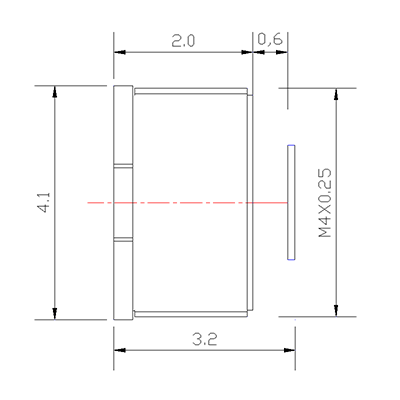
- M3.5 lenses
- M5 lenses
- M6 lenses
- M8 lenses
Explore our Small Mount Lenses for compact medical imaging systems.
Related reading: Medical Endoscope Micro Lenses for Minimally Invasive Surgery.
Digital Pathology
AI models analyze digitized pathology slides to assist with cancer detection and tissue classification.
These systems typically require:
- High resolution optics
- Low distortion performance
- Accurate color reproduction
Ophthalmology Imaging
AI is widely used for retinal disease detection and vision assessment. Optical quality is critical because AI algorithms evaluate extremely fine anatomical features.
AI Surgical Imaging
Modern surgical systems increasingly combine high-definition cameras with AI-assisted guidance and image analysis.
What Lens Characteristics Are Important for AI Diagnostics?
| Lens Characteristic | Why It Matters for AI |
|---|---|
| High Resolution | Improves feature detection accuracy |
| Low Distortion | Maintains geometric accuracy |
| High Contrast | Enhances image analysis performance |
| Good Color Reproduction | Supports diagnostic consistency |
| Low-Light Capability | Improves image quality in challenging environments |
| Mechanical Stability | Ensures repeatable imaging results |
Can M12 and Miniature Lenses Support AI Diagnostics?
Yes. Many AI-enabled medical devices use compact optical systems.
M12 lenses and miniature mounts are widely used in:
- Portable medical devices
- Endoscopy systems
- Diagnostic cameras
- Point-of-care imaging equipment
Learn more about our M12 Lens Solutions.
As image sensors continue to improve, compact lens systems are becoming increasingly capable of supporting AI-assisted medical analysis.
How to Select a Medical Imaging Lens for AI Applications
Step 1: Determine Imaging Requirements
Define the target application, resolution requirements, and diagnostic objectives.
Step 2: Choose the Appropriate Sensor
Sensor selection directly influences lens requirements.
Read our Sensor Guide.
Step 3: Calculate the Required Field of View
Use our FOV Calculator to estimate the required optical parameters.
Step 4: Evaluate Distortion and Resolution
Low distortion and high image quality are essential for AI training and deployment.
Step 5: Work with an Experienced Lens Manufacturer
Custom medical projects often require optical optimization specifically designed for AI-powered workflows.
Related Medical Imaging Resources
- Medical Imaging Lens Solutions
- Machine Vision Solutions
- M12 Lens Solutions
- Small Mount Lenses
- Medical Endoscope Micro Lenses
- Machine Vision Lenses Used in Medical Imaging
- Lens Selection Guide
- Sensor Guide
Frequently Asked Questions
Q: Can medical imaging lenses improve AI diagnostic accuracy?
A: Yes. High-quality optics provide clearer images that help AI systems identify patterns more accurately.
Q: Do AI diagnostic systems require high-resolution lenses?
A: In most cases, yes. Higher image resolution allows AI algorithms to analyze more visual details.
Q: Why is low distortion important for AI diagnostics?
A: Distortion can alter image geometry and potentially affect AI analysis and measurements.
Q: Can miniature lenses support AI medical imaging?
A: Yes. Modern miniature lenses are widely used in AI-assisted endoscopy and portable diagnostic devices.
Q: Are M12 lenses suitable for AI healthcare applications?
A: Yes. Many compact AI-enabled medical devices utilize M12 lens systems.
Conclusion
Medical imaging lenses are a critical component of AI-powered healthcare systems. By providing high-resolution, low-distortion, and consistent image quality, they help AI algorithms perform more accurate analysis and support better clinical outcomes.
From endoscopy and pathology to surgical imaging and diagnostic cameras, the demand for AI-assisted imaging continues to grow. As a result, lens performance is becoming increasingly important in the design of next-generation medical systems.
The answer to the question “Can medical imaging lenses support AI diagnostics?” is clearly yes. Modern optical technologies are helping transform healthcare by enabling AI systems to analyze medical images with greater speed, accuracy, and reliability.