


What Is a Biometric Recognition Lens?
06/22/2026
What Causes Optical Distortion?
06/23/2026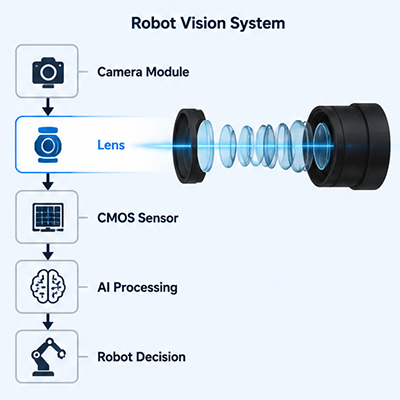
Introduction
A SLAM camera lens plays a fundamental role in modern robotics systems, especially in autonomous navigation and machine perception.
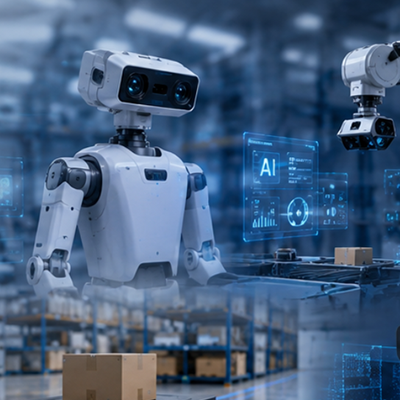
In robotics vision applications such as warehouse automation, autonomous mobile robots (AMR), and drone navigation, a SLAM camera lens ensures that the system can accurately capture environmental features for real-time mapping and positioning.
At TOWIN, SLAM-related optical solutions are part of our Robotics Vision Lens Solutions, designed for high-precision industrial imaging applications.
What is SLAM in Robotics?
- SLAM stands for Simultaneous Localization and Mapping
- It allows robots to build a map while simultaneously tracking their location
- It is widely used in autonomous systems without GPS dependency
Common SLAM applications include:
- Warehouse AGV / AMR navigation
- Autonomous drones
- Industrial inspection robots
- Security and service robots
What is a SLAM Camera Lens?
A SLAM camera lens is not an algorithm but an optical component that directly affects SLAM system performance by improving image quality, feature detection, and tracking stability.
Without a properly designed lens, even advanced SLAM algorithms may fail to achieve stable navigation results.
- Enhances feature point detection
- Reduces image distortion
- Improves wide-area scene capture
- Supports real-time mapping accuracy
Key Optical Parameters of SLAM Camera Lenses
| Parameter | Importance in SLAM Systems |
|---|---|
| Field of View (FOV) | Wide FOV improves environmental awareness and tracking stability |
| Distortion | Low distortion ensures accurate mapping and reduces tracking errors |
| Resolution Compatibility | Higher resolution improves feature extraction accuracy |
| Working Distance | Affects depth perception and spatial recognition accuracy |
Learn more about optical distortion in our Optical Distortion Guide.
For sensor compatibility, visit our Sensor Guide.
Types of SLAM Camera Lenses
- Best for AMR navigation and obstacle detection
- Provides large environmental coverage
- Essential for accurate SLAM mapping
- Reduces edge deformation in image processing
Stereo Vision Lens
- Enables 3D depth perception
- Used in robotics perception systems
- Compact design for embedded robotics systems
- Widely used in AI cameras and mobile robots
Explore related optical solutions in our Machine Vision Lens Solutions.
SLAM Camera Lens vs Standard Camera Lens
| Feature | SLAM Camera Lens | Standard Camera Lens |
|---|---|---|
| Distortion Level | Very Low | Medium to High |
| FOV | Optimized Wide Angle | Varies (often narrower) |
| Use Case | Robotics Navigation | Photography / General Imaging |
| Stability | High for real-time mapping | Not optimized for SLAM |
How to Choose a SLAM Camera Lens
1: Define your application
- Warehouse robotics
- Drone navigation
- Industrial automation
2: Select sensor compatibility
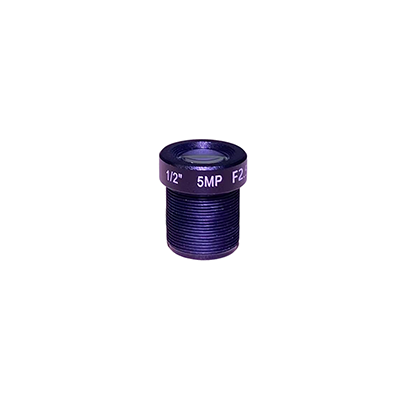
- Small sensors: M12 lenses
- Industrial systems: C-mount lenses
3: Determine optical requirements
- Wide FOV for navigation
- Low distortion for mapping accuracy
4: Environmental conditions
- Indoor warehouse
- Outdoor robotics systems
Applications of SLAM Camera Lenses
- Autonomous Mobile Robots (AMR)
- Automated Guided Vehicles (AGV)
- Warehouse logistics systems
- Autonomous drones
- Industrial inspection robots
- Smart security robots
These applications are part of our Robotics Vision Solutions.
Frequently Asked Questions
Q: What is a SLAM camera lens?
A: It is a lens used in robotics vision systems to improve mapping and navigation accuracy.
Q: Do SLAM systems require special lenses?
A: Yes, low distortion and wide-angle lenses are preferred.
Q: Why is distortion important?
A: It directly affects mapping accuracy and tracking stability.
Q: Can M12 lenses be used in SLAM systems?
A: Yes, especially in compact robotics applications.
Q: What industries use SLAM lenses?
A: Warehousing, robotics, drones, and automation industries.
Conclusion
A SLAM camera lens is a fundamental component in modern robotics vision systems, directly influencing navigation accuracy, mapping quality, and AI perception performance.
Choosing the right optical design—such as wide-angle, low distortion, or M12-based lenses—ensures stable and reliable SLAM performance in industrial applications.
For industrial robotics solutions, explore our Robotics Vision Lens Solutions.
SLAM camera lens technology is essential for next-generation autonomous robotics and AI vision systems.