


What lens is best for machine vision?
06/18/2026
What is the Difference Between M12 and C-Mount Lenses?
06/20/2026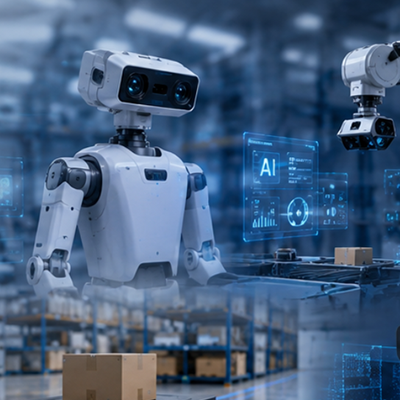
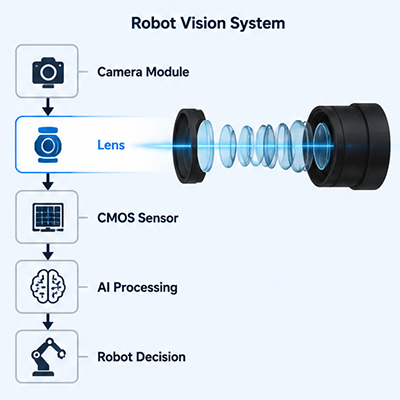
Choosing the right robotics vision lens is one of the most important decisions when designing a robotic vision system. Whether the robot is used for navigation, object detection, pick-and-place automation, warehouse logistics, or autonomous operation, the lens directly affects image quality, perception accuracy, and overall system performance.
A well-selected lens enables robots to accurately identify objects, estimate distances, avoid obstacles, and make intelligent decisions in real-world environments.
Why Lens Selection Matters in Robotics Vision
Modern robots rely heavily on cameras and vision systems to understand their surroundings. However, even the most advanced image sensor cannot perform well if paired with an unsuitable lens.
The right lens for robotics vision helps improve:
- Object recognition accuracy
- Navigation reliability
- Depth perception performance
- SLAM mapping precision
- AI vision algorithm effectiveness
- Low-light imaging capability
To explore complete robotics imaging applications, visit our Robotics Vision Solutions.
Understand Your Robotics Application First
Different robotic systems require different optical characteristics. Before selecting a lens, define the robot’s primary function.
Mobile Robots and AMRs
Autonomous Mobile Robots (AMRs) require wide scene coverage for obstacle avoidance, navigation, and environmental awareness.
Wide-angle lenses are commonly used to maximize the robot’s field of view.
AGV Systems
Automated Guided Vehicles typically use vision systems for path tracking, object detection, and safety monitoring.
Industrial Robotic Arms
Pick-and-place robots often require higher image resolution and lower distortion to accurately identify and locate objects.
Humanoid Robots
Humanoid robots frequently use stereo vision or depth-sensing cameras that require carefully matched optics for accurate perception.
Key Factors When Choosing a Robotics Vision Lens
1. Field of View (FOV)
Field of view is one of the most critical considerations for robotics vision.
A wider field of view allows robots to monitor more of their surroundings, while a narrower field of view provides greater detail at longer distances.
You can calculate the required viewing area using our FOV Calculator.
2. Sensor Size Compatibility
The lens image circle must fully cover the camera sensor to prevent image darkening and reduced performance.
For more information, see our Sensor Size Guide.
3. Focal Length Selection
The focal length determines how much of the environment the robot can see.
- Short focal length = wider coverage
- Long focal length = greater magnification
Mobile robots typically favor shorter focal lengths because environmental awareness is more important than magnification.
4. Distortion Performance
Robotics systems that rely on measurement, localization, or mapping require low-distortion optics to maintain positional accuracy.
Learn more in our Lens Distortion Guide.
5. Depth Sensing Requirements
Many modern robots utilize stereo vision cameras, structured light systems, or Time-of-Flight (ToF) sensors.
In these applications, lens consistency and optical alignment play a critical role in depth accuracy.
Why M12 Lenses Are Popular in Robotics
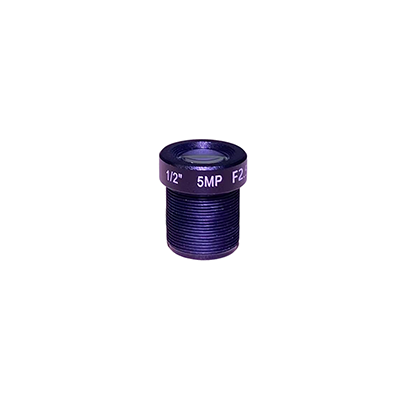
Many robotics manufacturers choose M12 lenses because they provide an excellent balance between performance, size, and cost.
Advantages include:
- Compact design
- Lightweight construction
- Wide-angle options
- Low power system integration
- Compatibility with embedded vision platforms
Explore our complete M12 Lens Solutions for robotics applications.
Wide-Angle vs Low-Distortion Lenses for Robots
| Lens Type | Best For |
|---|---|
| Wide-Angle Lens | Navigation, obstacle avoidance, SLAM |
| Low-Distortion Lens | Measurement, localization, machine vision inspection |
| Telephoto Lens | Long-distance object recognition |
| ToF Lens | Depth sensing and 3D perception |
The best choice depends on the robot’s operational environment and imaging objectives.
Lens Selection Workflow for Robotics Vision
A typical robotics lens selection process includes:
- Define the robot application
- Determine camera sensor size
- Calculate required field of view
- Measure working distance
- Select focal length
- Evaluate distortion tolerance
- Consider environmental conditions
- Validate image quality through testing
For a more detailed engineering process, review our Lens Selection Guide.
Robotics Vision Applications Using Specialized Lenses
- Autonomous Mobile Robots (AMR)
- Automated Guided Vehicles (AGV)
- Warehouse Automation
- Industrial Robot Arms
- Service Robots
- Humanoid Robots
- SLAM Navigation Systems
- AI-Powered Vision Robots
Many technologies used in robotics also overlap with advanced imaging applications such as Drone Imaging Solutions, where wide-angle and lightweight optics are equally important.
Frequently Asked Questions
Q: What is the best lens for robotics vision?
A: The best lens depends on the robot’s purpose, sensor size, field of view requirements, and operating environment. Wide-angle M12 lenses are among the most common choices for mobile robots.
Q: Are M12 lenses suitable for robots?
A: Yes. M12 lenses are compact, lightweight, and widely used in robotics, embedded vision, AI cameras, and autonomous systems.
Q: What focal length is commonly used in robotics?
A: Many robotics applications use short focal lengths between 1.8 mm and 6 mm to achieve a wider field of view.
Q: Why is low distortion important in robotics?
A: Low distortion improves navigation accuracy, object positioning, SLAM mapping, and machine vision measurements.
Conclusion
Choosing the right lens for robotics vision requires careful consideration of field of view, sensor size, focal length, distortion performance, and application requirements. The ideal robotics vision lens should provide reliable imaging, accurate perception, and long-term performance in dynamic environments.
To learn more about robotic imaging systems and industrial optics, visit our Industrial Optical Lens Solutions Center or explore our Robotics Vision Solutions.