



Industrial Lens Environmental Design: Ensuring Stable Performance in Harsh Conditions
06/09/2026
How to Calculate FOV for Industrial Lens
06/09/2026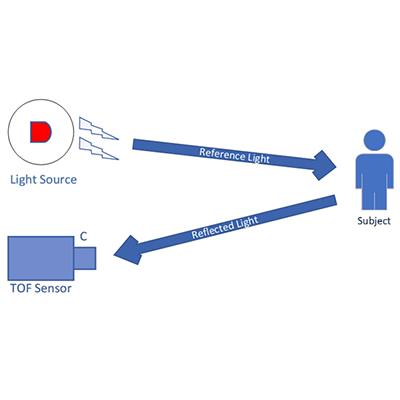
Infrared Focus Shift is a critical optical phenomenon that affects the performance of TOF cameras, machine vision systems, and infrared imaging devices. Although many lenses produce sharp images under visible light, the focal position often changes when the imaging wavelength shifts into the infrared spectrum.
For applications such as TOF depth sensing systems, robotics vision, and industrial automation, understanding infrared focus shift is essential for achieving reliable image quality and accurate depth measurements.
What Is Infrared Focus Shift?
Infrared focus shift occurs when visible light and infrared light focus at different positions behind a lens.
This happens because different wavelengths of light refract differently as they pass through optical elements.
As a result, a lens that appears perfectly focused under visible illumination may become slightly out of focus when operating at 850nm or 940nm wavelengths.
The effect becomes increasingly important in systems using infrared illumination, including 940nm TOF cameras and biometric recognition devices.
Why Does Infrared Focus Shift Occur?
Every optical material has a wavelength-dependent refractive index.
Visible light typically ranges from approximately 400nm to 700nm, while many TOF and machine vision systems operate at 850nm or 940nm.
Because infrared wavelengths bend differently inside lens elements, the focal plane moves.
This optical behavior is a natural consequence of chromatic dispersion.
Visible Light Focus vs Infrared Focus
In a conventional lens, visible light may focus precisely on the image sensor while infrared light focuses slightly in front of or behind the sensor plane.
This difference can lead to:
- Reduced image sharpness
- Lower contrast
- Measurement inaccuracies
- Depth sensing errors
- Reduced recognition performance
For precision imaging applications, even a small focus shift can significantly affect system performance.
Why Infrared Focus Matters in TOF Cameras
TOF systems calculate distance by measuring the travel time of emitted infrared light.
Accurate signal capture is essential for generating reliable depth maps.
If infrared focus is not properly optimized, the reflected signal may become blurred before reaching the sensor.
This can reduce depth accuracy and introduce noise into the measurement process.
Modern TOF lenses are therefore designed to minimize infrared focus shift and maintain consistent optical performance at infrared wavelengths.
Applications Affected by Infrared Focus Shift
TOF Depth Sensing
Depth sensing systems require accurate infrared imaging to achieve reliable distance calculations.
Robotics Vision
Autonomous robots rely on depth information for navigation and obstacle avoidance.
Learn more in our guide to TOF lenses for robotics.
Facial Recognition
Many biometric systems use infrared illumination to improve security and anti-spoofing performance.
Industrial Machine Vision
Industrial imaging systems often combine visible and infrared inspection methods.
Understanding machine vision lens selection criteria can help engineers choose the correct optical solution.
What Is an IR-Corrected Lens?
An IR-corrected lens is specifically engineered to reduce the focal difference between visible and infrared wavelengths.
By optimizing optical design and material selection, IR-corrected lenses help maintain image sharpness across a wider spectral range.
This design approach is commonly used in advanced machine vision, security, and TOF imaging systems.
How Lens Designers Reduce Infrared Focus Shift
Several techniques are used to improve infrared focusing performance:
- Special optical glass materials
- Infrared-optimized optical design
- Multi-element correction groups
- Infrared-specific focus calibration
- Athermal optical design strategies
These techniques are often combined with optimized relative illumination performance and low-distortion optical design.
Infrared Focus Shift and Temperature Stability
Temperature changes can further influence focus position.
As optical components expand or contract, infrared focus may shift even more.
This is why many industrial systems require lenses with strong environmental stability characteristics.
Temperature compensation and athermal design techniques help maintain focus consistency across varying operating conditions.
How to Select a Lens for Infrared Imaging
When evaluating a lens for infrared applications, engineers should consider:
- Infrared wavelength compatibility
- Focus stability at 850nm or 940nm
- Infrared transmission efficiency
- Relative illumination performance
- Environmental stability
- Sensor compatibility
Reviewing image sensor specifications and 940nm TOF lens requirements can help identify the most suitable optical solution.
Conclusion
Infrared Focus Shift is an important optical consideration in TOF cameras, machine vision systems, and infrared imaging applications. Understanding how infrared wavelengths affect focus position allows engineers to select lenses that deliver higher image quality and more accurate measurements.
Modern IR-corrected optics minimize focus shift and help maintain stable performance across a wide range of industrial and commercial applications.
Explore Towin’s TOF Lens Solutions and M12 Lens Solutions to discover infrared-optimized lenses for robotics, automation, and 3D vision systems.