


How Sensor Size Affects Field of View
06/08/2026
Relative Illumination Explained: Why It Matters in Machine Vision and TOF Lenses
06/09/2026
940nm TOF Lens technology has become the preferred choice for modern depth sensing systems. As robotics, autonomous mobile robots (AMRs), facial recognition devices, and industrial automation continue to adopt 3D vision, the demand for accurate and reliable depth sensing has increased significantly.
Compared with traditional 850nm solutions, a 940nm TOF Lens offers better ambient light suppression, improved eye safety, and more stable depth measurements in challenging environments.
For companies developing TOF camera lens solutions, selecting the correct infrared lens is one of the most important decisions in system design.
What Is a 940nm TOF Lens?
A 940nm TOF Lens is an optical lens optimized for infrared imaging systems operating at a wavelength of 940 nanometers.
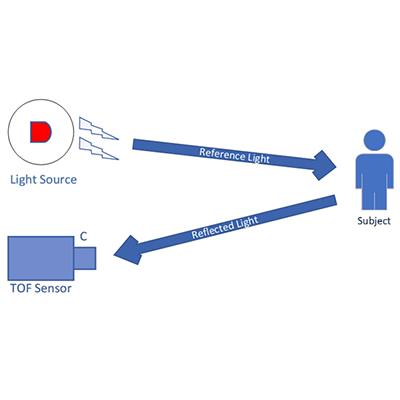
The lens works together with infrared emitters, TOF sensors, and depth processing algorithms to generate accurate three-dimensional depth maps.
If you are unfamiliar with TOF technology, we recommend reading What Is a TOF Lens? before continuing.
Why 940nm Is Becoming the Industry Standard
Better Ambient Light Rejection
Outdoor environments contain large amounts of infrared interference. A properly designed 940nm TOF Lens helps improve depth stability under sunlight and complex lighting conditions.
Improved Eye Safety
940nm illumination is less visible to the human eye than 850nm illumination, making it ideal for consumer devices and human-machine interaction systems.
Reduced Visible Red Glow
Unlike 850nm emitters, 940nm emitters produce almost no visible red glow, which is beneficial for facial recognition and smart home applications.
Key Optical Requirements for 940nm TOF Lenses
High IR Transmission
Infrared transmission directly affects signal quality and depth accuracy.
Low Distortion
Optical distortion can introduce depth reconstruction errors. Engineers should prioritize lenses with excellent low distortion performance.
High Relative Illumination
Uniform infrared brightness across the sensor helps maintain depth consistency. Learn more in our Relative Illumination Guide.
Stable IR Focus
Infrared focus stability is critical for accurate distance measurement.
Temperature Stability
Environmental changes can influence optical alignment and depth accuracy. Industrial systems should use lenses designed for harsh operating environments.
Applications of 940nm TOF Lenses
Robotics Navigation
Robots rely on depth information for obstacle avoidance and path planning. Learn how TOF technology is used in robotics vision systems.
AMR and AGV Systems
Warehouse automation increasingly depends on TOF-based navigation and positioning.
3D Machine Vision
Depth sensing enables volume measurement, object recognition, and automated inspection.
Facial Recognition
3D depth information improves biometric security and anti-spoofing performance.
How to Choose a 940nm TOF Lens
When selecting a TOF lens, engineers should evaluate:
- Focal length
- Sensor compatibility
- Infrared transmission
- Relative illumination
- Temperature stability
- Optical distortion
Understanding sensor size compatibility and machine vision lens selection principles can help optimize system performance.
Conclusion
940nm TOF Lens technology is becoming the preferred solution for modern depth sensing cameras because it offers superior ambient light resistance, better eye safety, and more reliable depth measurements.
Explore our TOF Lens Solutions and M12 Lens Solutions for robotics, industrial automation, and 3D vision applications.